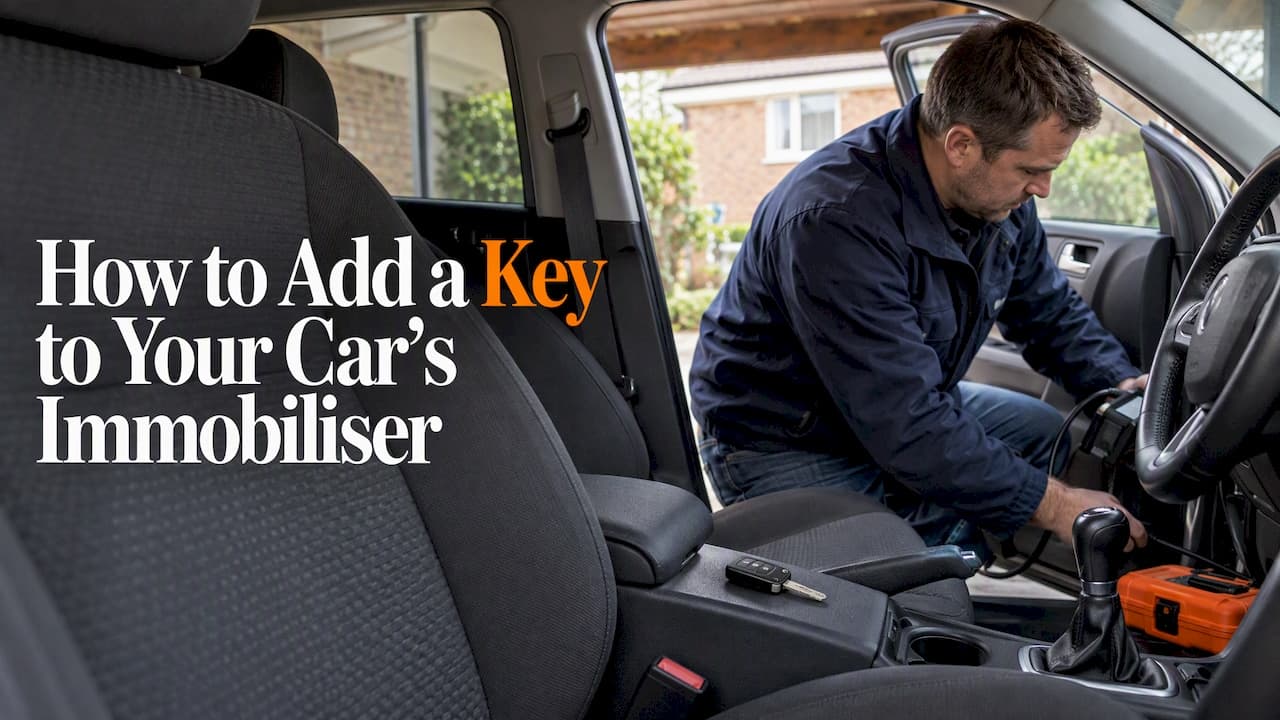
A new key only starts your car once the immobiliser has been taught to recognise it. Cutting the metal blade is the easy part. The real work is registering the key's transponder chip with the car's computer, which needs diagnostic equipment and, on many models, a security procedure. A mobile auto locksmith can do this at your home or workplace, usually without a tow to a dealership. This guide explains what happens, what to prepare and what can go wrong.
TL;DR
- Most modern cars and vans will not start with a key that has only been cut. The key must be programmed so the car's computer accepts it.
- If you still have a working key, adding a spare is usually quicker and simpler than replacing a set after losing every key.
- Have your registration, proof of ownership and photo ID ready, plus every key you still own.
- A key that unlocks the doors but will not start the engine has usually not been matched to the immobiliser. It is not necessarily faulty.
- We programme keys on site across Essex and Hertfordshire, with programming from £120.
Table of Contents
- What your immobiliser actually checks
- Does a spare key need to be programmed?
- Three situations, three routes
- What to have ready before the locksmith arrives
- When the new key opens the doors but will not start the car
- Our perspective: what we see on the driveway
- Booking key programming with us
- Other things worth knowing
- FAQ
- Sources
What your immobiliser actually checks
An immobiliser stops a vehicle starting unless the correct key, fob or activation process is used, as police crime prevention guidance explains. It does this by disabling at least two of the ignition, fuel system and starter motor, so a thief who forces the lock still cannot drive away.
The recognition happens through a small transponder chip inside the key head or fob. Volkswagen describes it simply: when the key is inserted, the transponder sends a unique code to the car, so only the correct key will start the engine. Bosch sets out the sequence in more detail. The engine management system asks for the key ID, the transponder replies, an encrypted exchange is set up with the engine control unit, and the unit compares the ID with the key data it has stored.

That last step is why programming matters. The car holds a list of key identities it trusts. A blank key, however well cut, is not on that list. Adding a key to the immobiliser means putting its identity on the list.
One detail surprises people. Many transponder chips have no battery. BMW explains that its chip is powered by the transceiver module through a loop antenna, a bit like a transformer. So a flat key battery does not mean the chip has stopped working, and a dead battery is rarely the reason a key fails to start the car.
Does a spare key need to be programmed?
In most cases, yes. Carbuyer's guide to immobilisers says a key must be programmed before the car's computer will recognise it as the right one. It also notes that older cars may need only a cut key, while newer cars need the key synced with the computer before the engine will start.
In practice, here is how we think about it:
- Older vehicles with a plain metal key and no chip. Cutting may be all that is needed. Many cars from the mid-1990s onward changed this, so do not assume.
- Vehicles with a chipped key. The key must be cut and the chip registered with the immobiliser.
- Remote keys and key fobs. Two jobs are involved: the remote locking function and the immobiliser. They can be programmed separately, which is why a fob sometimes locks the doors but will not start the car (more on that below).
- Smart or keyless keys. These rely on a proximity signal, so the key must be registered with the car's security system before it will be detected.
If you are unsure which group your car falls into, the registration, make, model and year tell a locksmith what is needed. We can usually tell you before we arrive.
Three situations, three routes
How a key is added depends mostly on one question: do you still have a working key?
| Your situation | What usually happens | Difficulty |
|---|---|---|
| You have one working key and want a spare | The new key is cut, if it has a blade, and registered to the car using diagnostic equipment. Your existing key stays valid. | Lowest |
| You have lost your only key (all keys lost) | The locksmith gains access, then reads or resets the security data through the car's diagnostic port so a new key can be registered. | Higher |
| A key was stolen and you want it blocked | The lost key's identity is deleted from the car and the remaining and new keys are programmed in. | Medium |
Adding a spare when you have a working key
This is the simplest case. With a working key present, the car is already in a state where it trusts one key, and the process of adding another is more straightforward. Many people only discover they need a spare after losing their single key, so doing it while you still have one is cheaper and far less stressful.
A spare also protects you against the next problem. A workshop manual for one Mazda model, for example, states that a maximum of eight key IDs can be registered to a single vehicle. Limits differ by manufacturer, but it shows that the car keeps a finite list, which is why a stolen or lost key is worth deleting rather than leaving on it.
Adding a key when every key is lost
It is still possible, but it takes longer because there is no existing key to authorise the new one. The locksmith has to get into the car without damage, connect to the diagnostic port and work through the car's security procedure. We have a separate walkthrough of how an all keys lost programming job runs in one visit if you want the step-by-step.
Removing a stolen or lost key
If a key has been stolen, programming a new one is only half the answer. The missing key should be removed from the car's memory so it can no longer start the engine. We offer stolen key deletion and reprogramming for exactly this case.
What to have ready before the locksmith arrives
A little preparation saves time on the day. Here is what we ask for:
- Registration number, make, model and approximate year. This tells us the immobiliser type and the right key.
- Proof you own or are entitled to use the vehicle. A V5C logbook is ideal. A reputable locksmith will ask for it because a key is the most valuable thing you can hand someone who might be stealing the car.
- Photo ID. It should match the name on your proof of ownership.
- Every key you still have. Even a damaged or non-working key can help. A spare you thought was dead may still carry a readable chip.
- Clear access to the car. For all keys lost jobs, parking where the car can be reached and the diagnostic port is accessible makes things quicker. Most ports sit under the dashboard on the driver's side.
- A rough idea of how many keys you want. Programming several at once is more efficient than coming back later.
If you drive a van, tell us when you book. Commercial vehicles sometimes have different security systems and we plan the visit around that. Our team handles van key replacement too.
When the new key opens the doors but will not start the car
This is the most common complaint after a poorly done key job, and it is also one of the questions readers ask most. The cause is usually a mismatch between the remote and the immobiliser, not a fault in the key.
Here is what to check, in the order we would:
- Was the immobiliser programming actually done? Many online blank keys and cheap fobs are programmed only for remote locking. If nobody registered the chip to the car, it will lock and unlock but not start.
- Is the key the right type? Keys that look identical can have different chips. The chip must be compatible with your car's system.
- Is the chip damaged? A key dropped repeatedly or put through a wash can stop being read. Our guide on what to do when a transponder key is not working lists the checks.
- Is it a smart key? If the car says the key is not detected, try the checks in our guide to a smart key not detected before assuming the worst.
- Has a component recently been replaced? The Mazda manual mentioned earlier notes that the system must be reset after some component swaps, such as an engine control module or keyless unit. If a part has been changed, the keys may need to be registered again.
If none of this fixes it, stop pressing the starter and get a locksmith to read the car's security data. Repeated attempts will not teach the car anything.
Our perspective: what we see on the driveway
Most people who ring us have bought a key online, or had one cut at a kiosk, and found it does not start the car. The metal part is fine. What was missing was the programming. If you take one thing from this guide, make it this: the key and the car have to agree with each other, and that agreement is created with diagnostic equipment, not with a file.
We work from vans equipped with advanced diagnostic tools, so the job is done at your location instead of on the back of a recovery truck. Typically that means 30 to 60 minutes on site. Our technicians are licensed, insured and SERMI-certified, which matters because a technician programming keys is working on your car's security. You should be comfortable asking any locksmith for proof of that.

The second thing we would say is to add the spare early. Replacing a set after losing every key costs more and takes more effort than adding a key while one still works. We would rather programme you a spare on a quiet Tuesday than get a call at 11pm from a supermarket car park.
The third is about trust. Key programming tools are legitimate professional equipment, but they can be misused. The Crown Prosecution Service reported that a gang used automatic key programmers to programme blank keys and steal 81 cars. That is exactly why we ask for proof of ownership and ID every time, and why you should be wary of anyone who does not.
— James
Booking key programming with us
We cover Harlow, Chelmsford, Epping, Brentwood, Billericay, Loughton, Ongar, Great Dunmow, Braintree, Bishop's Stortford, Sawbridgeworth, Ware, Stansted and the surrounding areas of Essex and Hertfordshire. We come to you, register the key to your immobiliser and check it starts the car before we leave.
Published prices start at £120 for key programming. A standard key starts from £120 and a remote key from £150, as shown on our vehicle key pages. The emergency callout fee starts from £120. We do not publish a price for all keys lost jobs, key cutting or stolen key deletion because they depend on the vehicle, so we quote once we know your make, model and year.

If you want a spare, a replacement or a lost key blocked, see our mobile key services or contact us with your registration and we will tell you what your car needs.
Other things worth knowing
Cutting and coding are not the same job
Cutting shapes the blade. Coding or programming makes the car accept the key. Our explainer on car key coding covers what it costs and who can do it. If your car only needs a cut key, cutting by code may be an option, though it will not make a chipped key start the car.
Brand-specific notes
Some manufacturers have their own quirks. If you drive a Toyota, see our notes on Toyota key programming in Essex and Herts. For Audi, the Audi key programming guide explains what you can try yourself and what needs a professional. We also replace keys for Volkswagen models.
Keep the new key safe from relay theft
Once your keys are working, protect them. Police guidance on relay theft says criminals use a device that fools the car into thinking the key is close by, unlocking the car and starting the ignition. Their advice is to keep keys away from the car and use a screened or signal-blocking pouch. Keep your spare in one too, away from the front door.
A quick checklist after programming
Before the locksmith leaves, test every key you paid for:
- Lock and unlock with the remote from a few metres away.
- Start the engine and let it run for a minute.
- Turn it off and start it again.
- Check the dashboard for an immobiliser or security warning light.
- Confirm any stolen or lost key has been removed, if you asked for that.
It takes two minutes and avoids a second call-out.
FAQ
Does a spare key need to be programmed?
Usually, yes, if your car has an immobiliser. The car's computer has to recognise the key's chip before the engine will start, and newer cars need the key synced with the computer. Older cars with no chip may only need the key cut.
Can I add a spare key if I have lost every working key?
Yes, but it is a bigger job than adding a spare to a car where you still have a working key. The locksmith must get into the car, connect to its diagnostic port and work through the security procedure so a new key can be registered. Proof of ownership and ID are required.
Why does my new key unlock the car but not start it?
The remote locking was probably programmed, but the transponder chip was never registered with the immobiliser. Wrong chip types and damaged chips can also cause this. A locksmith can read the car's security data and tell you which it is.
Do I need to go to a dealership to add a key?
Not necessarily. A mobile locksmith with the right diagnostic equipment can programme keys at your home or workplace, so the car does not need towing. Our technicians are SERMI-certified and we aim to finish most jobs within 30 to 60 minutes on site.
How much does programming a key cost?
Our published price for key programming starts from £120, with remote keys from £150. The final quote depends on your vehicle and whether you have a working key. Give us your registration and we will confirm the price before we come out.
Sources
- Preventing car and vehicle theft, police.uk
- Preventing car and vehicle theft, South Wales Police
- What is a Car Immobiliser? AXA UK
- Locking and security systems, Volkswagen UK
- Electronic immobilizer, Bosch
- Electronic Vehicle Immobilization System EWS 2, BMW
- What is a car immobiliser and does my car have one? Carbuyer
- Immobilizer system outline, 2003 Mazda RX-8 Workshop Manual
- Gang of professional car thieves jailed, Crown Prosecution Service