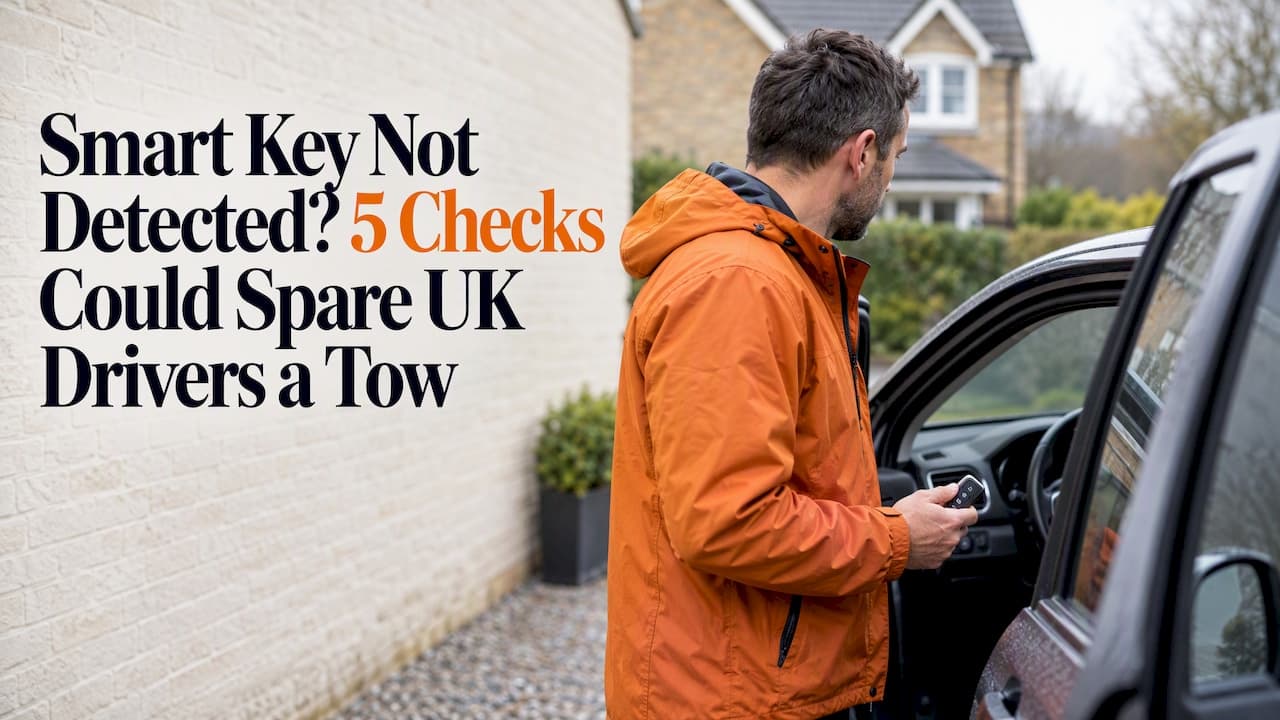
If your vehicle shows "smart key not detected", check the fob battery and try the emergency start method first. Most drivers regain entry or get the engine running within minutes using these two steps alone. If both fail, calling a mobile locksmith for on-site diagnostics beats waiting for a tow truck.
TL;DR:
- A weak fob battery often causes intermittent detection, while a receiver or antenna fault tends to persist; if every key fails, suspect the vehicle.
- Remove phones, chargers, RFID cards, and extra fobs from the keyring, then retest near the car; radio or metal interference can shorten range.
- Hold the fob against the emergency pickup point throughout the start button press; if the dashboard stays dark, check the 12V battery.
- Before paying for diagnostics, test a working spare, inspect the fob for water or casing damage, and remove nearby RFID cards or aftermarket trackers.
- Give a technician the exact dashboard message, vehicle make and model, and whether emergency starting worked to help narrow fault codes and receiver checks.
Table of Contents
- Quick checks to try now (5 simple steps)
- How to start the car if the key isn't detected
- Common causes explained: key fault vs vehicle-side fault vs interference
- What to try next if quick checks don't work
- Professional triage: what a mobile locksmith will check
- Author's perspective: common patterns seen in the field
- How Auto Key Maker can help now
- FAQ
- Sources
Quick checks to try now (5 simple steps)
Before assuming the worst, work through these in order. Most "key not detected" faults trace back to something small.
- Check the fob battery first: most smart keys use a CR2032 or CR2025 coin cell, and a simple swap often solves the problem instantly.
- Try your spare key and strip other fobs or cards off the same ring, since a crowded keyring can mask the signal.
- Move away from phones, chargers and other transmitters, then retest nearer the car.
- Use the mechanical key blade to open the door if the fob still will not unlock it, then attempt the emergency start procedure.
- Note the exact dashboard message and when it started, since this detail speeds up any later diagnosis.
Battery replacement, basic reprogramming and radio interference are among the most common causes cited by motoring organisations when a key fob stops working.
Pro Tip: Keep a spare fob battery in the glovebox. It costs little and saves you from being stranded over a two-minute fix.

How to start the car if the key isn't detected
When the fob will not communicate at all, most manufacturers build in a backup starting method. The exact sequence varies by model, but the principle is the same across brands.
- Find the emergency pickup point, usually marked in the handbook or on the key slot near the steering column.
- Hold the fob directly against that point, then press and hold the start button as described in your owner's manual.
- Keep the fob in contact with the pickup point for the full press, not just a quick tap.
- If the dashboard shows no lights at all, suspect the 12V battery rather than the key, and check terminals and charge before anything else.
This emergency method and the mechanical-key workaround are the steps motoring recovery services recommend when keyless entry doesn't work.
If the emergency start works, the fault likely sits with the fob. If it fails too, the problem is probably on the vehicle side, and that is the point to call a professional rather than keep guessing.
Common causes explained: key fault vs vehicle-side fault vs interference
Understanding which part of the system has failed saves you from replacing a key that was never the problem.
- A weak fob battery usually causes intermittent detection, where the key works at close range but not from further away or through a bag.
- A failed receiver or antenna tends to produce a consistent failure that no amount of repositioning fixes.
- Nearby transmitters, parking meters, other fobs and even some mobile phones can narrow the fob's working range.
One manufacturer's documentation puts the normal operating range at approximately 80 centimetres from the request switch when strong radio waves or metal interference are present, which shows how easily environmental noise can shrink an already short range.
When more than one key fails on the same car, that pattern usually points away from the fobs themselves and towards the vehicle's receiver or antenna wiring, according to OEM service bulletin guidance on "key not detected" faults. Immobiliser or body control module faults tend to show up as a persistent dashboard warning that does not clear even after a successful emergency start.
What to try next if quick checks don't work
If the basics have not resolved it, move to these before paying for a full diagnostic session.
- Swap in a known-good spare fob and inspect every key for water damage, cracked casings or a chewed battery contact.
- Check your 12V battery's charge and inspect fuses linked to the keyless entry module.
- Remove any aftermarket alarm, tracker or RFID card sitting near the key, since these can jam the signal just as effectively as a dying battery.
- If none of this clears the fault, ask a technician to read the fault codes and check the receiver and antenna wiring directly.
RFID tokens and multiple transponders sharing a keyring are a recognised cause of no-detect faults in OEM diagnostic notes, which is why clearing the keyring is worth doing before anything more involved.
Professional triage: what a mobile locksmith will check
When a mobile locksmith arrives, the process is methodical rather than guesswork. We start with a fob battery and signal test, attempt a reprogramming cycle where appropriate, then check the vehicle's receiver and read any stored fault codes.
- Battery and signal test on every key you have, not just the one giving trouble.
- A reprogramming attempt if the fob is communicating but not recognised.
- A check of the receiver, antenna wiring and related fuses if the fault looks vehicle-side.
Have your registration, make and model, the exact dashboard message, and whether the emergency start worked ready when you call. That detail lets us triage keyless faults accurately before we even reach the vehicle.
Pro Tip: A locksmith who asks these questions upfront is diagnosing before arrival, which usually means a faster fix on site.
Author's perspective: common patterns seen in the field
A recurring pattern: intermittent "key not detected" faults are, more often than not, a tired battery or something interfering with the signal rather than a failed key. Keeping a spare battery, trimming a bulky keyring and keeping RFID cards away from your fob prevents most of these call-outs before they happen. Mobile response also tends to beat towing to a dealer, since diagnostics happen where the car already is.
— James
How Auto Key Maker can help now
If the checks above have not solved it, we bring the diagnostic kit to you rather than sending your car to a dealership. We handle key programming, fob repair and replacement, emergency lockouts and ignition repairs on site, typically within 30 to 60 minutes of arrival, as our standard claim for mobile response.

Have these ready when you call:
- The exact dashboard message and when the fault started.
- Whether the emergency start method worked.
- Your vehicle's make, model and registration, plus your location.
Get in touch through our key programming page to book a mobile technician and get moving again without a tow.
FAQ
How do I fix a key fob that isn't working?
Start by replacing the battery and testing with other fobs removed from the keyring to rule out interference. If that doesn't work, try the emergency start procedure in your handbook before assuming the fob itself has failed.
What is a smart key system malfunction?
It's a failure in the communication between your key and the vehicle's receiver, caused by a flat fob battery, signal interference, or a fault in the vehicle's antenna or body control module. The exact cause depends on whether one key fails or all of them do.
My smart key isn't recognising my car. What can I do?
Try the mechanical key to get into the vehicle, then use the emergency start point described in your owner's manual while holding the fob against it. If that fails and you've already swapped the battery, the fault is likely vehicle-side and worth having checked on site.
How do you start a car with a dead key fob?
Locate the emergency pickup point, usually near the start button or steering column, and hold the fob against it while pressing the start button as manufacturer guidance describes. If the dashboard shows no lights at all during this attempt, suspect the 12V battery rather than the fob.
Sources
- What to do if your keyless entry doesn’t work - Green Flag
- 2024 Nissan Qashqai Intelligent Key Battery Discharge| Nissan UK
- Nissan; Intelligent Key Not Detected / Engine Will Not Start (OEM service bulletin)
- Key fob not working? Here's what to do — RAC