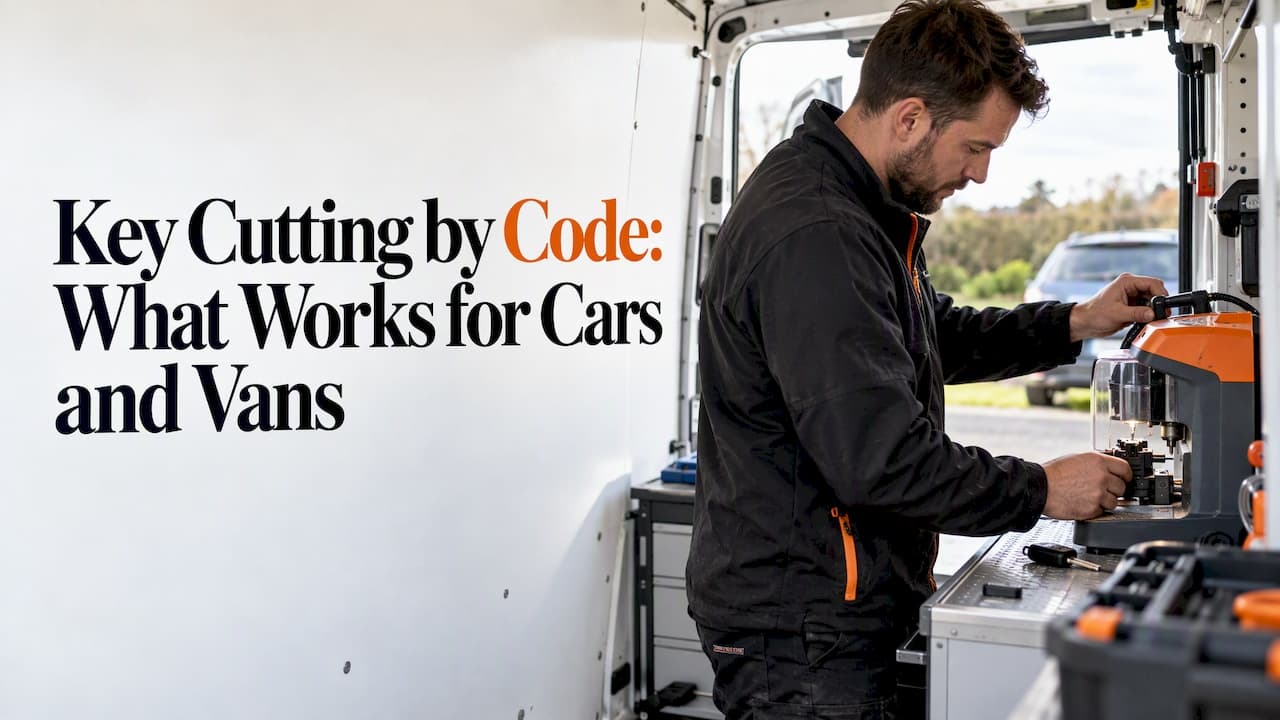
A key code lets a locksmith cut the metal blade of a key without a working key to copy. On a modern car or van, that is only half the job. The transponder chip still has to be programmed to the vehicle's immobiliser, and any remote buttons have to be paired, or the engine won't start. We are a mobile auto locksmith covering Essex and Hertfordshire, and we do both halves at your vehicle, usually within 30 to 60 minutes.
This guide explains what cutting by code really is, where the code comes from, what proof you will be asked for, and what it costs. It also covers when a code is not what you need.
TL;DR
- A key code gives the blade cut. It does not start a modern car: the chip must be programmed to the vehicle.
- Reputable locksmiths ask for proof of ownership first, usually the V5C logbook and photo ID, before cutting or programming anything.
- Online "keys cut to code" shops mostly suit lockers, desks and cabinets. Car and van keys need on-site programming.
- Our published prices start from £120 for a standard key and from £150 for a remote key, with programming from £120.
- If you've lost every key, ask the locksmith to delete the missing ones from the vehicle's memory.
Table of Contents
- What cutting a key by code actually means
- Where the key code comes from
- Why you'll be asked for proof
- Why a cut blade alone won't start the engine
- When cutting by code is the right route
- When it isn't the answer
- What it costs
- What happens when we come out
- Our view: treat a lost key as a security issue
- After a key goes missing
- Book a mobile key cut and programme
- FAQ
- Sources
What cutting a key by code actually means
Every lock is built to a factory specification, and that specification can be written as a code: a string of digits or letters that describes the cuts on the key blade. A locksmith with the code and the right machine can cut a new blade as the factory would have, without copying a worn original.
That is why searching for this term brings up so many online shops. They cut office furniture, locker and filing cabinet keys from a number stamped on the lock or the old key, then post them out. For those simple locks, a code and a postcode is often all it takes.
Cars and vans are different. Since the 1990s, most keys contain a transponder chip that talks to the immobiliser. The RAC explains that programming synchronises a key with the car's immobiliser so only programmed keys can start it. A blade cut perfectly to code can open the door and turn in the ignition, yet the engine stays dead because the car doesn't recognise the chip.
So think of cutting by code as step one of a sequence:
- Identify the vehicle and the correct key type.
- Cut the blade, from a code or by decoding the lock.
- Program the transponder chip to the immobiliser.
- Pair the remote buttons, if the key has them.
- Test every function: doors, boot, ignition, immobiliser and remote.
Where the key code comes from
This is the part that catches people out. The code is not printed on your V5C, and it is not something the DVLA holds for you. In practice, the code can come from a few places.
- A key tag or card. Some new cars come with a small tag or card showing the code. If you have one, keep it away from the vehicle.
- The service book or owner's pack. Occasionally a code is recorded here.
- The manufacturer or a franchised dealer. They can supply a code against proof of ownership and the VIN, though this can take days and costs extra.
- Reading it from the lock. A locksmith can often decode the lock itself, for example the door or ignition barrel, and cut the blade from what they find. This is how many lost-key jobs are done on site, and it avoids waiting for a code from anyone.
The practical upshot: you rarely need to find the code yourself. If you have it, mention it. If you don't, a mobile locksmith with decoding equipment can usually work without it.
Why you'll be asked for proof
A key code, or the ability to produce a key from the lock, is a way into your vehicle. That is why a legitimate locksmith checks you have the right to authorise a key before cutting or programming one.
Expect to be asked for:
- the V5C registration document (the logbook) showing your name, or the keeper's;
- photo ID, such as a passport or driving licence;
- sometimes proof of address, or written authority from your employer if it is a company van.
This is not red tape for its own sake. Someone who only has a registration number and a story is exactly who the checks exist to stop. Be wary of any service that offers to make a car key from a registration number alone and asks for nothing else.
For commercial vehicles, have the paperwork ready before we arrive. If the van is registered to a company and you are an employee, a short note from the business authorising the work saves time on the day.
Why a cut blade alone won't start the engine
Imagine you order a key online cut to a code for your 2014 hatchback. It arrives, the blade slides into the door lock and turns. You get in, turn the key, and the dash lights flash a little security symbol. The car cranks or doesn't, and then cuts out. The chip inside has never been introduced to the car.
Programming means connecting diagnostic equipment to the vehicle, usually through the OBD port, and adding the new key to the immobiliser's memory. Some older and simpler vehicles allow a manual procedure at home, but the RAC notes that modern electronic keys almost exclusively need professional equipment to talk to the onboard computer. That is why attempting it with a cheap online kit often ends in a wasted purchase.

It is also why we treat "cutting" and "programming" as one job. If you want to know more about how we approach the electronic side, our key programming service page explains what is involved. And if a key you already own has stopped working, our guide on what to check when a transponder key won't work is a good place to start before you book anything.
When cutting by code is the right route
Code cutting makes sense when:
- you have lost the only key and there is nothing to copy;
- the existing key is so worn that copying it would copy the wear;
- you need a purely mechanical key, such as for a caravan, a trailer, a toolbox or a very old vehicle with no immobiliser;
- you want a spare made before the last key fails.
The last point matters most. Having a spare made while you still hold a working key is almost always simpler and cheaper than an all-keys-lost job. The ALA notes that in most cases a lost car key can be replaced, whether it's a traditional key or a keyless fob, but the process is smoother when you plan ahead.
When it isn't the answer
Sometimes a code is the wrong tool entirely.
- Keyless or smart keys. These use encrypted radio communication. The blade, if there is one, is an emergency backup. Our write-up on replacing a lost smart key without a tow covers this.
- A broken key case or shell. If the electronics are fine, you may only need a new case. See our piece on replacing a car key case on site.
- A worn lock or ignition. If the key goes in but won't turn, the barrel may be at fault rather than the key. That is a lock and ignition repair.
- A lockout. If the key is simply inside the car, you don't need a new key at all, you need non-destructive entry.
What it costs
Prices vary widely, and anyone who quotes one number for every car is guessing. Here is what we publish on our site, all one-off prices per job:
| Service | Price |
|---|---|
| Standard key | from £120 |
| Remote key | from £150 |
| Key programming | from £120 |
| Emergency callout fee | from £120 |
| Lockout, lock and ignition repair | from £120 |
Other jobs, such as all keys lost replacements, key copying and cutting, stolen key deletion and van key replacement, are quoted by vehicle. Give us the make, model, year and registration and we will tell you what is involved before we set off.
For context, FixMyCar's figures put the average price of a replacement key booked through its platform at £281.78 and the average for programming at £250.33. Your own price will depend on the vehicle and how complex its security system is. A basic mechanical key costs far less than a remote or keyless key for a late-model car, which needs programming on top of the hardware.
The saving with a mobile service comes from what you avoid: a tow or recovery to a dealership, a day without the vehicle, and often a long wait for a code or a key to be ordered in.
What happens when we come out
Here is the process on a typical job at your home, workplace or roadside in Harlow, Chelmsford, Brentwood or anywhere else we cover.
- You call with the details. Make, model, year, registration, and what you have: a working key, a broken one, or none.
- We confirm what the job needs. Cut only, cut and program, or a fob replacement, and a price from the vehicle.
- We check ownership on arrival. V5C and photo ID, as above.
- We cut or decode. If you have a code we use it. If not, we read the lock where we can.
- We program and pair. The new key is added to the immobiliser, and remote buttons are paired.
- We test everything. Doors, boot, ignition, immobiliser and remote. You leave with every key working.
Our technicians are licensed, insured and SERMI-certified, and our vans carry diagnostic tools so the work happens at your vehicle rather than a workshop. If you have lost every key, our eight-step walkthrough of an all keys lost job shows how that visit runs from start to finish.
Our view: treat a lost key as a security issue
We get a lot of calls from people who just want "a key cut". Often the real question is different: where is the old one?
If a key is lost rather than broken, someone else may have it. For us, the job is not finished when the new key works. It is finished when the missing key no longer does. Deleting lost or stolen keys from the vehicle's memory means that even if the old key turns up in someone's pocket, it will not start your car. It is a short extra step during the same visit, and we would sooner do it than leave you wondering.

We also think people over-rely on key codes. A code is useful, but it is one input among several. The things that matter on the day are: whose vehicle is it, what security system does it have, and does every key we hand over work? We would sooner spend ten minutes on the paperwork and testing than hand you a key that cuts perfectly and does nothing.
One more thing: get a spare. Most of our emergency callouts could have been a calm, cheaper appointment if the owner had a second key. If you are down to your last one, book before it goes missing.
— James
After a key goes missing
As well as having the vehicle's memory cleared, a few habits reduce the risk. Police.uk advises keeping keys and fobs out of view at home and away from the front door, since a thief who can reach a key or fob can clone it.
If you are moving house and the car is going by transporter, hand over only the keys that are needed and make sure the rest are secure. A guide on preparing a car for a long-distance relocation covers what to do before a vehicle leaves your hands.
If your car is insured, check your policy too. Some cover key loss, and the RAC advises contacting your insurer first. Its guide on what to do when you lose your keys walks through the order of calls to make.
Book a mobile key cut and programme
If you need a key made for a car or van in Essex or Hertfordshire, we come to you. A standard key is from £120, a remote key from £150, and programming from £120. Browse our full list of services, see our emergency callout details if you are stranded, or start from our home page. We cover Harlow, Chelmsford, Epping, Brentwood, Billericay, Bishop's Stortford, Braintree, Great Dunmow, Ongar, Loughton, Stansted, Ware, Writtle and nearby.
For more guidance, our blog has articles on whether a locksmith can make a car key on site and the saving from mobile rekeying.
FAQ
Can you get a car key cut with a code?
Yes, the blade can be cut from a code, or from a reading of the lock itself. The key will usually not start the engine until its transponder chip has been programmed to the vehicle. Cutting and programming are best done in one visit.
How do I find my key cut code?
Check for a tag or card from when the car was new, and look in the service book and owner's pack. It is not on the V5C. If you cannot find it, a locksmith can often decode the lock, or a franchised dealer can supply the code against proof of ownership.
How much does it cost to get a key cut and coded?
On our site, a standard key is from £120, a remote key from £150 and programming from £120, one-off prices. Complex or keyless vehicles can cost more, so we confirm a price from your make, model and year before we attend.
Do I need my V5C to have a key made?
Yes, expect to show it along with photo ID. A responsible locksmith checks that you are entitled to authorise the key before cutting or programming. For a company van, bring written authority from the business as well.
Sources
- RAC: Key programming and codes
- RAC Drive: What to do when you lose your car keys
- ALA: Replacing lost or stolen car keys FAQs
- FixMyCar: Car key replacement
- Police.uk: Preventing car and vehicle theft