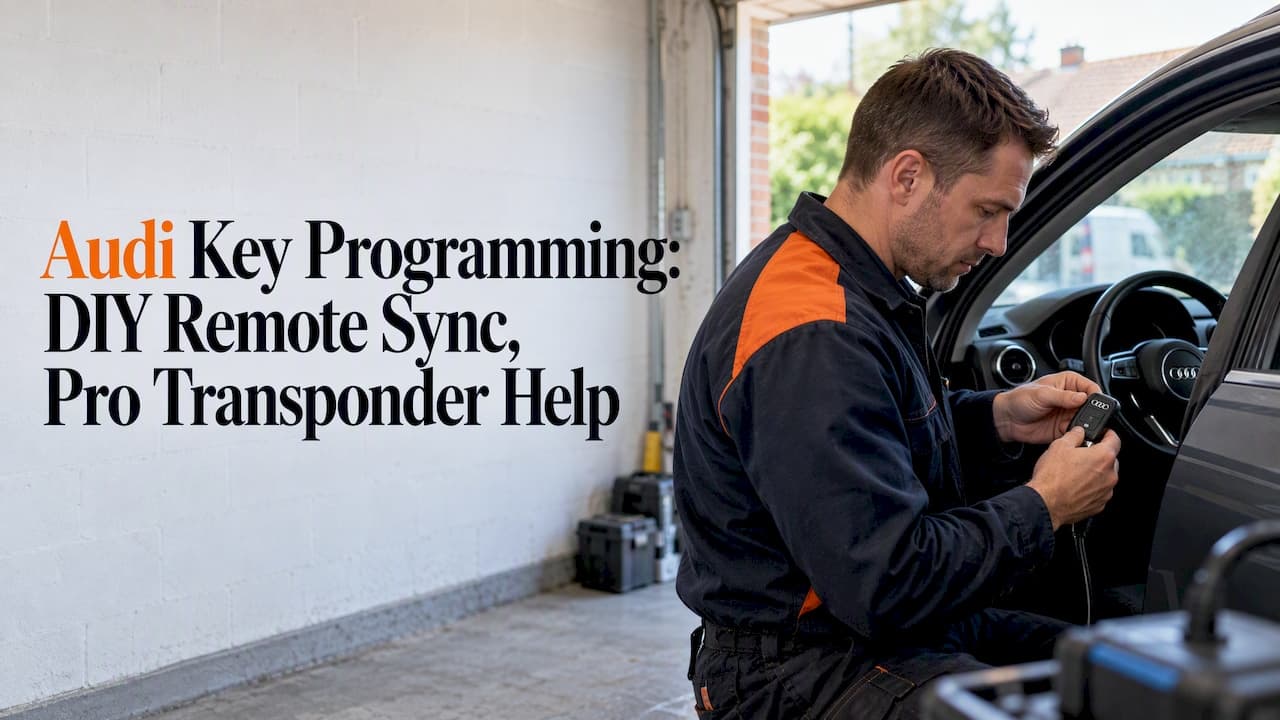
In many Audis you can resynchronise the remote yourself, but registering the engine transponder with the immobiliser often needs dealer or speciality diagnostic access. If your key already starts the car, try remote sync first. If it does not start the engine, you likely need professional immobiliser programming, which a mobile locksmith such as Auto Key Maker can usually complete on-site.
TL;DR:
- Older Audi models use Module 46, while newer ones often use Module 09 or BCM; confirm the correct comfort module before adapting remotes.
- Most comfort modules replace the saved remote list, so present every fob you want to keep during one adaptation session.
- A compatible fob must match the car’s chip, frequency, and board layout; a fresh battery and correct mechanical cut also prevent common failures.
- Mobile locksmith programming starts at £120 and typically takes 30 to 60 minutes on site; dealer replacement can take longer when all keys are lost.
Table of Contents
- Types of Audi keys and why type determines the programming method
- Remote synchronisation vs immobiliser programming: the essential difference
- Step-by-step: adapting an Audi remote
- Tools, time and cost expectations for DIY, locksmith and dealer options
- Why adaptation sometimes fails and what to try first
- What a mobile auto locksmith can do on site
- A technician's note on common mistakes
- Book Auto Key Maker for on-site Audi key programming
- FAQ
- Sources
Types of Audi keys and why type determines the programming method
The method that works depends entirely on which key you are holding. Audi has used several generations of keys, and each one talks to the car's electronics in a different way.
- Transponder-only key: a basic chip inside the key that only needs to be registered with the immobiliser to allow engine start.
- Remote key (comfort module): adds central locking, boot release and panic functions that are learned separately from the immobiliser.
- Smart key or keyless-go fob: handles proximity locking and push-button start, usually requiring both comfort module adaptation and immobiliser registration.
An aftermarket blank that looks correct will not always work. Chip type, frequency and the internal board layout vary between suppliers, so checking the blank's provenance before attempting any programming saves wasted time.
Remote synchronisation vs immobiliser programming: the essential difference

This is the distinction that trips up most owners. Remote synchronisation deals with the comfort functions: locking, unlocking, boot release and the panic alarm. Immobiliser programming is a separate process that registers the transponder chip with the engine control unit so the car will actually start.
A simple rule helps here: if the mechanical key already starts the engine, the immobiliser is almost certainly fine and you only need to sort the remote. If it does not start, the transponder needs registering, which is a different job entirely. Some authoritative VAG procedure guides are explicit that a successfully adapted remote will operate the locks but still leave the engine immobilised if the transponder itself was never registered.
- Remote sync needs a working remote, a fresh battery and either a factory button sequence or a scanner.
- Immobiliser programming usually needs an adaptation-capable scanner and, on many models, online access to Audi's dealer system.
Step-by-step: adapting an Audi remote
Before starting, make sure you have a working key already paired to the car, a freshly charged remote battery, a genuine or verified-compatible fob, and a scanner with comfort module adaptation access. On older VAG-platform cars this is Module 46 (comfort), while many newer models route the same function through Module 09 (BCM), so check which applies to your car before you begin.
- Connect the scanner and select the comfort module (46 on older cars, 09/BCM on newer ones).
- Clear channel 00 if a previous adaptation attempt failed or left stale data.
- Select the adaptation channel, commonly channel 01, and enter the total number of remotes you want paired.
- Save the entry, then press the buttons on each remote in turn when the scanner prompts you.
- Test lock, unlock, boot release and panic functions from every remote before finishing.
All remotes you want to keep working must be presented together during this sequence, because most comfort modules overwrite the entire memory rather than adding one key at a time. The Ross-Tech wiki_Comfort_System) documents this channel mapping in detail for the Audi A4 8E and 8H platforms, including the need to type the memory position in rather than scroll to it.
Pro Tip: Typing the channel or memory number directly, rather than scrolling through a menu, avoids the most common adaptation mistake on VAG scanners.
A mobile locksmith typically completes an on-site remote adaptation and function test within 30 to 60 minutes, according to Auto Key Maker's service description, which is broadly in line with the step count above for a straightforward job.
Tools, time and cost expectations for DIY, locksmith and dealer options
An adaptation-capable OBD2 scanner matters because a generic code reader cannot access the comfort module's adaptation channels. Without it, you are limited to factory button sequences, which only exist on some models and software versions.
- DIY resync: minutes, assuming you have the right scanner or know the button sequence for your specific model.
- Mobile locksmith: typically 30 to 60 minutes on-site, covering both remote adaptation and immobiliser registration where needed.
- Dealer, especially all-keys-lost scenarios: longer, often requiring online access to Audi's central system and a tow if the car cannot be driven in.
Cost broadly falls into three bands: the fob or blank itself, labour and a callout fee for a locksmith visit, or a full dealer replacement that includes parts, diagnostic time and administration. Key programming through a mobile locksmith starts from £120 one-off, which typically covers both the adaptation work and the visit.
Why adaptation sometimes fails and what to try first
A failed adaptation attempt is usually traceable to one of a handful of causes, and most are worth ruling out before booking a technician.
- Check the remote's battery and confirm the mechanical cut matches the ignition barrel.
- On older models, try the driver-side door lock resynchronisation sequence before reaching for a scanner.
- Use a scanner to read the comfort module or BCM for stored fault codes.
- Present every remote you intend to keep together in a single adaptation session, since presenting them one at a time is a common error.
- Confirm whether the mechanical key starts the engine at all, which tells you whether the fault lies with the remote or the immobiliser.
The Ross-Tech wiki notes that Audi 8E and 8H comfort systems can lose synchronisation after a low-voltage event such as a flat battery, and gives a practical ignition-and-lock test sequence to check for this before assuming a deeper fault. If these checks do not resolve the problem, or if fault codes point to the immobiliser or ECU, the job has moved beyond a simple remote resync and needs professional diagnostic equipment.
What a mobile auto locksmith can do on site
For jobs that go beyond a straightforward remote resync, on-site professional equipment closes the gap between what an owner can safely attempt and what the car actually needs.
- Key cutting and fob replacement for Audi models, handled directly at the vehicle.
- Transponder and remote programming, including cases where the engine will not start.
- All-keys-lost replacement and stolen key deletion, where the old key must be removed from the system before a new one is added.
Mobile vans carry diagnostic tools for dealership-level programming, and many visits are completed within 30 to 60 minutes on site. If an adaptation attempt also uncovers an unrelated module fault, such as an airbag control unit flagging a crash code, specialists like Airbag Reset UK handle that separately from key programming.
Pro Tip: Have your V5 logbook and proof of ID ready before a locksmith arrives, since most immobiliser work requires ownership verification.
James contributes technical guidance based on day-to-day locksmith work across Audi models.
A technician's note on common mistakes
The error I see most often is owners adapting remotes one at a time and wondering why the earlier ones stop working. Check the battery and the mechanical cut first, confirm whether the engine starts at all, and only then decide whether you need a mobile locksmith or a dealer appointment.
— James
Book Auto Key Maker for on-site Audi key programming
Diagnostic tools similar to those used by dealerships are brought directly to your car, eliminating the need for towing and waiting for a workshop slot. The equipment supports remote adaptation, transponder registration and all-keys-lost replacements, and many Audi jobs are finished on-site within 30 to 60 minutes by technicians.

- Lockout assistance is available from £120 one-off if you are locked out while sorting a key issue.
- Lock and ignition repairs are available from £120 one-off where the barrel or ignition itself is affected.
Call or book online to arrange an on-site visit, and one of our technicians will confirm which procedure your Audi needs before arriving.
FAQ
How much is a new set of Audi keys?
Pricing depends on key type and whether immobiliser programming is needed alongside the fob itself. Key programming through a mobile locksmith starts from £120 one-off, while a full dealer replacement for a lost set typically costs more due to parts and administration.
Do Timpson program car keys?
Timpson is a retail key-cutting chain and is not part of this guide's scope. For Audi transponder and comfort module programming, a specialist mobile locksmith or dealer with the correct diagnostic access is the appropriate route.
What is an Audi digital key?
A digital key uses a smartphone or digital credential instead of a physical fob to unlock and start supported Audi models. It still relies on the same underlying comfort and immobiliser systems, so the same distinction between remote sync and engine-start registration applies.
How do I program the key for my Audi TT Mk1?
The Audi TT Mk1 uses an older VAG comfort module, typically Module 46, for remote adaptation, following the same channel-clearing and button-press sequence used on VAG platforms from around the late 1990s through the 2010s. Immobiliser registration on this generation often needs older dealer-level software, so a specialist with the right scanner is usually the practical option.
Can I program an Audi key myself without a dealer?
Remote synchronisation is often possible yourself with the right scanner or button sequence, but immobiliser registration usually needs professional diagnostic access. A mobile locksmith can typically complete both parts of the job on-site within 30 to 60 minutes.