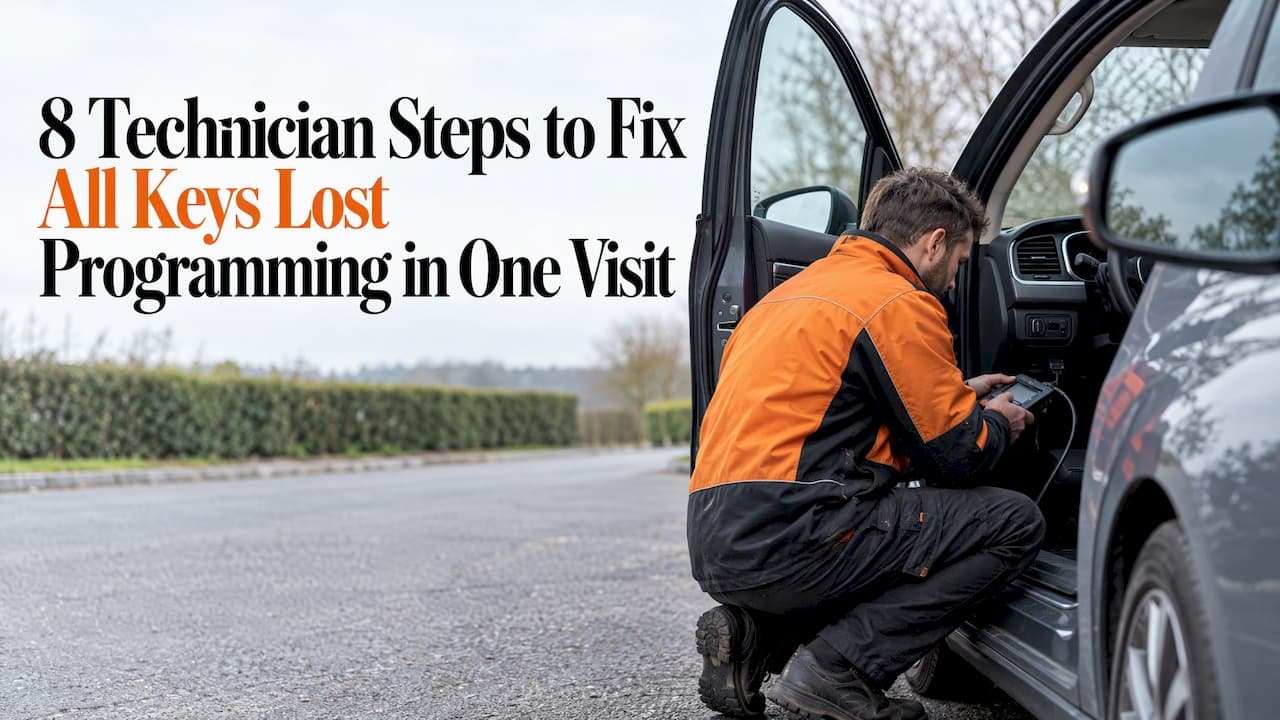
If you've lost every key to your car, the fastest and safest fix is to call a mobile locksmith who carries dealership-level programming tools rather than attempting it yourself. This avoids towing, protects your vehicle's immobiliser from being damaged by trial-and-error attempts, and gets you moving again in one visit. Before help arrives, find your V5 logbook, a photo ID, your vehicle's VIN and your current location.
TL;DR:
- Many immobiliser systems, especially newer or more secure ones, require direct module access or password calculation, which complicates DIY programming.
- On-site mobile locksmiths can typically retrieve or calculate security PINs, generate new keys, and program remotes without the need for vehicle removal or towing, usually within one visit.
- Fixing all-keys-lost situations can take from 30 minutes to several hours, depending on the vehicle's make, model, immobiliser complexity, and whether module removal is necessary.
- Attempting DIY programming with cheap tools risks bricking the ECU, increasing repair costs, and may affect insurance claims, making professional help the safer choice.
- Proper job sequencing involves confirming ownership, diagnosing the immobiliser, retrieving security data, and testing new keys, with most tasks completed through the OBD port unless advanced module work is needed.
Table of Contents
- Types of keys and immobiliser systems that change what the job involves
- Options: DIY programming kits, bench programming and calling a mobile locksmith
- Step-by-step checklist: what a technician does when all keys are lost
- Timeline and cost: typical timeframes and the main cost drivers
- Proof of ownership, fraud checks and what happens if you cannot provide documents
- Practitioner perspective: how a mobile locksmith handles all-keys-lost jobs
- The industry's quick-fix advice undersells the complexity
- Getting an all-keys-lost job booked with Auto Key Maker
- FAQ
- Sources
Types of keys and immobiliser systems that change what the job involves
Not every "all keys lost" job is the same, because the type of key and immobiliser fitted to your vehicle decides which programming route is possible. A basic transponder chip key only needs a chip read near the ignition barrel. A remote fob usually combines two separate functions: a short-range radio signal for locking and unlocking, and a transponder chip for starting the engine, which means both have to be programmed. Smart key or keyless systems, often called KESSY or keyless go, authenticate the key's presence inside the cabin before allowing a start, adding another layer that needs matching. Older mechanical keys with no chip are the simplest case, needing only a cut blade.
Underneath these key types sit immobiliser families that determine what a tool can actually do:
- CAS (Car Access System), used on many BMW models, stores security data that often requires a PIN or dump to bypass.
- FEM/BDC, BMW's newer body control modules, generally need password calculation or bench access.
- EIS (Electronic Ignition Switch), found on Mercedes-Benz vehicles, frequently requires reading data directly from the module.
- MQB, Volkswagen Group's modular platform, commonly needs an online password calculation step.
- Megamos, an older transponder protocol used across several European marques, varies in how easily it can be read depending on model year.
Support for each of these varies by diagnostic tool and by the exact year the vehicle was built, which is why "add key" jobs, where one working key already exists, are usually far simpler than "all keys lost" jobs that require recovering a PIN or password from scratch.
Options: DIY programming kits, bench programming and calling a mobile locksmith
Consumer and semi-professional OBD tools advertise one-tap programming, PIN reading and password calculation through the diagnostic port, and for many older or simpler vehicles these genuinely work. The limitation is that the most secure modern immobilisers, including several BMW and Volkswagen Group systems, often block OBD-only access entirely, forcing a different approach.
When OBD access is not possible, the job moves to bench or module-removal work: the relevant control unit is taken out of the car and read directly, sometimes to extract an ISN (Individual Security Number) that is cryptographically tied to the engine ECU. This raises both the skill required and the cost, since the module often has to be re-fitted and tested afterwards.
A mobile locksmith with professional-grade tools covers most of this range on-site:
- VIN and PIN reading performed at your vehicle's location, without removing it from your driveway or street.
- Key generation and remote programming completed in the same visit for most makes and models.
- No towing fee and no dealership queue, which on complex jobs can otherwise add days.
Pro Tip: Never attempt a DIY all-keys-lost job on a vehicle you plan to sell soon, since a failed OBD write can brick a module and the repair bill will usually exceed any smaller device purchase.
Buying a budget OBD device and getting it wrong risks a bricked ECU, a wasted tool purchase, and potentially an insurance issue if the attempt causes additional damage before a professional is called anyway.
Step-by-step checklist: what a technician does when all keys are lost
A proper all-keys-lost job follows a fairly fixed sequence, whether it happens on your driveway or inside a workshop. Knowing the order helps you follow along and ask sensible questions.
- Confirm ownership and record the VIN. The technician checks your V5 logbook against the vehicle identification number stamped on the car before touching any electronics.
- Inspect the vehicle's security hardware. A quick visual check of the ignition barrel, door locks and any visible tampering rules out prior break-in damage.
- Diagnose the immobiliser type. This decides the route: a straightforward OBD PIN read, an online password calculation, a direct dump or read of the relevant module (EIS, FEM or BDC, for example), or full bench removal on the most locked-down systems.
- Retrieve or calculate the security PIN. Depending on the system, this comes from an OBD read, a manufacturer-linked password service, or data pulled directly from the module.
- Generate new key data. The technician writes fresh transponder data to a blank key or emulator, matching it to your vehicle's immobiliser.
- Programme the remote functions. Door unlock, boot release, and remote start or stop (where fitted) are each tested individually.
- Synchronise and test every function. The ignition, central locking and alarm are checked together to confirm the new key behaves exactly as the originals did.
- Erase old keys if requested. If a key was stolen rather than simply misplaced, the old key's data is deleted from the immobiliser so it can no longer start the car.
Most of this happens through the OBD port within one visit. Bench or dealer-level work only becomes mandatory on the most security-hardened platforms, and when it is needed, expect the job to take longer and cost more, since a module may need to come out, be read on a bench, and go back in before testing can begin.
Timeline and cost: typical timeframes and the main cost drivers
A straightforward add-key or key generation job on a common make typically takes between 30 and 90 minutes on-site. Jobs requiring module removal or bench work take considerably longer, since the component has to be extracted, read, and refitted before testing.
Several factors push the price up or down:
- Make, model and year, since some immobiliser generations are far more complex to access than others.
- Transponder type, with basic chips cheaper to match than encrypted smart-key systems.
- Whether a new remote or fob is needed, rather than just a blade or chip.
- Module removal, which adds labour time and sometimes parts cost.
- Call-out fee and labour, which varies by job location and time of day.
Diagnostic tool documentation lists IMMO and key programming capabilities across a wide range of brands, noting that some of the most secure systems need extra hardware accessories to complete the job, which explains part of the cost spread between simple and complex cases.
On insurance, most insurers accept a locksmith's invoice as proof of work carried out, though some prefer a dealer-stamped record for high-value vehicles, so it's worth checking your policy wording before booking if a claim is involved.
Proof of ownership, fraud checks and what happens if you cannot provide documents
Because a stolen vehicle could otherwise be driven away on a freshly cut key, legitimate technicians will always ask for proof before programming starts. Typical documents requested include:
- Your V5 logbook (vehicle registration certificate), showing you as the registered keeper.
- A valid photo ID, such as a driving licence or passport.
- Proof of address, especially if the name on the V5 differs slightly from your ID.
If you cannot produce these on the spot, expect extra steps rather than an outright refusal: a phone check against the VIN, a call to the registered keeper if that is not you, or in some cases escalation to a dealer or a police reference number for a reported theft. Gathering your documents in advance, and taking clear photos of the V5 and your ID, speeds up any remote quote significantly.
Practitioner perspective: how a mobile locksmith handles all-keys-lost jobs
We run mobile vans carrying advanced diagnostic tools, which typically lets us complete an all-keys-lost job on-site within a short timeframe for common makes. Our technicians are experienced, and you can review our key programming service details before booking.
Three things speed up your visit: have your VIN ready, mention any previous immobiliser faults or warning lights, and flag any aftermarket alarm or tracker system fitted to the car, since these can interact with the factory immobiliser during programming.

The industry's quick-fix advice undersells the complexity
Most online guides treat all-keys-lost programming as a single checklist that applies to every car, which flattens a job that actually varies enormously by immobiliser generation. A Megamos-equipped hatchback from a decade ago and a current MQB-platform saloon are not the same job, and treating them as such sets unrealistic expectations on both time and price.

The bigger gap in conventional advice is the assumption that a cheap OBD gadget is a backup plan if the first attempt fails. It usually is not. Once a write attempt goes wrong on a locked-down module, you've often converted a straightforward call-out into a bench repair, which is the outcome DIY tools were supposed to avoid.
What matters most is diagnosing the immobiliser type correctly before any write attempt happens, not the brand of tool used to do it. Readers should prioritise finding out which system their vehicle runs, even roughly, before deciding whether a DIY attempt is sensible at all.
— James
Getting an all-keys-lost job booked with Auto Key Maker
We bring advanced programming tools straight to your location locally, avoiding towing and dealer waiting lists. Our vans carry the diagnostic kit needed for most on-site jobs, and our technicians are experienced professionals.

When requesting a quote, have the following ready:
- Your VIN, so we can confirm exactly which immobiliser system your vehicle uses.
- Your current location, so we can route the nearest available van.
- Whether the vehicle is locked or accessible, since this changes the approach.
- A preferred contact number, so we can confirm timing quickly.
Our key programming service page covers current pricing details, and our emergency call-out details explain the call-out fee structure for urgent visits. If you're locked out rather than missing keys entirely, our car lockout service may be the quicker option.
FAQ
How do you program a car when all keys are lost?
A technician confirms ownership, identifies the immobiliser type, retrieves or calculates the security PIN, then generates and programmes new key data before testing every function. On many vehicles this is done entirely through the OBD port, though some immobilisers require module removal first.
Do high street chains reprogram car keys for free?
No locksmith or retailer reprograms car keys for free, since programming requires specialist tools, security PIN retrieval and skilled labour. Pricing varies by provider and by how complex the vehicle's immobiliser system is.
What is the best tool for all-keys-lost programming on different cars?
There's no single tool that covers every vehicle, since immobiliser systems like CAS, FEM, BDC, EIS and MQB each need different access methods and sometimes different accessories. Professional-grade diagnostic suites, such as those referenced in Autel's IMMO documentation, cover a broad range of makes but still need additional hardware for the most secure systems.
Can a lost car key be reprogrammed once it turns up?
Yes, provided the key was simply deleted from the immobiliser rather than physically destroyed, a technician can usually reprogramme it back into the system. If the key was reported stolen and already erased for security, re-adding it follows the same process as adding a brand new key.