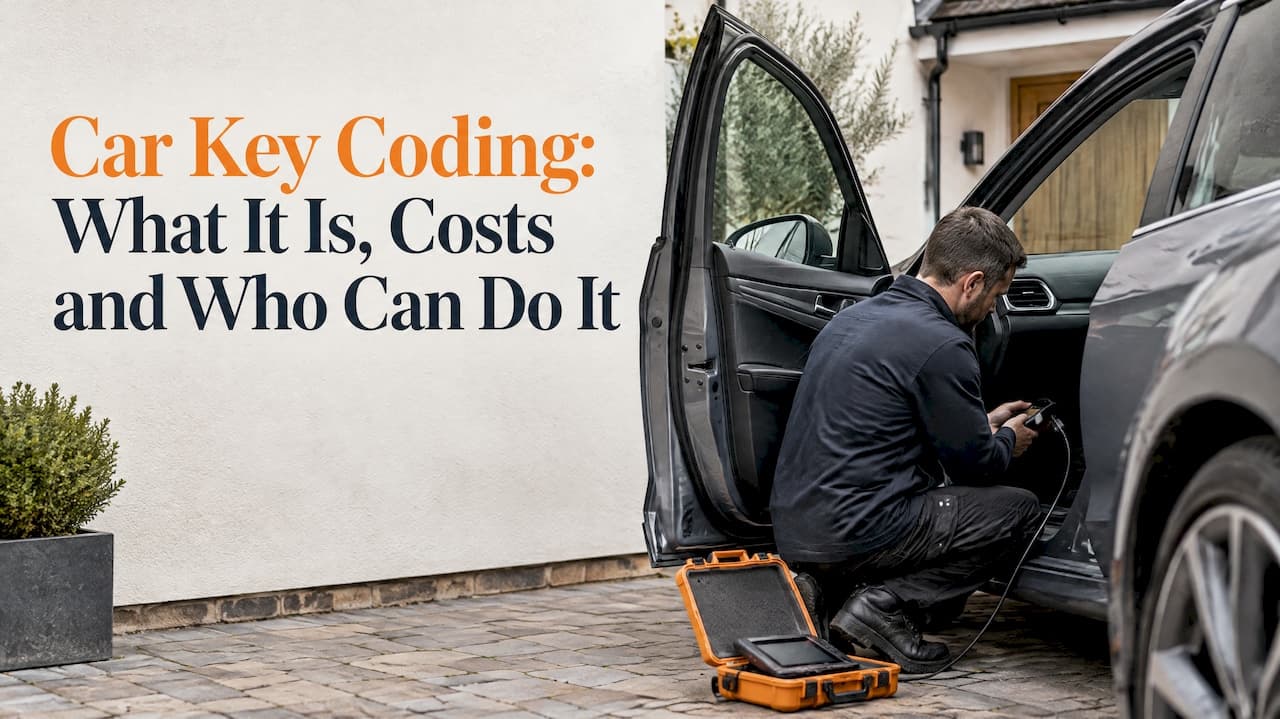
Car key coding is the process of pairing a key or fob with your vehicle's immobiliser, so the car recognises it and will start. Cutting the metal blade is only half the job. If the chip inside the key has not been coded to the car, the engine will not run, even when the blade turns in the ignition. A mobile auto locksmith can do this at your door in Essex or Hertfordshire, usually within 30 to 60 minutes, with no tow to a dealership.
TL;DR
- Coding (also called programming) synchronises the transponder chip in your key with the car's immobiliser. A cut blade alone will not start a modern car.
- Prices vary with make, key type and whether you still have a working key. Our own key programming starts from £120, and a remote key from £150.
- You cannot reliably code a key yourself on most modern cars. Many makes need specialist equipment and security data.
- Since 1 April 2026 the UK has had the SERMI scheme for security-related repair information. Ask any locksmith whether they are certified.
- Locked your keys in the boot? Do not force anything. Non-destructive entry is quicker and cheaper than repairing a damaged lock.
Table of Contents
- What car key coding actually is
- Which keys need coding
- How a mobile locksmith codes a key
- Can you code your own car key?
- What car key coding costs in the UK
- Who is allowed to code your key: SERMI explained
- Locked out or keys locked in the boot
- Our perspective on key coding
- Replacement keys by make
- Book a mobile key coding visit
- FAQ
- Sources
What car key coding actually is
A modern car key has two jobs. The blade, or the radio buttons on a remote, handles locking and unlocking. A small transponder chip inside the key handles starting. When you turn the key or press the start button, the car sends out a signal and the chip must reply with the right code. If it does, the immobiliser releases the engine. If not, the car stays dead.
Coding is the step where that conversation is set up. According to the RAC, it is the electronic synchronisation of the chip with the vehicle's immobiliser computer, carried out through the diagnostic port with specialist equipment. A training glossary on the subject describes the same idea: it ensures only authorised keys can start the vehicle.

The terms are used loosely. "Coding", "programming", "pairing" and "learning" all describe broadly the same thing for a customer: making a new key work with your car. Some garages use "coding" for the immobiliser side and "programming" for the remote buttons. If you ask for either, a good locksmith will know what you need.
Why it exists
Immobilisers were introduced because thieves could once start cars with little more than a screwdriver. A Home Office research report on vehicle crime notes that steering locks only slowed rising thefts, which is part of why electronic systems became standard. They work silently, with nothing for the driver to remember.
That security is also why a replacement key is not a quick job at a high street kiosk. The system is built so that a copy of the blade is useless on its own.
Which keys need coding
As a rule of thumb, if your car was built from the late 1990s onwards, the key probably contains a chip. Trade press on the history of the technology says almost every key carried an RFID chip by the late 1990s. These are the common types:
| Key type | What it is | Coding needed? |
|---|---|---|
| Basic mechanical key | Cut metal only, usually older cars | No |
| Transponder key | Cut blade with a chip in the head | Yes, chip paired to the immobiliser |
| Remote key | Blade or flip key with lock and unlock buttons | Yes, chip and remote functions |
| Smart or proximity key | Keyless entry and push-button start | Yes, and often more involved |
| Key fob repair or replacement | New shell, battery or board | Sometimes, depending on the fault |
If you are not sure which you have, a photo of your key and the registration number are usually enough for us to tell you what is involved before we travel.
How a mobile locksmith codes a key
The process is more methodical than people expect. The steps below are typical for a replacement or spare key. Exact steps differ by manufacturer.
- Identify the vehicle and key. Make, model, year and key type decide the tooling and the blank key needed.
- Prove ownership. A reputable locksmith will ask for the V5C logbook or other proof you own the car, and photo ID. This protects you as much as them.
- Cut the blade if needed. On many cars the blade can be cut from the lock itself when you have lost every key.
- Connect diagnostic equipment. The locksmith plugs into the car's diagnostic port, usually under the dashboard, to read the immobiliser.
- Add the new key. The tool writes the new key's chip into the car's memory, or the car is put into a learning mode.
- Test everything. Start the engine, test remote buttons, central locking and boot release, and check any existing keys still work.
The heavy lifting is done by diagnostic tools rather than anything clever with the key itself. The same kind of diagnostic work is behind other module jobs. For example, if a control unit loses its coding after a fault, a specialist such as an airbag module coding reset service deals with that separate system, while the key and immobiliser are our side of the work.
If you have lost every key, the job has an extra stage. We explain it in our walkthrough of how all keys lost programming is done in one visit.
Can you code your own car key?
Sometimes, but less often than the internet suggests. A few older or simpler cars allow a spare key to be added by a sequence of ignition turns and door actions, if you already have working keys. Check your handbook, because it varies by make and year.
For most newer cars, DIY is not realistic. Many Volkswagen Group vehicles are a good example. One owner thread on the UK Volkswagen Forum describes how pairing can require PIN codes or security data that cannot just be copied from an old key. That information has to be obtained through the right channels, which is part of why dealer quotes can climb into the hundreds of pounds.
There are cheap programmers sold online, and they raise a second problem. The Crown Prosecution Service has reported on a gang who used automatic key programmers to program blank remote keys to steal cars. The devices are used legitimately by locksmiths, which is exactly why a locksmith's credentials matter.
So the honest answer: if you have a working spare and a simple, older car, try the handbook method. If you have lost the keys, drive a newer car, or the handbook method fails, call a professional before you trigger any security lockout on the vehicle.

What car key coding costs in the UK
Prices vary widely because the work varies. Four things move the price most:
- Make and model. Premium and German brands tend to involve more security steps.
- Key type. A basic transponder is simpler than a smart key.
- Spare or all keys lost. Adding a spare when you hold a working key is usually simpler than starting from nothing.
- Where the work is done. A tow to a dealer adds cost and time. A mobile visit avoids that.
Our published prices are as follows. These are starting points, and the final quote depends on your vehicle:
| Service | Price |
|---|---|
| Key programming | from £120 |
| Standard key | from £120 |
| Remote key | from £150 |
| Emergency callout fee | from £120 |
Other services, such as key cutting, all keys lost replacement and stolen key deletion, are quoted per job, so we do not publish a figure. Call with your registration and we will give you a price before we set off.
Make sure any quote you compare covers the same things: the key itself, the cutting, the coding and the visit. A cheap programming-only figure can turn into a much larger bill once the key and callout are added.
Who is allowed to code your key: SERMI explained
The UK launched SERMI on 1 April 2026. It stands for Security-Related Vehicle Repair and Maintenance Information, and it covers key programming, immobiliser coding and access to security modules. Businesses go through criminal background checks, identity verification and proof of legitimate trading. The same report says certification can cost over £1,800 plus VAT and take months, so a certified business has made a real commitment.
For you, the practical point is simple. Ask before you book: "Are you SERMI certified?" Our technicians are licensed, insured and SERMI-certified. A trader who cannot show a certificate, insurance and a proper business address is a risk, particularly when they will hold the security data to your car.
Locked out or keys locked in the boot
A lot of people searching this topic have a different problem: the keys are in the boot, or the car has locked itself with the key inside. This is a lockout, not a coding job, though the two often come together.
What to do:
- Check every door and the boot release. It sounds obvious, but a rear door left unlocked saves a callout.
- Look for a manufacturer app. The AA notes that some newer cars can be unlocked from a smartphone app, if you set it up beforehand.
- Do not force a door, window or the boot. Prising a door or smashing a window leads to repair costs far above the price of a professional entry.
- Call a locksmith who does non-destructive entry. This opens the car without damaging the lock, paintwork or seals.
- If a child or animal is inside, call 999. That is an emergency, not a locksmith job.
If the boot is the issue, the method depends on the car. Many cars have a rear seat fold or an internal boot release that can be reached once a door is open. Our car lockout service starts from £120, and for urgent callouts see our emergency service.
Once the car is open, if the key is damaged or lost for good, we can cut and code a replacement on the same visit.
Our perspective on key coding
Most of the calls we get follow a pattern. Someone has lost their only key, or the spare has stopped working, and they have been told the car must go to a dealer on a recovery truck. Often it does not.
Our vans carry the diagnostic equipment to do the same job at the roadside, on a driveway or in a work car park. For a van owner, that can mean a working day saved. For a family, it is one less thing to arrange when stranded in Harlow, Chelmsford or Bishop's Stortford.
Three things we would tell anyone before they book:
- Get a spare made while you still have a key. Adding a key to a car with a working one is easier than rebuilding from nothing, and it costs less in time and worry.
- Check credentials, not just price. Ask about SERMI, insurance and proof-of-ownership checks. A locksmith who does not ask for your documents is not protecting you.
- Keep your fob out of sight at home. CPS cases include thieves who targeted high-value cars across Hertfordshire, and a fob left in view by the front door invites trouble.
We would rather you called early and spent £120 to £150 than called late after a tow and a dealer bill.
— James
Replacement keys by make
Some brands have their own quirks, so we have pages for the ones we see most. If you drive one of these, start there:
- Ford key replacement
- Vauxhall key replacement and Opel key replacement
- BMW key replacement and Mini key replacement
- Audi key replacement, with a separate guide on Audi key programming
- Volkswagen key replacement
We also cover vans. If your livelihood depends on one, the cost of a day off the road usually outweighs the cost of the key, so get in touch from our homepage for a van key quote.
Book a mobile key coding visit
We come to you across Essex and Hertfordshire, including Harlow, Chelmsford, Brentwood, Epping, Ware and Braintree. Our key programming service starts from £120, and remote keys from £150. Have your registration, the make and model and your proof of ownership ready, and we will tell you the price before we travel. For stolen key deletion, key cutting or all keys lost, see our full list of services.
FAQ
How much does car key coding cost?
It depends on your car and key type. With us, key programming starts from £120 and a remote key from £150. All keys lost, stolen key deletion and key cutting are quoted per job, and we give you the price before we travel.
Can I code my own car key?
On some older cars, yes, if you hold a working key and your handbook describes a procedure. On most modern cars you need diagnostic equipment and sometimes security data that is not public. Trying and failing can leave you needing a locksmith anyway, so check first.
How long does it take to code a car key?
Our mobile technicians typically complete a job on site within 30 to 60 minutes. Complex or all keys lost jobs on some makes can take longer. We will tell you what to expect when you call.
Do I need to take my car to a dealer?
Not necessarily. A mobile locksmith with the right diagnostic tools can cut and code keys at your location, which avoids the tow and the wait. Our technicians are SERMI-certified, so you can ask to see the certificate.
What should I do if my keys are locked in the boot?
Stay calm and do not force the boot or a window. Check for an unlocked door or a manufacturer app, and if neither works, call a locksmith who offers non-destructive entry. If a child or pet is inside, call 999.
Sources
- RAC: Key programming and codes
- Automotive Training Network: What is car key coding
- Home Office: Reducing criminal opportunity, vehicle security and vehicle crime
- Underhood Service: Programming keys, codes and diagnostics
- UK Volkswagen Forum: Replacement key costs
- CPS: Gang of professional car thieves jailed
- CPS: High-value keyless car thieves jailed
- Garage Wire: What SERMI actually checks
- The AA: Locked keys in car