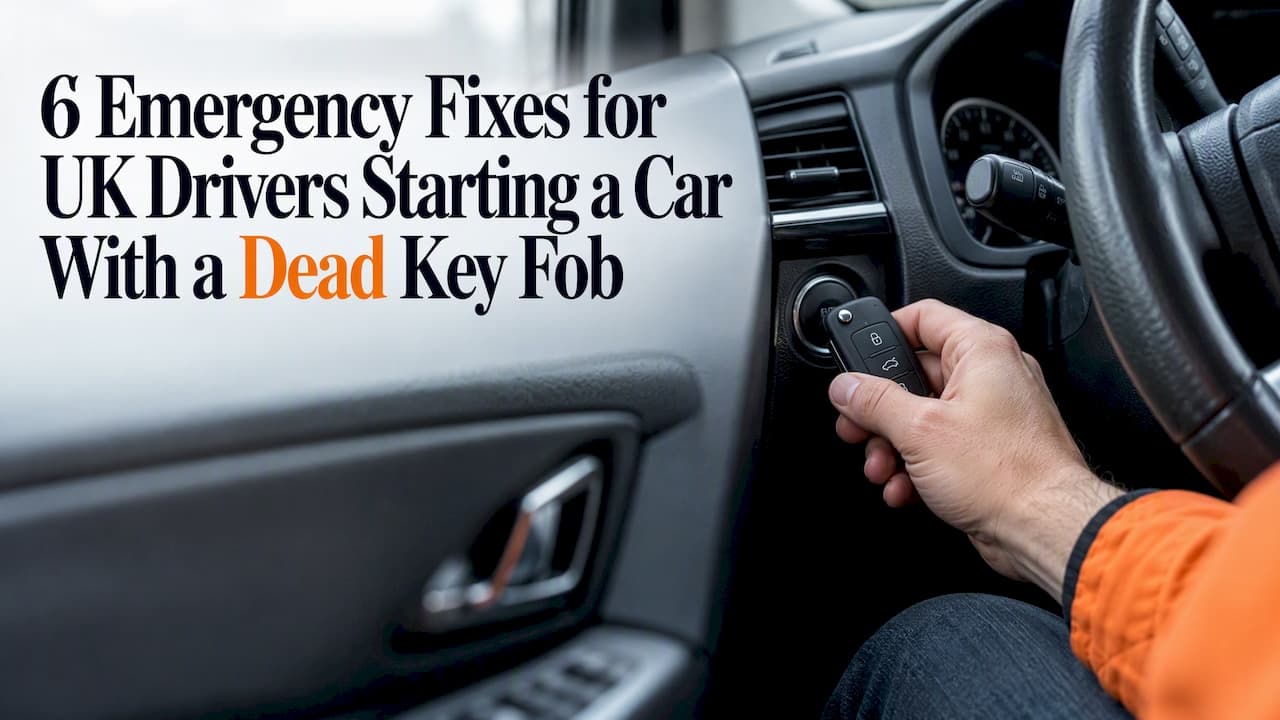
Yes, you can usually start a car when the key fob battery is dead, using a simple emergency method built into most modern vehicles. The fastest first move is placing the fob directly against the start button or the designated backup sensor. If that fails, replace the fob battery as soon as you can, and treat the problem as something bigger, possibly the 12V battery or the immobiliser, if the car still refuses to start.
TL;DR:
- Try the fob against the start button or backup reader, then use its hidden mechanical key; some vehicles also have a dedicated backup slot.
- If the dashboard stays dark or its lights are dim, suspect the 12V battery rather than the fob; a jump start may restore power.
- When both the main key and spare go unrecognized, stop trying fob workarounds; the vehicle may need system reprogramming by a locksmith or dealer.
- A phone app or remote unlock requires prior setup and mobile signal, so it may fail when you need it most.
Table of Contents
- Quick checklist: 6 emergency methods to try now
- Step-by-step: how to start your car with each common emergency method
- If the car still won't start: quick diagnostics and what each symptom likely means
- When to call a professional: what a mobile auto locksmith does and how we help
- Our take: speed matters more than brand-specific advice
- Need help right now? Our mobile locksmiths come to you
- FAQ
- Sources
Quick checklist: 6 emergency methods to try now
Before assuming the worst, work through these in order. Most dead-fob situations resolve within the first two or three steps.
- Move closer to the car and try unlocking or starting again, since a weak fob sometimes still works at short range, according to Mr Tyre.
- Release the mechanical key hidden inside the fob and use it to unlock the door manually.
- Hold the fob directly against the start button or the manufacturer's designated backup reader.
- Check for a hidden backup slot near the dashboard or centre console and insert the fob there if one exists.
- Try a manufacturer phone app or a roadside remote unlock service if your vehicle supports it.
- Replace the fob battery, or call a mobile locksmith if none of the above gets you moving.
Once the engine starts using an emergency method, the immobiliser deactivates and you can drive normally, though remote locking and unlocking will not work again until the battery is replaced, as Mr Tyre notes.
Step-by-step: how to start your car with each common emergency method
Different manufacturers build in different backup routes, so try these in sequence rather than assuming your car has only one option.
- Place the fob against the start button. Press the button itself with the fob touching it, usually on the edge nearest the steering column. Watch the dashboard for a key icon or chime confirming recognition.
- Extract the mechanical key. Most fobs have a small release catch or sliding tab on the back. Pop it out, then look for a small plastic cap on the door handle hiding the mechanical lock cylinder.
- Use the mechanical slot carefully. Prise the cap off gently with a flat tool wrapped in cloth to avoid scratching the trim, then turn the key as you would on an older car.
- Check for a backup fob slot. Some models have a dedicated slot near the steering column or cup holder, usually marked with a key symbol, and the fob needs to sit the right way up to be read.
- Try a manufacturer app or roadside remote unlock. This usually needs the app already linked to your account and a mobile signal, so it is not a reliable fallback if you set it up after the fact.
- Check the 12V battery if the dashboard stays dark. Dim or absent dash lights point away from the fob entirely and towards a flat starter battery.
Pro Tip: Before forcing anything, confirm the gear selector is in Park (or the clutch is depressed on a manual) and your foot is firmly on the brake, since many smart-key systems refuse to start without both.
Owner's manuals for specific models, such as the Toyota RAV4, document exact emergency start procedures and warn that repeated failed attempts may need a pause before trying again. If you are not confident prising off a lock cap or forcing an override, stop and get trained help rather than risk damaging the trim or wiring.
If the car still won't start: quick diagnostics and what each symptom likely means
A dead fob and a flat 12V battery look similar at first glance but behave differently once you dig in.
- No dashboard lights at all, total electrical silence: this is almost always the 12V battery, not the fob.
- Smart key system malfunction warnings: this suggests an immobiliser or smart-key fault that may need dealer-level diagnostic tools, as the Toyota RAV4 manual explains.
- Both your main key and a spare fail to be recognised: this moves well past a simple battery problem and towards a system fault needing reprogramming.
A discharged 12V battery can stop smart entry and other electrical systems working altogether, which is why checking it early saves time chasing the wrong fault, according to Toyota's own guidance. If dash lights are weak or absent, a jump-start may get you moving, but attach cables in the correct order and never let the clamps touch each other, as explained in detail in Batteries & Starting Issues | Coastal Ready Auto Repair. Until you can replace the fob battery or call for help, keep using the mechanical key and avoid draining the 12V battery further with lights or accessories left on.
When to call a professional: what a mobile auto locksmith does and how we help
Some situations are not worth fighting on your own driveway. If both keys fail, if you suspect an immobiliser fault, or if the car needs reprogramming rather than a fresh battery, a mobile locksmith is usually faster and cheaper than a tow to a dealer.
- All keys lost or both fobs unrecognised, which usually means reprogramming rather than a battery swap.
- Suspected immobiliser faults that throw up warning messages rather than simple non-detection.
- Lock or ignition damage from a forced mechanical override attempt.
On-site, we bring equipment for key programming, non-destructive entry, stolen key deletion, and ignition repair.
Pro Tip: Have proof of ownership, your vehicle's make and model, and the VIN ready before you call, since this speeds up the job considerably. Avoid repeated forced attempts on the mechanical lock before we arrive, as damaged trim often costs more to fix than the original fault.
Our take: speed matters more than brand-specific advice

The advice that circulates most, dig out your manual and follow the exact steps for your model, is sound but slow when you are standing in a car park with a dead fob and no signal to look anything up. The methods that work across nearly every modern car, touching the fob to the start button, finding the mechanical key, checking the 12V battery, cover the vast majority of real breakdowns without needing model-specific knowledge at all.
What gets underrated is how often people assume a dead fob when the real problem is a flat 12V battery, wasting time pressing a fob against a button that was never going to respond. Check the dashboard lights first: if they are dim or missing, stop troubleshooting the fob and address the battery instead. If two separate keys both fail to register, stop trying mechanical workarounds altogether. That pattern means a system fault, not a battery, and no amount of fob-pressing will fix it.
— James
Need help right now? Our mobile locksmiths come to you
When the emergency methods do not work, or the fault turns out to be an immobiliser or ignition issue rather than a flat battery, we bring dealership-level equipment directly to your location across Essex and Hertfordshire, so there is no towing and no dealership wait.

Our licensed, insured and SERMI-certified technicians carry on-site programming tools for key programming, lockout recovery, and ignition and lock repair, with an emergency callout fee from £120. Have your vehicle details and proof of ownership ready when you call, and we will get you back on the road without a trip to the garage.
FAQ
Can I start my push to start car with a dead key fob?
Yes, most push-to-start systems have a backup method, usually holding the fob against the start button or a designated sensor, that lets the car recognise the key even with a dead battery. If that fails, check for a hidden backup slot or the mechanical key hidden inside the fob itself.
Can I still drive my car with a dead key fob?
Yes, once the engine starts using an emergency method, the immobiliser deactivates and the car drives normally, according to Mr Tyre. Remote locking and unlocking will not work again until you replace the fob battery.
Can a dying key fob cause a car to not start?
Yes, a dead or dying fob battery can stop the vehicle recognising the key, often showing as a "key not detected" message or failed central locking, according to RAC Drive. This is different from a flat 12V battery, which causes total electrical failure with no dashboard lights at all.
Can I start my car with no key fob?
In most cases, no, since modern vehicles need the fob or its embedded chip to disarm the immobiliser, even with the mechanical key used to unlock the door. If both your main and spare keys fail to be recognised, a locksmith or dealer will usually need to reprogram the system rather than simply bypass it, as RAC Drive notes.
Sources
- How to unlock your car when the key battery is dead | Mr Tyre
- Ownersmanuals2
- Toyota won't unlock? smart entry, 12V battery and vehicle access | Toyota magazine