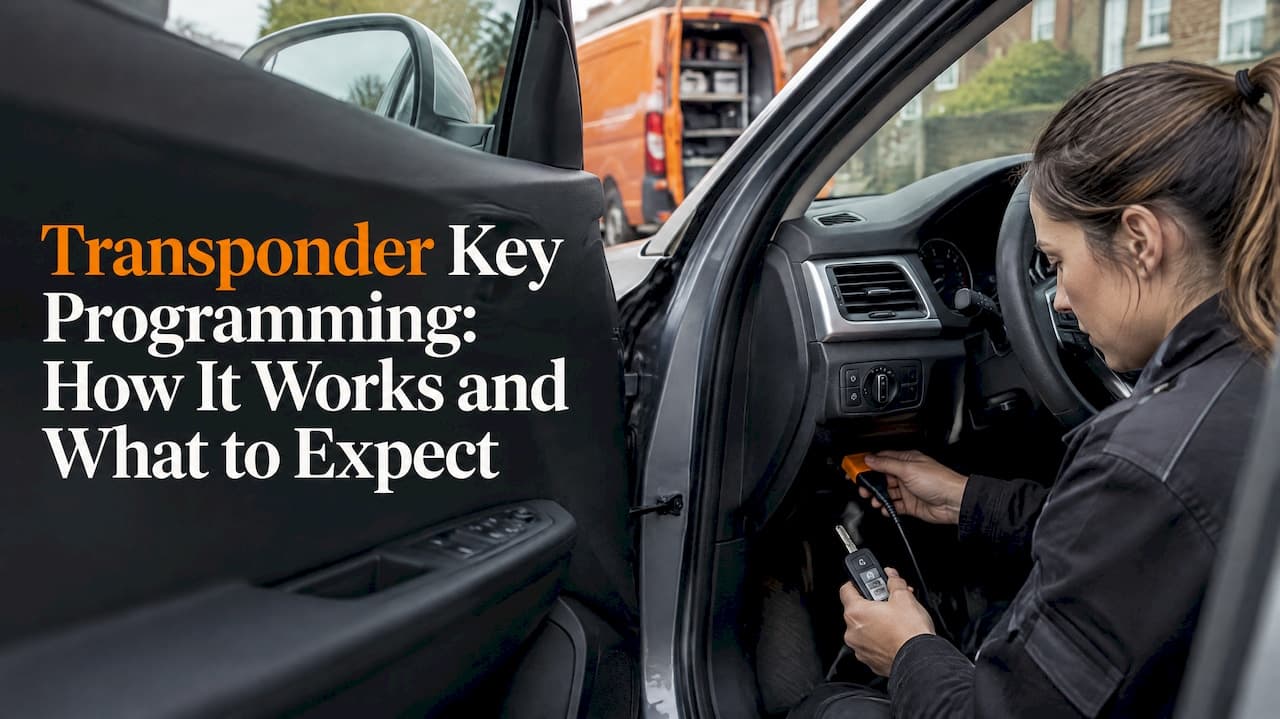
Transponder key programming is the step that teaches your car's immobiliser to recognise a new key. Cutting the metal blade is only half the job: unless the chip inside the key has been registered with the vehicle, the door may unlock but the engine will not start. A mobile auto locksmith does this at your car, using diagnostic equipment connected to the vehicle, so you don't need a tow to a dealership.
This guide explains what is happening inside the key and the car, the main ways keys are programmed, when you need it, what to check afterwards, and how we handle it across Essex and Hertfordshire.
TL;DR
- A transponder key contains a small chip that the car's immobiliser must recognise before the engine will run. Programming is what registers that chip.
- You need programming for a replacement, a spare, or any key added after a loss or fault. Programming a new key can also delete keys previously taught to the car.
- Some cars allow onboard programming with a working key. Many others need diagnostic equipment, and a few need specialist work on the immobiliser data.
- Our key programming starts from £120, and a remote key on the Ford page starts from £150. We come to you in Essex and Hertfordshire.
- After programming, test every key for starting, remote locking and the immobiliser light before the locksmith leaves.
Table of Contents
- What transponder key programming actually does
- When a key needs programming
- How keys are programmed: the three main methods
- Can you program a transponder key yourself?
- What the appointment looks like
- What to check after a key has been programmed
- What affects the price
- Our view on programming
- Need a key programmed in Essex or Hertfordshire?
- FAQ
- Sources
What transponder key programming actually does
Most keys made in the last couple of decades are really two things in one body: a mechanical blade that turns the lock, and electronics. HELLA's technical guide explains that the lower part of the key houses the immobiliser transponder, which has to be deactivated before the car will start, while the radio transmitter handles central locking. You can read this in their guide to programming car keys.
Programming, in HELLA's description, means teaching a new hand-held transmitter to the vehicle. In plain terms, the car keeps a list of the keys it trusts. A new key is a stranger until someone adds it to that list.

The conversation between key and car
The sequence is quick and invisible to the driver. According to ECU Repairs, an antenna around the ignition barrel energises the usually passive transponder. The chip returns its code, the immobiliser control unit compares it with the authorised data, and the engine control unit allows fuelling and ignition only after a valid match. The same source notes that modern systems may use fixed or rolling codes, or encrypted communication between key and vehicle.

The point of all this is theft prevention. The Home Office research report on vehicle security and vehicle crime states that electronic immobilisers stop an engine starting without the correct key, and were designed to prevent hot-wiring. That is why a key blank from a hardware shop, however well cut, will turn in the lock and then do nothing.
Transponder key or chip key?
People use the two terms for the same thing. "Chip key" is the everyday name; "transponder key" is the technical one. Both describe a key with an immobiliser chip in it. The distinction that matters in practice is between the chip, which lets the engine start, and the remote buttons, which lock and unlock the doors. A key can have one or both. A key with a flat remote battery can still start some cars, because HELLA's keyless-system guide explains that the transponder is powered from the car side, not by the key's battery. See their keyless entry and Go guide.
When a key needs programming
Programming is needed whenever the car must accept a transmitter it has not met before. HELLA lists an additional or replacement transmitter, including one needed because of loss or a defect. The usual situations are:
- You've lost your only key. This is the all keys lost situation, and it is the most involved because there is no working key to learn from. We cover how that visit runs in our article on all keys lost programming in one visit.
- You want a spare. Having a second key made while you still have one is usually the cheapest and least stressful route.
- A key has stopped working. Water damage, a dropped key or a failed chip can leave the blade turning the lock but the car refusing to start. Our guide to a transponder key not working covers the checks to run first.
- A key has been stolen. Programming can also remove a key from the car's list so it no longer starts the vehicle. We call this stolen key deletion and reprogramming.
- A replacement ignition or lock. Some repairs mean the keys and the car need to be matched again.
One detail catches people out. HELLA notes that during programming, previously taught transmitters are deleted. If you have two keys and one is new, you will generally want every key you intend to keep present at the appointment so all of them are programmed in the same session.
How keys are programmed: the three main methods
There is no single universal procedure. Manufacturers use different systems, and some require proprietary software. A summary from Locksmith Keyless, a US source, identifies three broad approaches, and they match how mobile locksmiths work in the UK too.
| Method | What happens | What it needs |
|---|---|---|
| Onboard programming | A sequence of actions inside the car, such as turning the ignition in a set pattern, teaches the new key | A working key (some models need two) and a car that supports it |
| OBD programming | Diagnostic equipment plugs into the car's diagnostic port and registers the new key with the immobiliser | Suitable equipment, software for that make, and the right security access |
| EEPROM programming | The immobiliser data held in a vehicle module is read or changed directly | Specialist equipment and expertise |
Onboard programming
On some cars the owner's handbook describes a procedure you can do with the keys you already have. It is the simplest route, but it depends on the make and model, and it generally cannot help if every key is lost.
OBD programming
This is the workhorse of mobile locksmithing. The diagnostic socket is normally under the dashboard near the steering column. The locksmith connects a tool, communicates with the immobiliser, and adds the new key. This is where having correct, up-to-date software for each manufacturer matters, because a tool that handles one brand may not talk to another.
EEPROM and module work
When the car won't allow a key to be added through the usual channel, the immobiliser information may have to be read from a module and handled directly. This needs specialist kit and experience, and it is not something to attempt on a drive with a tutorial video.
Can you program a transponder key yourself?
Sometimes, but less often than the internet suggests. Onboard programming works only on supported vehicles and needs a working key; some makes require two. OBD and EEPROM procedures need specialist equipment and technical knowledge.
There are practical reasons to leave it to a professional even when a DIY routine exists:
- Deleting keys by mistake. Because programming can wipe previously taught keys, a failed attempt can leave you with fewer working keys than you started with.
- Wrong chip type. Buying a blank online without knowing the exact chip and frequency for your vehicle is the commonest reason a cut key won't start the car.
- Security. A reputable locksmith checks that you own the vehicle before making a key for it. That check protects you, and it is how the immobiliser stays meaningful.
- Insurance. Never try to bypass or emulate an immobiliser to get a car moving. You remove the theft protection the manufacturer fitted, and your insurer may take a dim view of it. Check your policy wording or ask your insurer if you are unsure.
If you drive an Audi and want to know which part of the job you can realistically do yourself, we explain that in our Audi key programming guide, and we have a similar breakdown for Toyota key programming.
What the appointment looks like
Here is how a typical mobile visit runs with us. Every car differs, so treat it as a pattern, not a promise.
- You call and describe the situation. Make, model, year, how many keys you have, and where the car is. If the car is a van, tell us that too.
- We identify the key type. The vehicle details tell us which chip and remote the car uses, and whether a key can be made on site. Our article on whether a locksmith can make a car key covers the checks involved.
- We confirm ownership. Bring photo ID and proof the vehicle is yours, such as the V5C logbook. We will explain what we need when you book.
- We cut and prepare the key. If the blade needs cutting, it is cut to the lock. Our note on key cutting by code explains when that works for cars and vans.
- We program it. Using diagnostic equipment from the van, we register the new key and, where needed, remove old or stolen ones.
- We test everything with you. See the checklist below.
Our vans carry the diagnostic tools to do this at your location, and we aim to complete most jobs on site within 30 to 60 minutes. Complex vehicles can take longer.
What to check after a key has been programmed
Don't take the keys and wave goodbye until you have run through a short test. It takes five minutes and saves a second callout.
- Start the engine with each key. Do it more than once, with the key you will use daily and the spare.
- Test the remote functions. Lock, unlock, boot release and, where fitted, the alarm response.
- Check the mechanical blade. Turn it in the driver's door and, if applicable, the boot or glovebox lock.
- Watch the immobiliser light. It should behave as it did before. If it flashes oddly after starting, ask the locksmith to look before they leave. Our article on an immobiliser light flashing explains what the patterns can mean.
- Confirm which keys are registered. If you have lost or had a key stolen, ask the locksmith to confirm the old key has been removed.
- Keyless cars. Test walk-up unlocking and push-button start. If something misbehaves, our guide to keyless entry not working is a good starting point.
- Keep paperwork. Keep the invoice, and note the date and the number of keys programmed.
The same logic applies to any service that comes to you. The checks you make before a technician leaves matter more than where the work took place, a point echoed in this piece on mobile services for car owners.
What affects the price
The cost of programming depends on several things, and anyone quoting without asking about them is guessing:
- Make, model and year. Newer and premium vehicles often have more protected systems.
- Type of key. A standard transponder key is a different job from a remote key or a keyless fob.
- Spare or all keys lost. With no working key, more work is involved.
- Number of keys. Programming several in one session is usually more efficient than returning later.
- Time and place. Out-of-hours and emergency work is priced differently from a booked daytime appointment.
Our published starting prices are: key programming from £120, a standard key from £120 and a remote key from £150, and an emergency callout from £120. Those are starting points; the final quote depends on your vehicle and situation, and we give it before work begins. For key copying and cutting, remote programming, all keys lost replacements and stolen key deletion, ask us for a quote on your vehicle.
Our view on programming
We see the same mistake every week: someone has been quoted for a key cut and nothing else, then finds the car won't start. The programming is the job. The blade is the easy part.
That is why we do the work on your drive, at your workplace or at the roadside. A tow to a dealership adds cost, waiting and a day without your car. Our vans are equipped with diagnostic tools so we can do dealership-level work on site, and our technicians are licensed, insured and SERMI-certified.
Our advice is simple. If you have one working key, get a spare made now. It is a far easier appointment than all keys lost. If you've lost every key, don't try to bypass the immobiliser, and don't buy a blank without knowing the chip. Call us with the make, model and year and we will tell you what can be done on site.
James
Need a key programmed in Essex or Hertfordshire?
We come to you across Harlow, Chelmsford, Epping, Brentwood, Billericay, Bishop's Stortford, Braintree, Loughton and the surrounding towns, for cars and vans alike. Our key programming service starts from £120, and you can see what else we do on our services page.

If you are locked out or stranded, our emergency callout is also from £120. For more guides, see the Auto Key Maker blog.
FAQ
What is the difference between a transponder key and a chip key?
There is no practical difference: both terms mean a key with an immobiliser chip in it. The chip lets the engine start, while the remote buttons, if there are any, handle the locks. HELLA describes the transponder and the radio transmitter as separate functions in the same key.
Can I program a key with just the VIN?
The VIN helps a locksmith identify the right key type and chip, but it does not program anything on its own. The key still has to be registered with the car, using either an onboard procedure or diagnostic equipment. We will also ask for proof of ownership.
Does programming a new key stop my old keys working?
It can. HELLA notes that previously taught transmitters are deleted during programming on the system it describes. To avoid losing a working key, bring every key you want to keep to the appointment so they can all be programmed together.
Can a mobile locksmith program keys for vans?
Yes. We cover vans as well as cars across Essex and Hertfordshire, and van key replacement is part of what we do. Tell us the make, model and year when you call so we can confirm what can be done on site.
How long does it take?
We typically complete mobile jobs within 30 to 60 minutes on site. The time depends on the vehicle, the type of key and whether you have a working key already. All keys lost situations on complex vehicles can take longer.
Sources
- Programming car keys and changing batteries | HELLA
- Keyless Go & Keyless Entry system | HELLA
- Types of Immobiliser Systems: How They Work & Faults | ECU Repairs
- Reducing criminal opportunity: vehicle security and vehicle crime | Home Office
- What You Need To Know About Car Key Programming | Locksmith Keyless