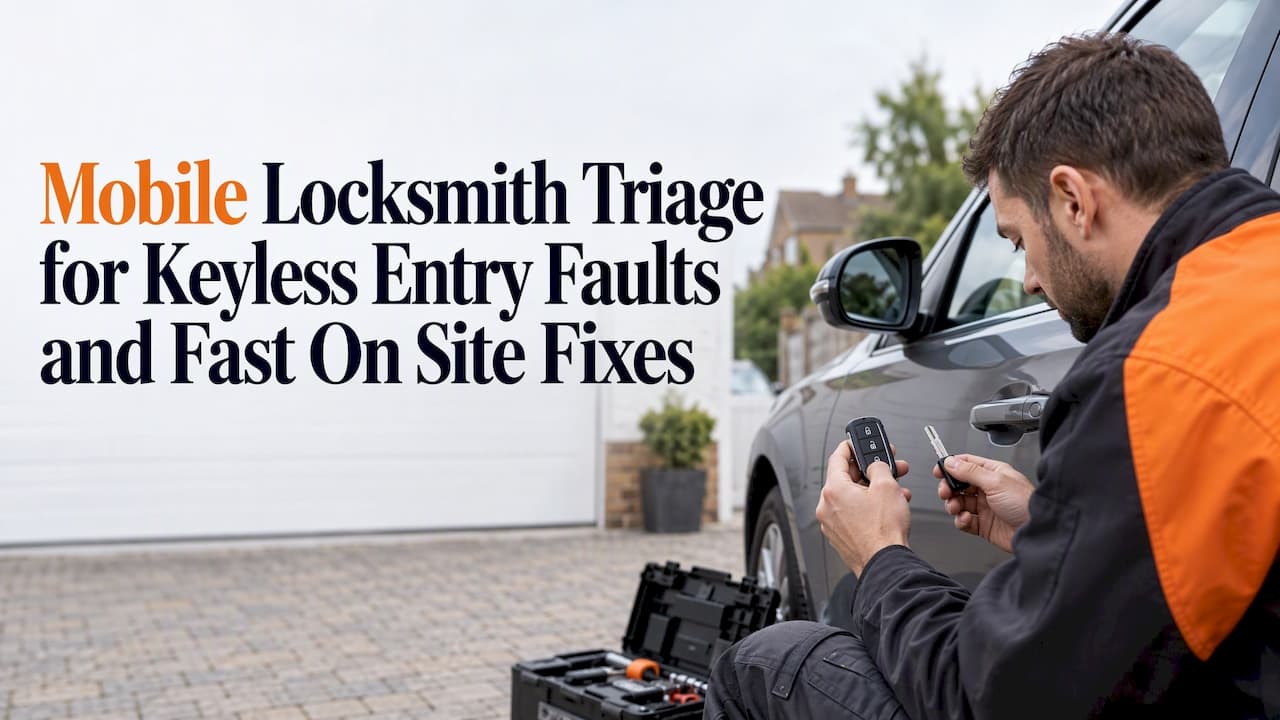
Start by swapping in a fresh battery and testing your spare fob: this fixes most keyless entry faults on the spot. If the spare fob works, the original fob's battery or internal contacts are the problem. If neither fob responds, the fault likely sits with the car's power supply, a fuse or the receiver module, and a mobile locksmith can diagnose that on-site.
TL;DR:
- Replacing the key fob battery with the specified type and correct polarity often resolves most remote entry issues.
- If both the original and spare fob fail tests, the problem likely involves the vehicle's fusing or receiver module, not the remotes.
- Professional diagnosis is recommended if fuse blowouts persist or if the receiver or antenna function appears compromised.
- Testing shielding pouches and storing keys away from windows can help prevent relay signal attacks during troubleshooting.
- Mobile locksmiths can often resolve issues on-site by diagnosing faults, replacing components, or reprogramming keys without vehicle towing.
Table of Contents
- A quick checklist to isolate fob vs vehicle problems
- How to fix the frequent causes safely
- When to stop and call a professional
- Relay attacks and practical prevention while troubleshooting
- Auto Key Maker: what we see and how we fix it on site
- Technician perspective: triage for fastest safe access
- How Auto Key Maker can help right now
- Manufacturer manuals and security guidance to check
- Sources
- FAQ
A quick checklist to isolate fob vs vehicle problems
Before changing anything, run through a short set of checks in order. This narrows down whether the fault is in the fob, the car, or something external like interference.
- Confirm the battery type and orientation against your vehicle handbook, since fitting the wrong type or reversing polarity is a common cause of a smart key behaving erratically. Open the fob case and check for corrosion or water marks around the contacts.
- Test the spare fob, the interior central-locking button and the physical key blade separately, and note which ones work and which don't.
- Check the car's 12V battery and dashboard warnings, then look at the fuses and relays tied to the remote-locking circuit, since a weak battery or blown fuse can disable the receiver even when the fob itself is fine.
- Move away from the house or garage and try unlocking at a few different distances, since nearby electronics, other key fobs or structural interference can occasionally block the signal.
Starting the car successfully does not mean the remote-locking function is fine. Manufacturer documentation treats keyless entry and keyless starting as separate systems, so one can fail while the other keeps working. If both fobs fail the same tests, the issue is almost certainly on the vehicle side rather than with the remotes themselves, which points you straight to the fuse box rather than a battery aisle.
Pro Tip: Write down exactly which tests passed and failed before calling anyone. A locksmith or dealer can often shortcut the diagnosis when you can say "spare fob also fails to unlock, but the key blade opens the door manually".
How to fix the frequent causes safely
Most keyless entry failures trace back to one of a handful of causes, and the fixes are straightforward if you follow the right order.
- Remove the mechanical key blade from the fob first, then open the case following the small release catch or screw.
- Fit the battery type specified in your handbook (often a CR2032 3-volt lithium cell) with the correct polarity facing up, since the wrong type or orientation can make the fob misbehave even when it technically powers on.
- Wipe the contacts gently with a dry cloth or a small amount of isopropyl alcohol if you see any residue or corrosion.
- Check the buttons for wear. A soft or unresponsive button usually needs replacing rather than cleaning.
- Reinsert the battery and test the fob before closing the case fully, in case it needs a second attempt to seat properly.
A battery swap does not usually wipe the immobiliser pairing with the car, but exact procedure, battery grade and casing design vary by manufacturer, so the handbook is the only reliable reference. There is no single universal reset sequence for reprogramming a fob: some vehicles need you to re-register the transmitter through a specific button and ignition sequence, others require checking the 12V supply, fuses, relays or the receiver module before any resynchronisation will succeed, according to reporting on manufacturer procedures. Short, practical fixes like these resolve the majority of common keyless entry complaints, according to guidance from the RAC.
If a fuse keeps blowing after replacement, or you suspect a fault inside the body control module, stop. That is not a DIY repair, and pushing further risks damaging wiring that a professional would otherwise fix cleanly.

When to stop and call a professional
Some symptoms mean the problem is beyond a battery swap or a fuse check, and calling in a mobile locksmith or your dealer saves time and avoids making things worse.
- Both the original and spare fob fail every test, which points to a vehicle-side fault rather than two dead remotes at once.
- You've lost all your keys, which needs a full key cut and programming rather than troubleshooting an existing fob.
- You suspect the receiver module or antenna has failed, since this needs proper diagnostic equipment to confirm.
- A fuse blows again shortly after replacement, which suggests a wiring fault rather than a one-off failure.
A mobile locksmith visit typically starts with confirming your vehicle's identity (make, model and VIN), running on-site diagnostics, then programming a new key or fixing the fault directly, often without needing to tow the car anywhere. Response times and costs vary by provider and job type, so it's worth checking current pricing on the emergency callout page before booking. Before the visit, have your vehicle's make and model, the VIN, proof of ownership and any working spare fob ready, since this speeds up the diagnosis considerably.
Relay attacks and practical prevention while troubleshooting
Relay attacks work by capturing your key's signal from inside your house and relaying it to the car outside, tricking it into unlocking as if the key were present. Thatcham Research treats this as a genuine risk and recommends testing any shielding pouch before trusting it, since not all Faraday pouches actually block the signal.
- Test a Faraday pouch by placing the key inside and trying to unlock the car from close range. If it still unlocks, the pouch isn't doing its job.
- Store spare keys away from the front door, hallway or any window, since a relay device can pick up a signal through walls and glass.
- Look into motion-sensor keys and manufacturer software updates where available, both of which reduce exposure to relay attacks.
Pro Tip: If you're troubleshooting a fob and need to test it outside its pouch, do the test and return it to secure storage straight away rather than leaving it out on the side.
Auto Key Maker: what we see and how we fix it on site
On call-outs, the pattern repeats: a dead fob battery, worn contacts, or a blown fuse feeding the receiver. Mobile locksmith technicians can often confirm the fault, cut or programme a replacement key, and check the receiver circuit without towing the car anywhere.
A fob that starts the engine but won't unlock the doors is one of the clearest signs the fault sits in the locking circuit, not the key.
Technician perspective: triage for fastest safe access
Getting you back into your car safely comes first, diagnosing the root cause comes second. Before any call-out, test the spare fob and note any visible damage, corrosion or a blown fuse you've already found. That record alone often cuts diagnosis time on-site, and it helps balance a quick fix against the security trade-offs covered above.
— James
How Auto Key Maker can help right now
If the steps above haven't restored access, a mobile locksmith can finish the job without a trip to the dealership. Auto Key Maker handles key programming, car lockout recovery and lock or ignition repairs on-site across Essex and Hertfordshire.

- Have your location, vehicle make and model, VIN and a description of the symptoms ready when you call.
- A mobile locksmith visit can avoid the need for a tow truck and dealership queue by bringing diagnostic and programming equipment to you.
- Check the emergency callout fee page for current pricing before booking.
Manufacturer manuals and security guidance to check
- Your vehicle's owner manual for exact battery type, polarity and intelligent key troubleshooting.
- Thatcham Research's guidance on relay attacks and shielding devices.
Sources
- Kia owners manual — battery replacement guidance
- Motoring Research — notes on manufacturer procedures and testing
- RAC — key fob not working? Here's what to do
FAQ
How do I reset my car keyless entry?
There's no single reset sequence that works across all cars: the exact steps for re-registering a transmitter are manufacturer-specific, so check your handbook first. If the handbook procedure doesn't resolve it, a locksmith or dealer can check the fuses, relays and receiver module.
How do I reset my keyless entry door lock?
Start by testing the interior central-locking switch and the physical key blade to see if the lock itself still works mechanically. If the lock responds manually but not to the fob, the fault is more likely in the fob or receiver than the lock mechanism itself.
My keyless entry key fob battery is dead. How do I replace it?
Remove the mechanical key blade, open the fob case, and fit the battery type and orientation specified in your vehicle's manual, often a CR2032 cell. Check for corrosion on the contacts before closing the case and test the fob straight away.
Why does my key fob start my car, but the buttons don't work?
Starting the engine and unlocking the doors run through separate systems in most cars, so one can fail while the other still works. This points to a fault in the remote-locking circuit, fuse or receiver rather than the fob's battery, and is worth checking against your handbook's troubleshooting section.