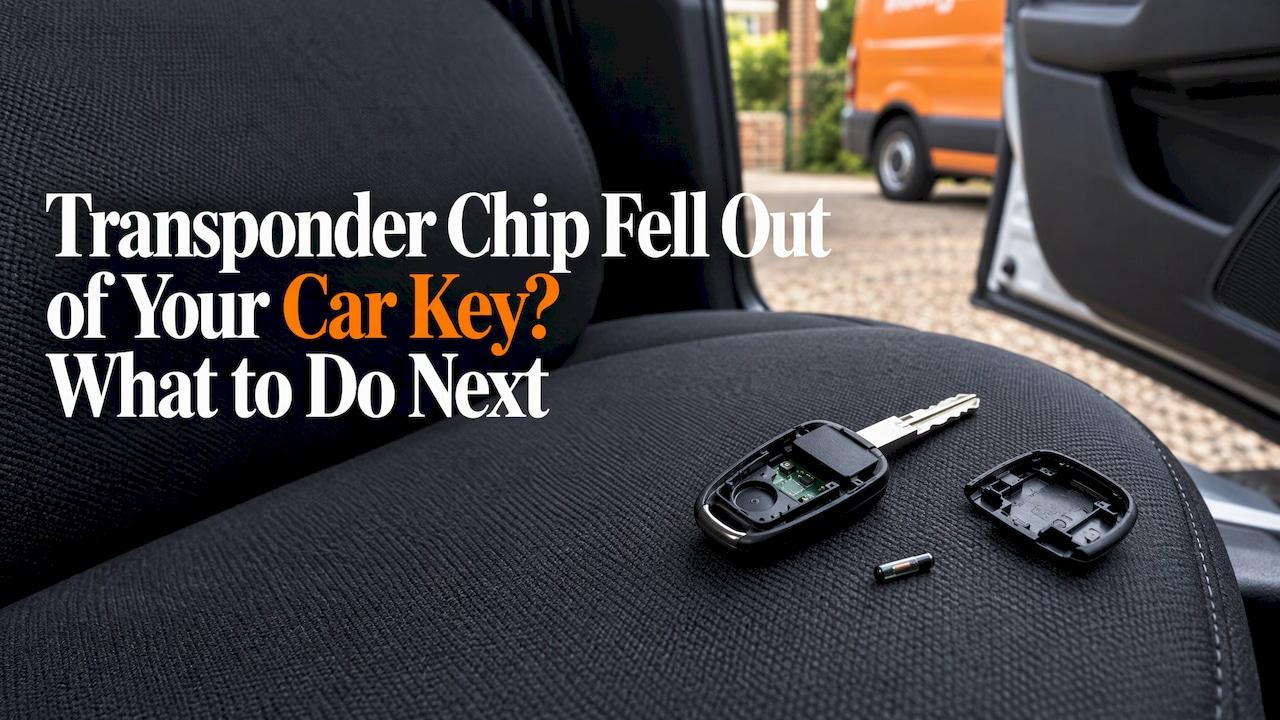
If the transponder chip has fallen out of your key, the key blade may still turn in the ignition, but the car will usually not start. The immobiliser needs to hear from the chip. Stay calm and keep hold of the chip if you can find it. A small chip that has simply come loose can often be refitted. A chip that is lost or cracked needs a new one, which has to be coded to your car. Neither job needs a tow to a dealership.
This guide explains what the chip does, how to check what has gone wrong and what your options are. It also covers what to have ready and what a mobile fix costs in Essex and Hertfordshire.
TL;DR
- A key with no working chip will often open the doors but will not start the engine, because the immobiliser cannot recognise it.
- If you find the chip and it is undamaged, it can sometimes be put back in the key. If it is lost or broken, a new chip or key must be programmed to the car.
- Do not keep trying to start the car. Check the spare key first, then call a mobile locksmith.
- Have your V5C logbook or other proof of ownership, photo ID and the registration number ready.
- We programme keys at your location, with Standard Key jobs from £120 and Remote Key jobs from £150.
Table of Contents
- What the transponder chip does
- Will the car still start without the chip?
- First checks when the chip has fallen out
- How to tell if the chip is missing, damaged or faulty
- Can a loose or broken chip be fixed?
- How a replacement chip is fitted and programmed
- What you need to prove before a key is made
- What it costs
- Mobile locksmith or dealership?
- Our perspective
- Book a mobile fix in Essex or Hertfordshire
- How to avoid a repeat
- FAQ
- Sources
What the transponder chip does
A transponder chip is a tiny electronic component inside your key or fob. When you turn the key or press the start button, the car sends out a signal. The chip answers with a code. If the code matches the one stored in the car's immobiliser, the engine is allowed to run. If the chip is missing, damaged or has never been registered to the car, the engine will not start.
That is why a key can feel perfectly normal and still fail. The metal blade turns the lock, but the security check is separate. Most cars from the late 1990s onwards use this system.
The chip is not always the same shape. In many traditional keys it is a small glass or ceramic capsule sitting in the plastic head of the key. In other keys it is part of a circuit board inside a remote fob. Knowing which type you have tells you what has probably happened.

Will the car still start without the chip?
In most cases, no. Without a chip the immobiliser stays active. You may see an immobiliser warning light on the dashboard, or the engine may turn over and then cut out. Some cars will not crank at all.
With a keyless entry car there is a further point. Auto Express notes that most electronic keys hide a physical key for emergency entry. It also says a keyless car still needs the key or a replacement transponder to unlock and start. So getting inside with the emergency blade does not mean you can drive away.
If the engine will not start for a reason that may not be the key, a general no crank, no start checklist can help you rule out the battery and starter. This no crank no start diagnosis guide walks through that process. If the chip is the problem, though, none of those checks will help.
First checks when the chip has fallen out
Before you call anyone, spend five minutes on these steps.
- Stop trying to start the car. Repeated attempts will not help and can run the battery down.
- Look for the chip. Check the key head, your pocket, the bag or the footwell. Glass capsules are only a few millimetres long and easy to lose. Use a torch and look on a light surface.
- Look at the key itself. See whether the plastic head has cracked, whether a small compartment has opened, or whether the fob has split along the seam.
- Try the spare key. If the spare starts the car, the car is fine and the fault is with the damaged key only.
- Keep every piece. Even a cracked shell or a split fob is useful, because a locksmith may be able to reuse parts or the blade.
- Note the car details. Write down the make, model, year and registration, and find the VIN, which is on the V5C and often at the base of the windscreen.
If you have lost the only key and the chip with it, you are in an all keys lost situation. Our guide to fixing all keys lost programming in one visit explains how that works.
How to tell if the chip is missing, damaged or faulty
The symptoms overlap, so look at the pattern.
| What you notice | Likely cause |
|---|---|
| Doors open, engine will not start, immobiliser light flashing or staying on | Chip missing, damaged or not recognised |
| You can hear something rattling inside the key head | Chip has come loose in its housing |
| Key worked yesterday, now nothing, but the spare works | The chip in this key has failed or fallen out |
| Neither key starts the car | Look at the car: battery, immobiliser or antenna problems |
| Remote buttons dead but car starts | Fob battery or button board, not the chip |
If the chip is on a circuit board, a fall or water damage can break it without any part coming loose. A locksmith with diagnostic equipment can read the key and tell you whether the chip responds. Our article on what to check when a transponder key is not working goes through the checks in more detail.
Can a loose or broken chip be fixed?
It depends on what you have in your hand.
The chip is intact and you have found it. If it has simply dropped out of its slot, it can often be seated back into the key head and secured. If the original chip is still the one registered to your car, it may work again without any programming. The car's immobiliser has not forgotten it.

The chip is cracked or the circuit board is damaged. A damaged chip cannot be repaired in any practical sense. It needs replacing with a new transponder, which then has to be registered to the car.
The chip is lost. A new chip cannot simply be dropped in. Blank chips come unregistered, so the car must be taught to accept the new one. That is done by programming.
In short, a recovered chip may be a quick job, and a lost one needs programming. In both cases a mobile locksmith can sort it where you are.
How a replacement chip is fitted and programmed
Programming registers the new transponder with your car's immobiliser. On most cars made in the last decade or so this is done through the OBD port under the dashboard, using diagnostic equipment. Older or more secure vehicles can need deeper work on the immobiliser or its memory.
The usual sequence for a job is:
- The locksmith confirms who you are and that you are entitled to the car.
- They identify the car and the key type from the VIN and registration.
- A suitable blade, chip or complete key is cut or supplied if needed.
- The new key or chip is programmed to the car through the diagnostic port.
- The locksmith tests that the key opens the doors, starts the engine and that any remote functions work.
If you want the longer version, read our explainer on how transponder key programming works. For cars with a keyless system, see keyless fob programming in the UK.
If the old chip is lost, the key itself should also be removed from the car's memory. Cars UK explains that old keys, even physically missing ones, should be deleted from the immobiliser memory. That stops anyone starting the car with the lost key if it turns up in the wrong hands. We offer stolen key deletion and reprogramming for exactly that reason.
What you need to prove before a key is made
A reputable locksmith will not programme a key for a car without checking you are entitled to it. This protects you.
Have the following ready:
- The V5C logbook. Cars UK says documents such as the V5C and proof of identity are usually required to confirm the person asking is the rightful keeper.
- Photo ID, such as a driving licence or passport.
- The registration number and VIN.
If you cannot find the V5C, a replacement is £25 from the DVLA, though that page also notes it is a keeper document and not strict proof of ownership. If the logbook is locked in the car, tell us when you call, and we will explain what else can be used.
What it costs
Costs vary a great deal with the make, the key type and whether a chip alone or a whole key is needed.
For context, RAC Drive says a replacement or spare key typically costs £250 to £400 or more, and that keyless systems cost more than a physical key. The ALA says a basic mechanical key might be £50 to £100, while a modern remote or smart key can cost several hundred pounds once programming is included.
Our published prices are:
| Job | Price |
|---|---|
| Standard Key | from £120 |
| Remote Key | from £150 |
| Key Programming | from £120 |
| Emergency callout fee | from £120 |
Other jobs, such as key fob repair and replacement or all keys lost replacement, are priced by vehicle, so call us with your make, model and year for a figure. Prices are as published on our site and may change, so check the relevant page for the current figure.
Because we come to you, there is no tow, no dealership appointment and no day without the car. If you have insurance that covers keys, check your policy first. The ALA says its Keycare cover starts from £48 per year, and RAC Drive notes that key cover is not standard on car insurance but can be added. Whatever your cover, a fast local fix may still be the sensible choice.
Mobile locksmith or dealership?
A dealership may need to order a key and have you bring the car in. If the car cannot start, that can mean recovery to the garage first. RAC Drive describes a route where a new key is sent to the dealership or to your home and then has to be programmed to the vehicle.
A mobile locksmith does the programming at your location. Our vans carry diagnostic equipment, and jobs are typically done on-site within 30 to 60 minutes. That suits a parked car on a driveway, a car in a supermarket car park or a van you need back on the road for work.
The duration can be longer where a fob has to be ordered in. Cars UK says the process can take from an hour to several days, particularly if a new fob has to come from the manufacturer.
Our perspective
A fallen-out chip feels like a tiny problem, and it is. The trouble is that it stops a car as completely as a flat battery does. People often assume they must tow the car to a dealership and wait. That is rarely necessary.
What we do is turn up with the equipment to read the key, identify the chip type and register a new one to the car, all on your drive or in the car park. Our technicians are licensed, insured and SERMI-certified, and they are experienced with modern security systems.
Our advice is simple. Do not force the key and do not keep cranking. Keep every fragment of the key. Have your V5C and photo ID to hand. Call us before you order a blank chip online, because the right part for your car makes the job quicker.
If the chip is lost, ask us to delete the old key from the car as well. That is part of doing the job properly.
James
Book a mobile fix in Essex or Hertfordshire
We come to you across Harlow, Chelmsford, Epping, Brentwood, Billericay, Loughton, Ongar, Great Dunmow, Braintree, Bishop's Stortford, Sawbridgeworth, Ware, Stansted and the villages in between. Tell us the make, model and year, and whether you still have the chip or the spare key, and we can tell you what the job involves.
For a replacement key, see our key programming service. If you drive a Ford, our Ford key page shows the standard and remote key prices. For a Volkswagen, see Volkswagen car key replacement.

If you also need a van key, or you are locked out as well, our emergency services page explains the callout.
How to avoid a repeat
- Get a spare key made now. Adding a key while you still have a working one is generally simpler than starting from nothing. Our guide to adding a key to your car's immobiliser explains it.
- Fix cracked key heads early. A split case is the usual route by which a chip falls out.
- Do not swap a key into a new shell without moving the chip. The chip must go across, or the new shell will not start the car.
- Keep the V5C somewhere safe, not in the car.
- Consider key cover. It can be added to some insurance policies and also sold separately.
If you want to understand what the programming itself involves, our article on car key coding covers it.
FAQ
Will my car start if the transponder chip fell out of the key?
Usually not. The immobiliser needs the chip's code to allow the engine to run, so the key may open the doors but the engine will not start. Refitting an undamaged chip, or programming a new one, solves it.
Can I put the transponder chip back in myself?
If the original chip is intact and has only dropped out of its slot, it can often be seated back into the key head. If it does not work after that, or the chip is cracked or lost, a locksmith needs to programme a replacement. Do not keep trying to start the car in the meantime.
How much does transponder chip replacement cost in Epping?
We publish Standard Key jobs from £120 and Remote Key jobs from £150, and Key Programming from £120. The final price depends on your make, model and key type. For comparison, RAC Drive puts typical replacement or spare keys at £250 to £400 or more.
What do I need to replace a lost transponder chip?
Bring the V5C logbook or other proof you are entitled to the car, photo ID and the registration number. Having the VIN to hand also speeds the job up.
Can I drive while waiting for a new chip?
Not if the immobiliser is blocking the engine. If you have a spare key that works, use it and avoid using the damaged key. Otherwise a mobile locksmith can usually reach you the same day.
Sources
- What to do when you lose your car keys, RAC Drive
- Car Key Replacement in the UK, Cars UK
- Lost car keys: what do you do now?, Auto Express
- Replacing lost or stolen car keys FAQs, ALA
- V5C Logbook Explained, Logbook.co.uk
- No Crank No Start Diagnosis: A Step-by-Step Guide