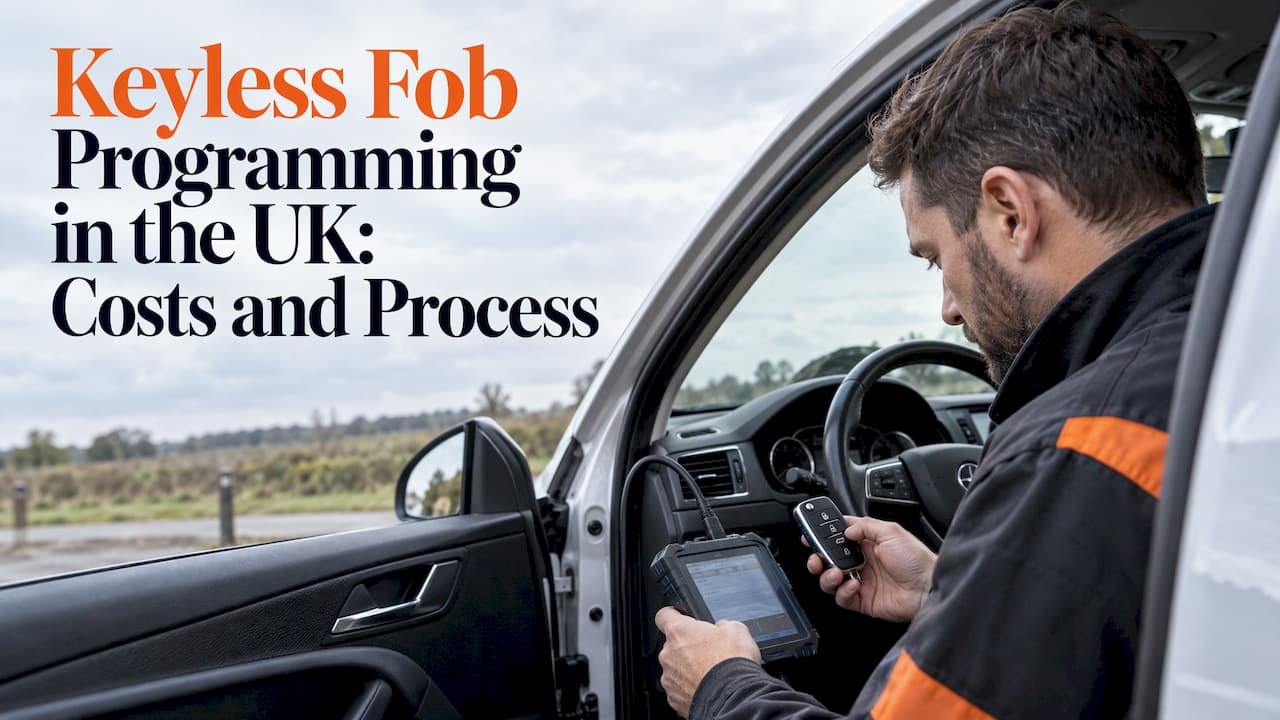
Keyless fob programming means pairing a new or spare key with your car's electronics, so the car recognises it, unlocks for it and, on most modern cars, lets it start the engine. Some older remote fobs can be paired with a button sequence at home. Most keyless, smart and push-to-start keys need diagnostic equipment connected to the car. If you are in Essex or Hertfordshire, we bring that equipment to your car, so there is no tow and no dealership queue.
This guide explains what is being programmed, what you can and cannot do yourself, what a mobile visit looks like and what to have ready before you call.
TL;DR
- A fob can need two separate jobs: remote programming (the lock and unlock buttons) and immobiliser key programming (permission to start the engine). Some keys need both.
- Older cars sometimes allow a do-it-yourself sequence for the remote buttons. Smart keys, proximity keys and push-to-start keys generally need a diagnostic tool.
- If every key is lost, a mobile locksmith can cut, create and programme a new key at your car. Our published prices start from £120 for a standard key and from £150 for a remote key.
- Keep your registration, make and model, VIN and photo ID ready. It speeds up the job.
- Repeated failed attempts at programming can make things worse, so stop and call a professional if the first try does not work.
Table of Contents
- Do key fobs have to be programmed?
- Keyless, smart, proximity and push-to-start: what the names mean
- Can you programme a replacement fob yourself?
- What a mobile keyless fob programming visit involves
- When all your keys are lost
- What to have ready before you call
- Our view: why mobile programming makes sense
- What it costs
- Need a fob programmed in Essex or Hertfordshire?
- Keeping a keyless car secure
- FAQ
- Sources
Do key fobs have to be programmed?
Yes, in nearly every case. A key fob is not just a plastic case with buttons. It carries a transmitter that talks to the car, and usually a transponder chip as well. A manufacturer's key manual for one common fob design describes it as containing both a transponder function and a radio transmitter for locking and unlocking, and says only keys programmed to the vehicle electronics can start and operate the car.
That is why a blank key from an online marketplace will not simply work. The car has to be told to accept it.
Remote programming versus key programming
The trade distinguishes two operations. A UK key-programming tool manual separates "key programming" (adding, clearing or reprogramming immobiliser keys) from "remote programming" (adding, clearing or reprogramming remotes). The two can be done separately.
In practice that means a fob can fall into one of three situations:
- The remote buttons work, but the car will not start. The immobiliser has not accepted the key.
- The car starts, but the buttons do nothing. The remote has not been paired.
- Neither works. This is the usual situation with a brand new replacement, and it needs both jobs.
Knowing which one you need helps you describe the problem accurately when you call, and avoids paying for work you do not need.
Keyless, smart, proximity and push-to-start: what the names mean
The terms overlap, and manufacturers use their own names. Here is how we use them.
| Key type | What it does | Typical programming need |
|---|---|---|
| Remote fob with a blade | Buttons lock and unlock; the blade turns in the ignition or door | Remote pairing, plus immobiliser programming for the chip |
| Transponder key | Chip allows the engine to start, sometimes no buttons | Immobiliser key programming |
| Smart key / proximity key | Car detects the key nearby, unlocks as you touch the handle | Diagnostic programming of the key to the car's modules |
| Push-to-start key | Same as a smart key, with a start button instead of a turn | Diagnostic programming, often with security access |
| Phone-based digital key | App replaces or supplements the fob | Set up through the manufacturer's app and account |
Some current cars now support phone-based keys: for example, the Volvo EX30 supports digital keys through a smartphone app. A physical fob is still normally supplied, and that is what a locksmith deals with.
Can you programme a replacement fob yourself?
Sometimes, and mostly on older cars. A US consumer article on the subject says owners can programme fobs for most vehicle models, but the tools needed depend on the age and model of the vehicle, and that newer vehicles need more sophisticated equipment, including a scan tool. It also describes the on-board method used on many older cars: cycling the ignition with the key in a set pattern, then pressing the buttons on the fob, sometimes combined with door or brake pedal steps.

The same article is American, so treat its brand examples with care. UK models and trims differ, and your owner's manual is the first place to look for whether your car has an on-board procedure at all.
When the DIY route stops working
The DIY method suits a simple remote on an older car, where the key already starts the engine and only the buttons need pairing. It is not realistic when:
- The key is a smart or push-to-start type.
- You have lost every key, so there is no working key to start the sequence.
- The car needs the old key erased for security reasons.
- The programming needs security access from the car's computer.
The same source warns that DIY programming can, in rare cases, disable electrical features, trigger warning lights or cause ECU problems that need a locksmith or dealer to put right. Some manufacturers go further. Jaguar's technical procedure for its smart key warns that incorrect or repeated programming attempts can orphan a smart key and that a specific recovery procedure is needed afterwards. If your first attempt fails, stop there.
If you are still working out whether the fob itself is the issue, our guide to fixing a key fob in three quick checks covers the battery, the key position and the signs that point to programming. For problems with keyless entry on the car side, the keyless entry triage guide is a good next step.
What a mobile keyless fob programming visit involves
We come to your car, wherever it is parked: at home, at work, at a supermarket or on the roadside. Our vans carry diagnostic tools so that the work is done on site, typically within 30 to 60 minutes. Here is the usual sequence.
- Identify the car. We confirm make, model, year, registration and VIN, and check the key type the car uses.
- Check ownership. We ask for photo ID and proof the vehicle is yours. This protects you as the owner.
- Cut or prepare the key. If the key has a blade, it is cut to the lock. Smart and proximity keys are emergency-ready or prepared for pairing.
- Connect the diagnostic tool. We link to the car's diagnostic port, with battery support where needed so the car's voltage stays stable during the job.
- Programme the key. The new key is added to the immobiliser and, where relevant, the remote and keyless functions are paired.
- Delete lost keys if needed. If a key is lost or stolen, we can remove it so it no longer works.
- Test everything. We check locking, unlocking, starting, the boot or tailgate and any keyless entry sensors before we leave.
Stable power matters more than most people expect. Our note on battery support when programming immobilisers explains why a voltage drop mid-job is a risk worth managing.
Why we delete lost keys
A lost key is also a security issue. Volvo's UK support guidance says that when a key is lost, the remaining keys must go to a workshop so the missing key's code can be erased from the system, as a theft-prevention measure. We offer stolen key deletion and reprogramming for the same reason, and without moving the car to a workshop.
When all your keys are lost
No key does not mean no solution. When every key is gone, the car cannot be used to start a sequence, so the work goes through the diagnostic port instead. A new key is made and programmed to the car, and the old keys are cleared from the system if you want them disabled.
Smart and push-to-start cars add a layer. Jaguar describes its smart key as two systems: passive entry and starting, plus an active-starting backup used when the key battery is flat or there is radio interference. A technician needs to understand both when pairing a replacement. Faults that come and go on these systems are also hard to pin down, and garages that diagnose intermittent car faults systematically tend to find them faster. A key that works some days and not others is worth having checked before you assume it is dead.
We have written two detailed guides for these cases: lost smart key replacement without a tow and the technician steps for all keys lost programming. If you only need a spare, the guide on adding a key to your car's immobiliser shows what that involves. For one make in particular, see our notes on Audi key programming.

What to have ready before you call
A few details make the booking quicker and the visit smoother:
- Make, model and approximate year of the car or van.
- Registration number and, if you can find it, the VIN (on the V5C logbook and at the base of the windscreen on most cars).
- Photo ID, such as a passport or driving licence, and proof the vehicle is yours.
- Your location or postcode, and whether the car is on private or public land.
- How many keys you still have, and whether any are damaged rather than lost.
- Whether the buttons work, the engine starts, or neither.
If you have a working key, tell us. Copying from a working key is often simpler and cheaper than a replacement when every key is lost.
Our view: why mobile programming makes sense
We have seen the same pattern many times: someone loses the only smart key, the car is recovered to a dealership, and a simple job turns into days of waiting plus a recovery bill.
Our approach is different. Our vans carry the diagnostic equipment to do the programming on site, our technicians are licensed, insured and SERMI-certified, and we work on cars and vans of all major makes. We would rather you spend your time on your day than on a tow truck.
If you can still start the car, ask us whether a spare is worth getting now. A second key programmed while the first still works is calmer and usually easier than an all keys lost call. And if your fob is old and unreliable, replacing it before it fails completely is sensible.
James
What it costs
Our published prices are a starting point. The final price depends on the make, the key type and the work needed, so we confirm it with you before we start.
| Service | Published price |
|---|---|
| Key programming | from £120 |
| Standard key | from £120 |
| Remote key | from £150 |
| Emergency callout | from £120 |
| Lock and ignition repair | from £120 |
For smart key work, remote programming, key copying and cutting, all keys lost replacement and stolen key deletion, we quote after we know the vehicle. Contact us with your registration and we will tell you what applies. You can read more on our key programming page.
One tip that saves money: if the fob case is cracked or the buttons are worn but the electronics are fine, ask whether a repair is possible before you buy a full replacement. Our vehicle pages list key fob repair and replacement among the options.
Need a fob programmed in Essex or Hertfordshire?
We cover Harlow, Chelmsford, Epping, Brentwood, Billericay, Braintree, Great Dunmow, Bishop's Stortford, Sawbridgeworth, Ware, Loughton, Ongar, Stansted and the villages in between. Tell us your make, model and registration, and we will come to your car with the right equipment.

For remote and smart key programming, book a mobile visit on our key programming page. Van owners can ask about van key replacement through our main site. If you are locked out as well, our emergency callout service is available.
Keeping a keyless car secure
Programming a new fob is a good moment to think about how the key is used day to day.
- Know your car's settings. Ford says Intelligent Access can be switched on or off through the vehicle settings menus, which some owners use when the car is parked at home overnight. Check your own manual for what your car allows.
- Be aware of relay attacks. Thieves can boost a key's signal range to unlock the vehicle. Land Rover says its UWB smart key technology helps prevent relay attacks. If your car is not a UWB model, ask the manufacturer or us about sensible storage of the key at home.
- Remove lost keys from the system. A key that is still programmed can still open the car.
- Keep a spare. Having a spare programmed and stored somewhere safe makes the next lost key an inconvenience rather than an emergency.
FAQ
Can I programme a keyless fob myself?
On some older cars with a simple remote, yes, using a sequence in the owner's manual. Smart, proximity and push-to-start keys generally need diagnostic equipment, and a failed attempt can leave the key unusable. If the car will not accept the key after one careful try, stop and call a locksmith.
Is a key fob the same as a transponder key?
No. The fob's buttons lock and unlock the car, while the transponder chip lets the engine start. Many keys contain both and the two functions are programmed as separate operations, so a key can need one, the other or both.
Can you make a smart key if I have lost every key?
Yes. We programme a new key through the diagnostic port, and we can delete the lost keys so they stop working. Bring your registration, photo ID and proof of ownership, and we come to your car in Essex or Hertfordshire.
How long does keyless fob programming take?
Our mobile visits typically take 30 to 60 minutes once we are with the car. The exact time depends on the make, the key type and whether old keys are being deleted.
How much does it cost to programme a key fob?
Our published prices start from £120 for key programming and a standard key, and from £150 for a remote key. We confirm the final price for your vehicle before work begins.
Sources
- Key Programming Operating Manual (Advanced Diagnostics)
- Can I Program My Own Car FOB? (Family Handyman)
- Jaguar Smart Key programming procedure
- Volvo V90 remote control key support
- Volvo EX30 features
- Ford: activating or deactivating keyless entry
- Land Rover security and protection FAQs
- Diagnosing intermittent car faults (Carozo)