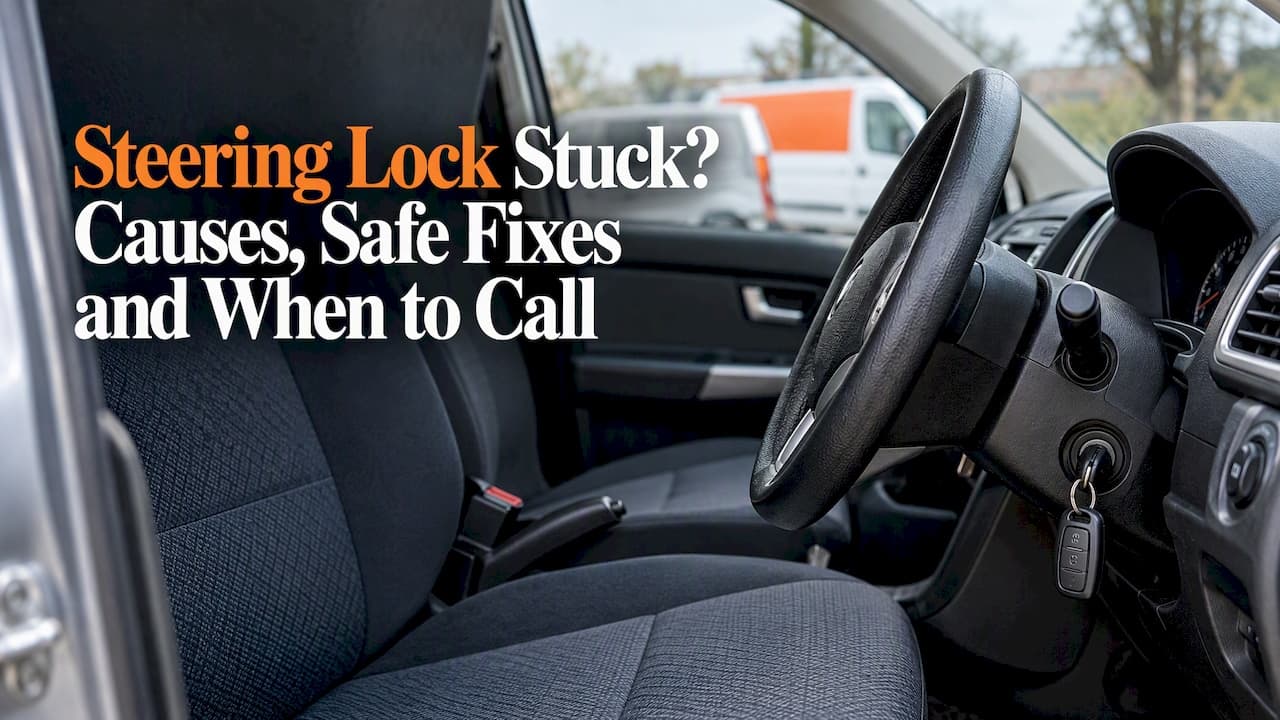
If your steering lock is stuck, the wheel won't turn and the key won't turn with it. In most cases the lock is simply under tension: the wheel was nudged after the engine was switched off and the locking pin is pressed against the column. Gently rocking the wheel while you turn the key usually frees it. If that fails, the cause is usually a worn key, a flat battery, a grubby ignition barrel or a failed electronic lock. Each of those has its own safe next step, and this guide takes you through them in order.
We are a mobile auto locksmith covering Essex and Hertfordshire, so we see this fault on driveways, supermarket car parks and station car parks most weeks. Some of what follows you can do yourself in two minutes. Some of it you should leave alone, because forcing the wrong part turns a cheap fix into an expensive one.
TL;DR
- Most stuck steering locks are tension, not breakage: turn the wheel gently in the direction it will move while turning the key. Never force either.
- Try your spare key before blaming the car. A worn or damaged key is a common culprit, and a spare that turns easily points straight at the main key.
- Dim dashboard lights or a car that won't start can mean a weak battery, which may stop an electronic steering lock releasing.
- A red steering warning light, or a lock that stays seized on a push-button car, needs diagnostic equipment. Stop driving and call a specialist.
- We repair locks and ignitions on site across Essex and Hertfordshire, with no tow to a dealership.
Table of Contents
- What the steering lock actually does
- Step one: the safe release for a tensioned lock
- Step two: test the key itself
- Step three: is it the battery?
- Push-button cars and electronic steering lock faults
- Red steering warning light: stop first
- Older cars: grime in the ignition barrel
- A different kind of stuck: the aftermarket steering wheel lock
- What we would do on site
- Perspective: why we don't recommend a tow first
- Preventing a repeat
- When to call us
- FAQ
- Sources
What the steering lock actually does
The steering lock is an anti-theft device. When you remove the key and turn the wheel slightly, a metal pin drops into a slot in the steering column. The wheel can no longer be turned, so the car can't be steered away by someone without the key.
On older cars the lock is mechanical and sits in the ignition barrel. Turn the key and the pin retracts. On newer cars with push-button start, the lock is an electronic steering lock (ESL), a small motor-driven unit that retracts the pin when the car recognises your key. That distinction matters, because the two fail in very different ways and need very different fixes.

The AA explains that most car keys are really three keys in one: a mechanical blade that releases the steering lock, a transponder chip the car reads, and a remote. If any one part is worn or failing, the car can behave as if the lock itself is broken.
Step one: the safe release for a tensioned lock
This is the fix for a traditional key and ignition, and it works far more often than people expect.
- Check the gearbox. A manual should be in neutral or in gear with the clutch pressed, and an automatic must be in Park.
- Insert the key fully and keep it in the "off" position.
- Hold the wheel with one hand and turn it gently to the left, then to the right, to find the direction it moves even a few millimetres.
- Keep light pressure on the wheel in that direction and turn the key with the other hand.
- If it doesn't release, ease the pressure off and try the other direction. Don't hammer or yank.
The pin is jammed because the wheel is leaning on it. Taking that load off lets it retract. Many drivers fail because they turn the key hard while the wheel is still loaded, which can bend a worn key or snap it in the barrel.
If the key snaps or won't come out, stop. That is a job for a locksmith, not a screwdriver.
Step two: test the key itself
Before you suspect the column, test the key. The AA notes that drivers often blame the lock when a worn blade or failed transponder chip is the real problem.
Use your spare. If the spare turns easily and the main key sticks, the main key is the fault. Look for:
- A blade that is visibly bent, rounded at the edges or shiny from wear.
- A heavy keyring. Weight hanging from the key can pull on the barrel and make the lock bind.
- Cracked casing or a loose blade on a flip key.
- Dirt or lint packed into the blade grooves.
If the main key is worn, a fresh cut from a code or from the lock gives you a key that fits properly again. We cut and programme replacement keys at your location. If the spare is also stiff, the problem is likely in the barrel or the column, not the keys. For transponder faults specifically, see our guide on what to do when a transponder key isn't working.
Step three: is it the battery?
On modern cars the steering lock often depends on electrical power. The RAC points out that you should check whether dashboard lights, interior lights, windows and central locking are behaving normally. If they are dim or dead, a flat battery is the likely culprit, and an electronic steering lock may not have enough voltage to release.
Signs to look for:
- Slow or clicking starter, or nothing at all.
- Dim or flickering dash lights when you open the door.
- Central locking that works slowly or not at all.
- A smart key that the car stops recognising.
A jump start can sometimes get you going again. The RAC also gives a typical battery life of three to five years, after which failures become more common, so an older battery is a good suspect. If the steering stays locked even with a healthy battery, the lock unit needs diagnosing. On keyless cars, a weak battery in the key fob can also stop the car waking up, and our smart key not detected checklist covers that.
Push-button cars and electronic steering lock faults
With an ESL there is no wiggling trick that fixes the underlying fault. The lock is a motor and a control module, and when it fails, the car typically won't start and may show a warning on the dashboard.
A technical bulletin on a Mercedes-Benz case describes the common failure of the unit seizing in the locked position, with symptoms such as a non-start and no ignition lights. It lists stored fault codes, including A25407 for the electric steering lock, and explains that technicians read those codes before deciding whether a simple repair will do or the unit must be replaced. In bad cases the standard release bolt can't be reached, and removing the steering column module is the only way in.
The practical lessons for owners are these:
- Don't force a seized ESL. Attempting to do so can lead to expensive damage to the steering column.
- Don't keep pressing the start button. Repeated attempts can drain a weak battery further.
- Do note any warning light and message, and what the car did just before it failed. That speeds up diagnosis.
- Do call someone with the right diagnostic equipment.
On a Jaguar Land Rover model, for instance, the manufacturer's advice for a steering lock that stays engaged is to turn the wheel slightly while pressing the engine start switch. That is a model-specific step, so check your handbook before relying on it.
Red steering warning light: stop first
A stuck lock is a parked-car problem. A steering warning light on the move is a safety problem, and it must not be treated the same way.
Volkswagen's guidance says a red steering fault light means you should stop the car as soon as it is safe. The same page advises against towing a vehicle with this fault on its own four wheels. That is Volkswagen's instruction for its own cars, but it is a good reason to check your manual before agreeing to a standard tow. Recovery on a flatbed may be the safer option, and it is worth asking before the truck turns up.
It also helps to separate two conditions that feel alike:
| Situation | What it usually is | What to do |
|---|---|---|
| Wheel won't turn, key won't turn, car parked | Steering lock engaged or jammed | Wiggle method, test spare key, check battery |
| Wheel suddenly heavy while driving | Power steering failure, not a lock | Ease off the accelerator, slow gradually, pull over safely, call recovery |
| Red steering warning, car won't start | Electronic steering or ESL fault | Stop driving, avoid forcing, get diagnostics |
| Key stuck in ignition, won't come out | Worn key or barrel fault | Don't pull hard, call a locksmith |
Safety guidance is clear that a heavy wheel while driving is a power steering problem, not a lock. If that happens, ease off the accelerator and slow gradually before leaving the road safely. The lock engaging while the car is moving is rare, and an unresponsive wheel at speed should be treated as an emergency, not a fault to diagnose at the roadside.
Older cars: grime in the ignition barrel
On cars with a traditional ignition barrel, a very common cause is dirt. An RAC forum thread about a Vauxhall Astra describes a small plastic part inside the lock housing that sticks because of grime, leaving the key stuck and the radio staying on. One forum contributor's first suggestion is a spray of WD-40 using the tube supplied, then working the ignition back and forth one click at a time.
The same thread mentions a small punch in an access hole on the lock housing, and warns that if the key is pulled out while the barrel is removed, the tumblers can fall out and the repair becomes far more complicated. That is a forum anecdote about one model, not a manufacturer procedure, and we wouldn't suggest a driver tries it. Our advice:
- A light spray of lubricant into the barrel is the most you should try at home. Avoid flooding it.
- Do not take apart the column trim or remove the barrel yourself.
- If the key turns only with force, stop. Force is how keys snap.
When the barrel is worn, the cure is repair or replacement of the lock and ignition, plus new keys matched to it. Our ignition switch failure symptoms guide lists the signs that point to the switch rather than the lock.
A different kind of stuck: the aftermarket steering wheel lock
Some readers who search this phrase mean the bar-style device fitted over the wheel as a visible theft deterrent. If the key won't turn in that, check it isn't jammed against the rim or dashboard, and try the spare. Those devices come in several designs, and a double hook steering wheel lock is one example of the type. If a bar lock has seized and won't open, don't saw through the wheel: contact a locksmith, who can often open it without damage.

What we would do on site
This is the order we follow when someone calls us with a stuck steering lock.
- Ask the right questions on the phone. Make, model and year, key type, any dashboard messages, and whether the spare behaves differently.
- Rule out the simple causes. Tension, battery and key condition.
- Diagnose. We use diagnostic equipment on the van to read the vehicle's systems rather than guessing.
- Repair or replace. That might be a barrel repair, a new ignition switch, a replacement lock or a new key cut and programmed to the car.
- Test the result. We confirm that the keys, immobiliser and steering release all work before we leave.
Where keys are involved, our key programming service starts from £120, and vehicle lock and ignition repair also starts from £120. Both are published "from" prices, so the final figure depends on your vehicle and the job. An emergency callout fee also starts from £120.
Perspective: why we don't recommend a tow first
When a driver's steering lock sticks, the first instinct is often to call recovery and have the car taken to a dealership. We understand why. But a tow adds cost, wait time and disruption, and in many cases the fault can be dealt with where the car is parked.
Our vans carry diagnostic and key programming equipment, and our technicians are licensed, insured and SERMI-certified. That lets us do dealership-level work at the roadside or on your drive, typically within 30 to 60 minutes of arriving. For a steering lock, that matters because the cause is so often a key, a battery or a worn barrel rather than a catastrophic failure.
What we would ask of every driver is restraint. The most expensive steering lock jobs we hear about began with someone forcing the key or levering the wheel. A bent key becomes a snapped key. A snapped key becomes a damaged barrel. A damaged barrel becomes a column repair. If it doesn't release with gentle pressure, stop and call.
We also ask drivers to carry a working spare and keep it somewhere other than the main key's bunch. A spare turns a bad morning into a quick test, and it is much cheaper to cut when you still have a key than when you have lost them all.
— James
Preventing a repeat
- Park with the wheels straight. A loaded wheel is the main reason the pin binds.
- Lighten the keyring. Heavy bunches wear the barrel over time.
- Replace worn keys early. A key that is rounded at the edges should be re-cut before it fails.
- Watch the battery. If starting is getting slower, test it before winter.
- Keep the barrel clean. Avoid greasy sprays that attract grit.
- Know where your spare is. Test it every few months so you know it works.
If you have lost every key, that is a different job and one we handle regularly. See our all keys lost programming steps for what happens in one visit.
When to call us
Call a specialist if any of these apply:
- The wiggle method fails and the spare also won't turn.
- The key is stuck, bent or broken in the ignition.
- A push-button car won't start and the steering stays locked.
- There is a red steering warning light.
- The battery is healthy but the lock still won't release.
We work across Essex and Hertfordshire, including Harlow, Chelmsford, Epping, Brentwood, Billericay, Bishop's Stortford, Braintree, Loughton, Ware and the villages between. If you need us now, our emergency callout starts from £120, and you can see our full range on the Auto Key Maker services page. Van owners can ask about van key replacement as well, because a van off the road costs a working day.
If you're not sure whether the issue is the lock or a locked-out car, our guides on a car door that won't open with the key and keys locked in the car may help you work it out.
FAQ
What should I do when my steering locks up?
Keep the key in the ignition, turn the wheel gently in the direction it will move, and turn the key at the same time. Never use force. If it doesn't release after a few careful attempts, try your spare key and then call a locksmith.
Can a dead battery cause the steering wheel to lock?
On cars with an electronic steering lock, a weak battery can stop the lock releasing. The RAC advises checking dashboard lights and central locking to confirm the battery is the cause. A jump start may help temporarily, but if the wheel stays locked afterwards, the lock needs diagnosing.
Can I drive with a steering lock fault?
If a red steering warning light is showing, stop as soon as it is safe and don't carry on driving. Volkswagen, for one, says that a red steering fault means stopping the car as soon as it is safe. Then get recovery or a specialist to the car.
Is a stuck steering lock the same as power steering failure?
No. A locked wheel won't move at all and happens when parked. Heavy steering while driving is usually power steering failure, and you should slow gradually and pull over safely.
Can the steering lock be removed permanently?
We wouldn't recommend it. The lock is part of the car's anti-theft protection and is integrated with the ignition and electronics. If it keeps failing, the right answer is to repair or replace it, not defeat it.
Sources
- What to do if you've lost your car keys, The AA
- What to do if you have a flat or dead battery, RAC Drive
- Friday Fault to Fix: Steering Lock Failure
- Steering Fault Warning Lights, Volkswagen UK
- Driving in Heavy Rain
- Vauxhall Astra key removal problem, RAC Forum