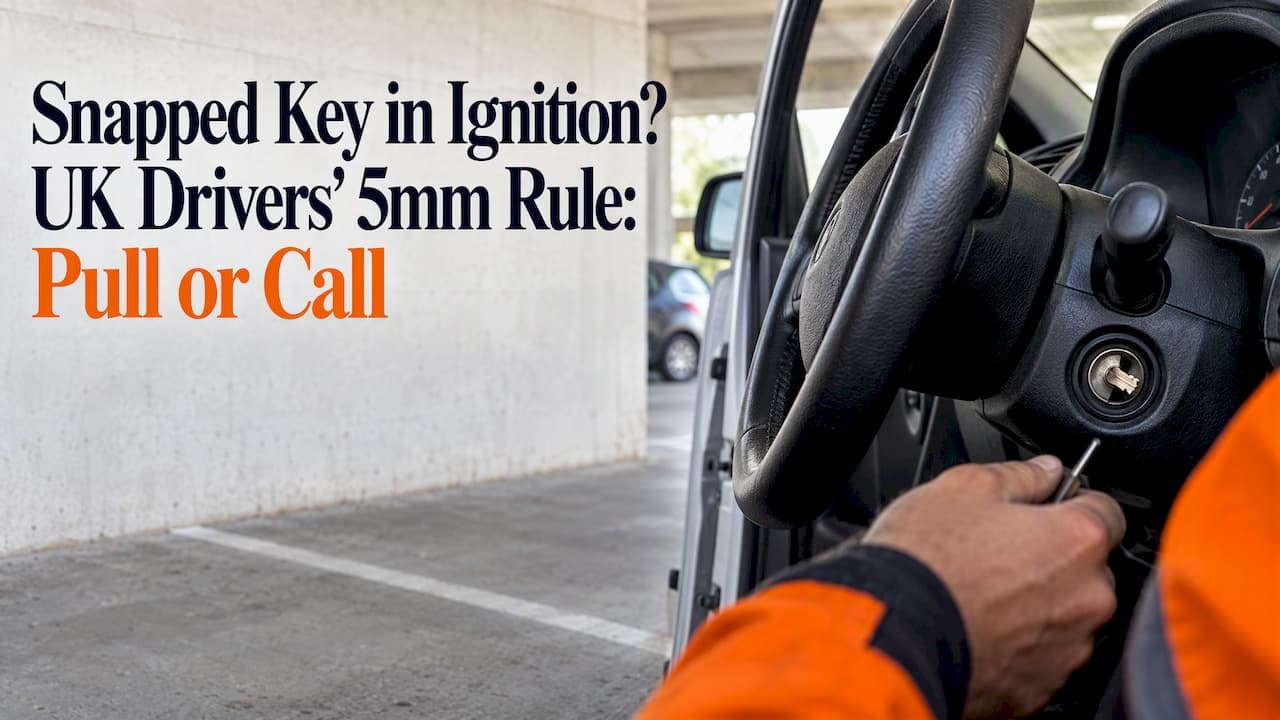
Stop turning the key the moment it snaps and resist the urge to force anything. If more than about 5mm of metal blade is still sticking out of the barrel, a careful, single extraction attempt can work. If the break sits flush with the lock or feels buried, your best move is to call a mobile locksmith rather than risk further damage.
TL;DR:
- After the key snaps, switch off electrical loads, secure the vehicle, photograph the fragment, and avoid twisting it deeper into the ignition.
- Avoid glue, magnets, paperclips, and household oils; they can damage the barrel, immobilizer, or key circuitry, turning extraction into a larger repair.
- A UK daytime extraction costs £60 to £150, while London and South East jobs can reach £90 to £180; after hours adds £40 to £90.
- Share the vehicle’s make, model, year, and key type, then confirm fixed pricing and on site transponder programming before the technician sets out.
- A clean extraction often takes 15 to 30 minutes, but a damaged or high security barrel may need replacement, raising the time and cost.
Table of Contents
- What to do immediately after the key snaps
- Deciding whether to try DIY removal yourself
- How a professional extracts a broken key safely
- Costs and timeframes you can realistically expect
- What to prepare while you wait for help
- What mobile, on-site locksmith help actually looks like
- Balancing speed, cost and the risk of further damage
- How we can help if your key has snapped
- FAQ
- Sources
What to do immediately after the key snaps
The first few minutes matter more than most drivers realise. A calm, methodical response protects the ignition barrel and gives a locksmith the best chance of a clean extraction later.
- Stop turning the key straight away and leave the broken piece exactly where it sits in the barrel.
- Switch off any electrical loads, such as lights or the radio, and make sure the vehicle is somewhere safe.
- If it's safe to do so, gently return the steering wheel or ignition lock to the position it was in when the key snapped.
- Avoid twisting, wiggling or jarring the fragment, since this can push it deeper into the cylinder.
- Look closely at how much of the blade protrudes and take a photograph from a couple of angles. This helps a technician assess the job before they even arrive.
- If a small length of blade is visible, a lock-appropriate lubricant such as powdered graphite or a purpose-made lock spray can help. Household oils tend to gum up the pins and should be avoided.
- Try one gentle, straight pull with fine needle-nose pliers or a dedicated key extractor if you happen to have one, keeping the motion straight rather than sideways.
- Never resort to glue, magnets, paperclips or other improvised tools. These routinely destroy the immobiliser or the lock barrel itself, turning a simple extraction into a much bigger repair.
Pro Tip: Photograph the broken key and the ignition before touching anything further, since this record speeds up diagnosis and quoting when help arrives.
Deciding whether to try DIY removal yourself
Not every snapped key is a DIY job, and getting this call wrong can turn a small problem into an expensive one.
- Attempt removal yourself only when roughly 5mm or more of solid blade protrudes cleanly from the barrel.
- Stop immediately if the break is flush with the cylinder face or the lock feels seized, since further attempts are likely to cause more damage.
- Be cautious with transponder or fob-style keys. If the electronic head is still attached, pulling or prising risks destroying the chip or circuitry inside.
- Call a locksmith straight away if you don't have proper extractor tools or fine probes, or if you're stuck somewhere unsafe, such as a busy road or dark car park.
These rules exist because the ignition barrel is a precision mechanism. A fragment pushed deeper by a clumsy attempt often means the difference between a quick fix and a full barrel replacement.
How a professional extracts a broken key safely
A trained locksmith approaches a snapped key differently to a determined owner with pliers, and that difference usually shows up in the final bill.
- Purpose-made extractors, fine probes and micro-grips designed specifically for broken key fragments, rather than general-purpose tools.
- Torches, inspection scopes and diagnostic equipment to read the transponder and check for remote programming needs.
- Non-destructive probing and hooking techniques, followed by a straight pull, with partial cylinder removal reserved for cases where extraction genuinely isn't possible any other way.
- On-site checks for transponder or remote damage, plus the equipment to programme a replacement key without a trip to a dealership.
The AA's guidance on locked keys notes that attempting improvised fixes often causes further damage, while trained technicians can usually extract a key non-destructively and cut or programme a replacement on site within around 30 to 40 minutes. That gap between a professional's toolkit and a makeshift one is exactly why technicians avoid the immobiliser and ECU damage that DIY attempts frequently cause.
Costs and timeframes you can realistically expect
Pricing for a snapped key varies with the complexity of the job, the time of day and where you're based.
Broken key extraction in the UK commonly costs between £60 and £150 including VAT for a standard daytime callout, rising to roughly £90 to £180 in London and the South East, with out-of-hours work adding another £40 to £90 on top. A clean extraction from a healthy lock often takes just 15 to 30 minutes. If the lock itself is damaged or high-security, the job can run longer and may call for a full cylinder replacement, which adds both time and cost.

Extra charges can also come from programming a new transponder key or from an emergency call-out fee if you need help outside normal hours. Where possible, ask for a fixed price upfront and confirm whether parts, such as a replacement barrel, are included before work begins.
What to prepare while you wait for help
A little preparation while you wait shortens the diagnostic process and often sharpens the quote you're given.
- Gather your vehicle's make, model, year and key type, since this affects which tools and replacement parts are needed.
- Photograph the broken key and the ignition from a few angles, which helps the technician plan before they even step out of the van.
- Track down any spare key, key paperwork or service history, since these can speed up programming a replacement.
- Ask the technician about fixed pricing, whether they can cut and programme a key on site, their expected arrival time and accepted payment methods.
Pro Tip: If your key has a transponder chip, confirm the technician can programme a replacement on site before they arrive, so you're not left waiting for a second visit.
What mobile, on-site locksmith help actually looks like
A mobile locksmith brings the workshop to you rather than the other way round. We operate equipped vans carrying extraction tools, programming equipment and the parts needed for most ignition jobs, and typically arrive within 30 to 60 minutes of a call.
Working on site with proper diagnostic kit means a snapped key can often be extracted, a new one cut and programmed, and the ignition checked, without ever needing to tow the vehicle to a dealership. That combination of speed and capability is usually what keeps both the wait and the final bill down compared with the dealer route.
Balancing speed, cost and the risk of further damage
The honest trade-off with a snapped key is between a few minutes of caution and a repair bill that can balloon if you get it wrong. A single, careful DIY attempt is reasonable when the blade clearly protrudes and the lock isn't seized, but that window is narrower than most drivers assume, and pushing past it is how a £60 extraction turns into a £300 barrel replacement.
Preserving the ignition barrel is almost always cheaper in the long run than a botched attempt that damages the immobiliser or the ECU. And if there's an immediate safety issue, blocked traffic, a child or pet locked in, or you're stranded somewhere exposed, that takes priority over saving money on the call-out. Breakdown cover or emergency services come first in that situation, cost second.

How we can help if your key has snapped
If you're dealing with a snapped key right now, we offer mobile extraction, on-site key programming and ignition barrel repairs, with vans typically reaching you within 30 to 60 minutes.

- On-site key programming for transponder and remote keys, cut and set up without a dealer visit.
- Car lockout services for the moments when you can't get back into the vehicle at all.
- Lock and ignition repairs when the barrel itself needs attention after extraction.
- An emergency call-out option when you need someone out of hours.
Our vans carry the diagnostic and programming tools needed to handle most jobs in one visit, so you're not left waiting on parts or a second appointment. Get in touch through our key programming page or lockout services page to check availability near you.
FAQ
How much does it cost to get a broken key out of the ignition?
Standard daytime extraction in the UK typically costs between £60 and £150 including VAT, with prices in London and the South East often running to £90 to £180. Out-of-hours call-outs usually add another £40 to £90 on top of the standard rate.
How much to fix a snapped car key?
The cost depends on whether the lock can be cleared with a straightforward extraction or needs a full cylinder replacement. A clean pull from a healthy lock often falls within the standard £60 to £150 range, while a damaged barrel or a replacement transponder key pushes the total higher.
Can a locksmith remove a broken key from the ignition?
Yes. A locksmith uses purpose-made extractors, fine probes and non-destructive techniques to pull the fragment free, and can usually also cut and programme a replacement key on site. The AA notes that trained technicians can typically complete extraction and key replacement within around 30 to 40 minutes.
How to get a snapped key out?
If at least 5mm of blade protrudes and the lock isn't seized, a steady, straight pull with fine needle-nose pliers or a dedicated extractor can work. If the break is flush with the barrel or the lock feels jammed, stop and call a locksmith, since further attempts risk pushing the fragment deeper or damaging the immobiliser.
Sources
For readers who want to dig deeper, the UK broken key extraction cost guide and the AA's advice on locked keys cover pricing and professional practice in detail. For real-world accounts of DIY attempts and outcomes, see this RAC forum thread. Drivers concerned about vehicle security more broadly may also find this guide on preventing car theft useful.