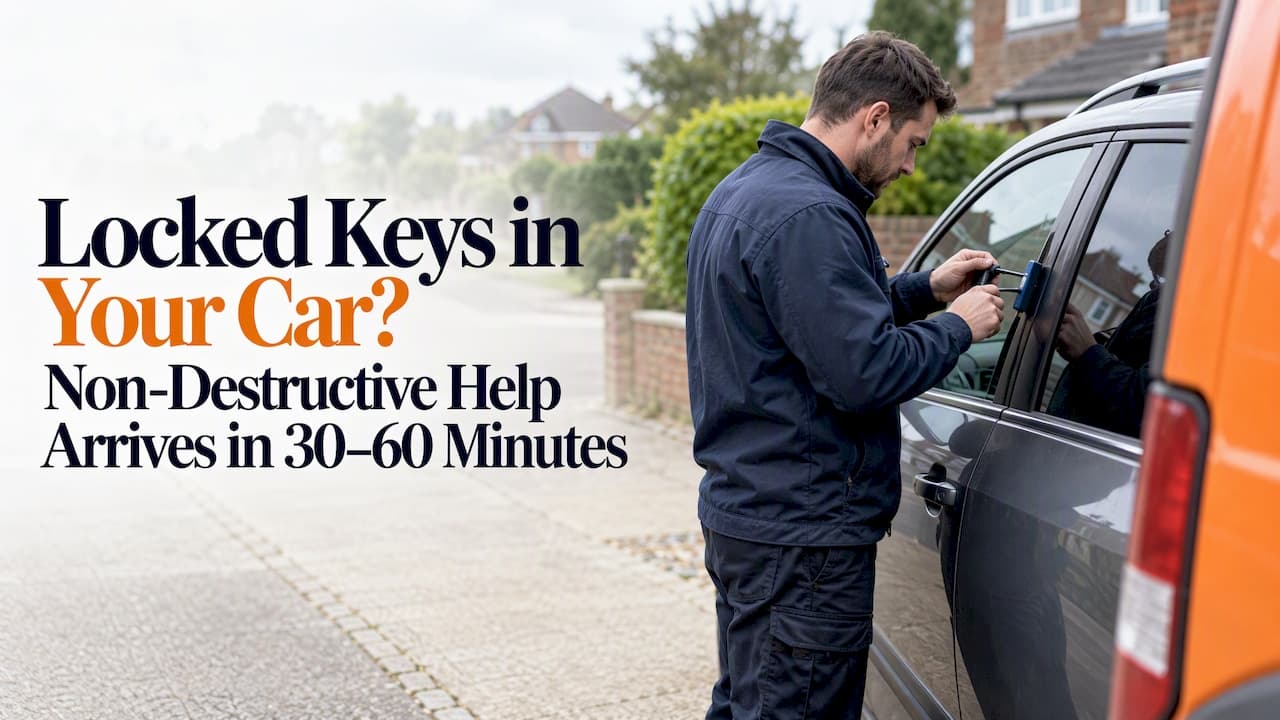
If you've locked your keys in the car, check every door, the boot and any boot release first, since one is often still open. Try the manufacturer's app or a spare key if you have access to either. If neither works, call breakdown assistance or a mobile locksmith rather than forcing entry, which can damage modern vehicles.
TL;DR:
- Using a manufacturer's app or spare key offers the quickest and safest way to unlock your vehicle without risking damage.
- Attempting physical entry methods like slim jams or coat hangers can cause damage and should only be a last resort before professional help.
- Call emergency services immediately if a vulnerable person, child, or pet is locked inside a hot car or if the vehicle poses an urgent traffic hazard.
- For non-emergency lockouts, contact a licensed mobile locksmith who can perform non-destructive entry and on-site key programming with a clear quote upfront.
- Setting up a spare key, testing remote unlock features, and establishing routines to check for keys can prevent future lockout situations.
Table of Contents
- Immediate steps to take now
- DIY methods you can try and the risks
- When to call professionals: breakdown cover, locksmith or emergency services
- What a mobile auto locksmith does and what to expect
- Cost drivers and questions to ask before authorising a locksmith
- How to avoid locking keys in the car again
- A mobile locksmith's quick take on staying calm
- How Auto Key Maker can help and how to get in touch
- Sources
- FAQ
Immediate steps to take now
Before doing anything else, check whether you or anyone nearby is in danger from traffic, weather or a vehicle left running. Safety comes before recovery every time.
- Try all four doors and the boot: central locking sometimes fails to catch on one side.
- Look for a separate boot release button or lever, which can offer another way in.
- Ask someone nearby to check their phone for the manufacturer's app, or to fetch a spare key if one exists.
- If a child, older or vulnerable person, or a pet is locked inside, treat it as an emergency straight away.
Heat builds quickly inside a closed vehicle, and children, pets and elderly people are particularly at risk once trapped. Councils and fire services both warn that temperatures can rise rapidly in locked vehicles, so this situation needs a 999 call rather than a wait-and-see approach.
Pro Tip: Keep your phone on you, not in the car. It's your fastest route to help if you're stuck outside.
DIY methods you can try and the risks
A manufacturer's app, where you've already set one up, is the safest first option: open it, confirm your location matches the vehicle, and use the remote unlock function. Many newer cars from Ford, BMW and others support this, though it depends on signal, battery charge and whether the feature was activated beforehand. A spare key kept at home or with a trusted person is nearly as quick, assuming someone can bring it to you.
Physical methods are riskier than people expect:
- A slim jim is a thin metal strip slid between the window and door panel to hook the lock mechanism, but most cars built in the last 15 years have changed linkage designs that make this unreliable.
- A wedge and long-reach tool creates a gap to access the lock or button, yet it can crack weather seals or bend door frames.
- A coat hanger, the classic improvised option, rarely reaches modern lock mechanisms and often just scratches paint or trim.
Improvised entry can damage weather seals, wiring, the locking mechanism itself, and in some cases can even trigger airbags or alarm systems on modern vehicles. The AA's own guidance is to try the least damaging option first and escalate only when necessary, since a botched DIY attempt often costs more to repair than a professional callout would have cost in the first place.
When to call professionals: breakdown cover, locksmith or emergency services
Who you call depends entirely on the situation. Match the service to the risk:
- Call 999 if a child or vulnerable person is locked inside, or if the vehicle is creating an immediate traffic hazard.
- Call your breakdown or key cover provider if you have one, since some policies include locksmith attendance or key replacement, such as Key Assist.
- Call a mobile auto locksmith for non-destructive entry, or if you need a key cut or programmed on-site.
Whichever you call, give them your exact location, vehicle registration, make and model, whether the engine is running, and where the key currently is (inside the car, lost, or with someone else). That detail lets the right help arrive with the right equipment the first time.
What a mobile auto locksmith does and what to expect
A mobile locksmith's first move is non-destructive entry: manipulating the lock or using specialist tools to open the door without cutting, drilling or forcing anything. This works for the majority of lockouts. Replacement or programming only becomes necessary when the key itself is lost, broken or stolen.
- Vans typically carry diagnostic equipment, a range of key blanks and programming tools, which is what makes on-site cutting and programming possible.
- Entry alone is usually the fastest job; cutting and programming a replacement key takes longer, with Key Assist-style services citing around 40 minutes where the vehicle is eligible.
- Expect to be asked for photo ID, proof of ownership and your registration number before work begins.
These checks exist because a locksmith working on someone's ignition or locking system needs to confirm they're dealing with the rightful owner, not helping someone break into a stranger's car.
Pro Tip: Photograph your V5C logbook and keep it on your phone. It speeds up ID checks considerably when you're stressed and stranded.

Cost drivers and questions to ask before authorising a locksmith
Pricing for a lockout callout depends on several factors: your vehicle's make and model, the time of day, your location, and whether a new key needs programming rather than just cutting. A late-night callout on a less common model will usually cost more than a daytime visit for a common hatchback.
Before you agree to anything, ask these questions:
- What is the total cost, including the callout fee, parts and any programming labour, not just the starting price?
- Does that figure include VAT?
- Do you have breakdown or insurance cover that might pay for this instead of me?
- Are you licensed, insured, and will you attempt non-destructive entry before anything more invasive?
Getting a full quote upfront, rather than authorising work based on a headline number, avoids the unpleasant surprise of extra charges once the job is already underway.
How to avoid locking keys in the car again
A lockout is rarely a one-off mistake, it's usually a gap in your routine. A few small changes close that gap for good.
- Keep a spare key at home with a trusted family member, or in a secure place you can reach without your main set.
- Set up your manufacturer's app now and test the remote unlock feature before you actually need it.
- Build a simple habit, such as checking your pocket or bag for keys every time you shut the door, or add a visible reminder like a keyring tag.
- Consider adding key cover, such as Key Assist, to your existing breakdown policy so a replacement is covered if the worst happens.
None of these takes more than a few minutes to set up, and each one removes a different way you could end up locked out again.
A mobile locksmith's quick take on staying calm
Most lockouts get resolved faster by a mobile van arriving at the roadside than by towing a car to a dealership. Avoid forcing entry on a modern vehicle. Have your ID and vehicle details ready before you call.
— James
How Auto Key Maker can help and how to get in touch

Being stuck outside your own car rarely happens at a convenient time, and towing it to a dealership only adds hours to a problem that's often fixable on the spot. A mobile locksmith service sends a fully equipped mobile van directly to your location, carrying out non-destructive entry, on-site key cutting, programming and ignition work without the vehicle ever leaving your location.
- Have your location, vehicle registration, make and model ready when you call.
- Let us know where the key currently is, whether it's inside the car, lost or damaged.
- The technicians are licensed, insured and SERMI-certified, and typically work on-site within 30 to 60 minutes of arrival.
If you're locked out right now, our car lockout service covers entry and replacement in one callout, and our full range of services covers everything from key programming to ignition repair for when the fix needs more than a simple unlock.
Sources
FAQ
How to unlock a car if you lock keys inside?
Check every door, the boot and any boot release first, since one is often still open. If that fails, try your manufacturer's app or a spare key, then call breakdown assistance or a mobile auto locksmith for non-destructive entry.
What should I do if my car keys are locked inside the car?
Stay calm, check all access points including the boot, and avoid forcing the door, since this can damage seals or wiring on modern cars. If you can't get in safely, call a breakdown provider or locksmith and give them your location and vehicle details.
What to do when you lock your keys in your car without a spare?
A locksmith offering on-site cutting and programming, such as through Key Assist-style services, can typically produce a working replacement without needing a spare at all. Expect to show photo ID and proof of ownership before the work begins.
What should I do if my car is running with my keys locked inside?
Do not leave the vehicle unattended, and if it's creating a traffic hazard, treat it as urgent and call for help immediately. Check for another unlocked door, try the manufacturer's app if available, and call roadside assistance or a mobile locksmith to attend.
What if a child or pet is locked inside a hot car?
Call 999 immediately, since temperatures inside a closed vehicle can rise rapidly and put children, pets and vulnerable people at serious risk. Fire and rescue services are equipped to gain entry quickly in these situations, so don't wait to see if the person or animal seems fine.