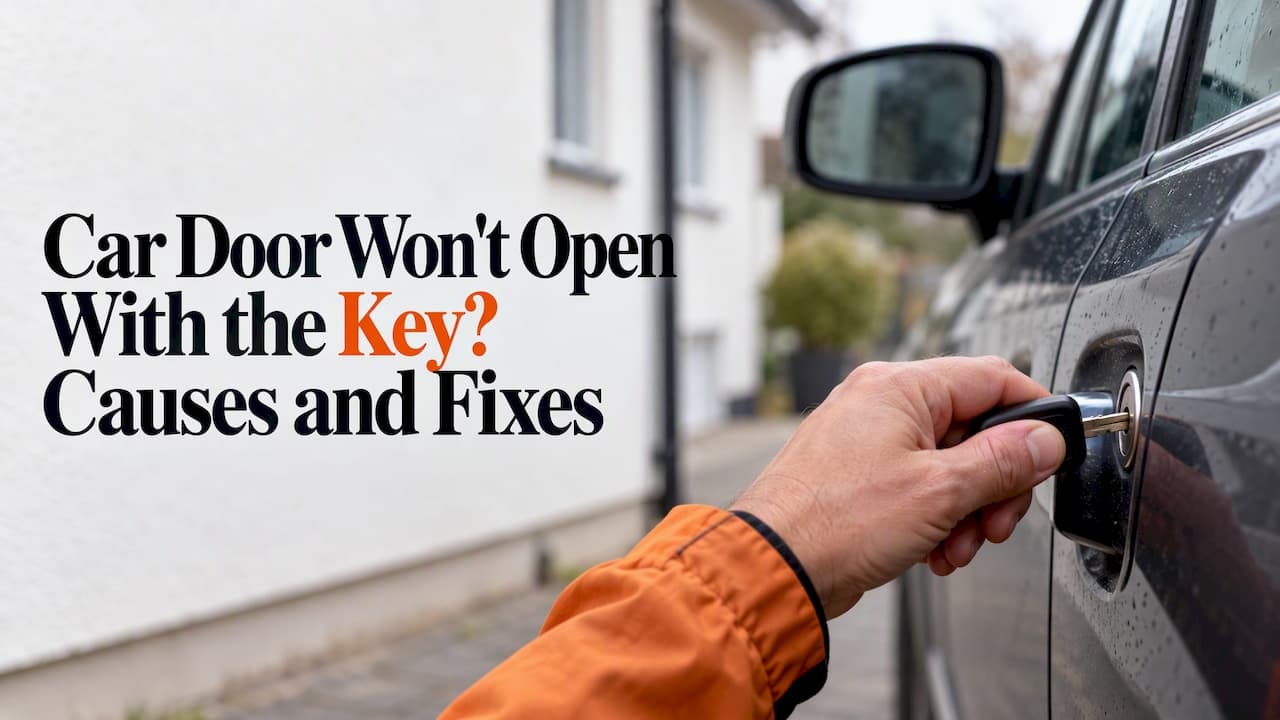
If your car door won't open with the key, the cause is nearly always one of five things: a flat key fob battery, a flat car battery, a worn key blade, a dirty or frozen lock, or a fault inside the door (a lock actuator, linkage or latch). You can check the first four yourself in a few minutes. The fifth usually needs a professional, and the sooner you stop forcing the key, the cheaper the fix will be.
This guide takes you through the checks in the order that saves most time, explains what each symptom means, and tells you when to stop and call a mobile locksmith. We cover drivers across Essex and Hertfordshire, so we also say what to expect if you call us.
TL;DR
- Try your spare key first. If it works, the problem is the worn or damaged key. If neither works, the problem is the lock, the door or the car's electrics.
- Many modern cars hide the keyhole under a plastic cover on the door handle. Check that you are not looking for a lock that is not visible.
- Never force or wiggle a key that has stopped turning. A snapped blade inside the lock turns a small job into an extraction job.
- If the key turns but the door still will not open, the fault is usually in the latch or linkage, not the key.
- We come to you in Essex and Hertfordshire, typically within 30 to 60 minutes, and call-outs start from £120.
Table of Contents
- Start with what the key and the car are telling you
- Check the key and fob before the lock
- When the key won't turn
- When the key turns but the door won't open
- When every door fails at once
- What not to do
- Our view on door lock faults
- When the problem is the key itself
- When to call a mobile locksmith
- How we can help in Essex and Hertfordshire
- What to have ready when you call
- FAQ
- Sources
Start with what the key and the car are telling you
The symptom narrows the cause faster than any tool. Before you touch anything, work out which of these describes your car.
| What happens | Most likely cause | First thing to try |
|---|---|---|
| Fob buttons do nothing, no lights, key blade fits but door stays locked | Flat fob battery or flat car battery | Use the hidden key blade in the door, check dashboard and interior lights |
| Key goes in but will not turn | Worn blade, dirt in the lock, frozen lock, or damaged cylinder | Try the spare key, clean and de-ice gently |
| Key turns freely with no resistance, nothing happens | Broken tailpiece or disconnected linkage | Try the other doors, then call a locksmith |
| Door unlocks (you hear it) but will not open | Stuck latch, bent linkage or child lock fault | Pull from the inside handle if you can reach it |
| Only one door fails | Local actuator or linkage fault | Use another door, book a lock repair |
| Every door fails together | Electrical issue: battery, fuse or central locking module | Check battery first |
If you want a quick rule: one door failing points to the door, every door failing points to the car's power or the key.
Check the key and fob before the lock
Try the spare
The single most useful test is a second key. If the spare works, the lock is fine and your main key is worn, bent or has a damaged transponder or fob. If neither key works, the fault sits in the lock, the door or the electrics. This is the same logic locksmith troubleshooting guidance uses: isolate the cause before replacing anything.
A worn key blade is common on keys that have been in daily use for ten years or more. Look at the cuts: rounded edges, shiny flattened patches or a slight bend all mean the key no longer lifts the lock's wafers properly. A copy cut from a worn key inherits the wear, so a freshly cut key from a worn original often fails too. Cutting from the lock's code, or making a new key properly, avoids that.
Flat fob battery
If your remote does nothing, the fob battery is the first suspect. The RAC says the most common key fob problem is a battery that has run out of charge and needs replacing. A coin cell costs a few pounds and the fob usually opens with a small screwdriver or coin.
Bear in mind that a dead fob battery does not stop the mechanical key working. It only stops the remote. If the remote is dead and the mechanical key also fails, you have two separate problems, or one lock problem you were masking by relying on the remote for years. Locks that are rarely turned with the key often seize or fill with grime without you noticing.
Find the hidden keyhole
Many newer cars, especially with keyless entry, have no visible keyhole at all. The mechanical key lives inside the fob, and the cylinder sits under a plastic cover on the driver's door handle. Hyundai's owner's manual describes the usual method: pull the handle, press the release button inside the cover with the mechanical key, then ease the cover off to expose the key cylinder. Other makes differ in detail, but the principle is similar: a small slot under the cover takes the key blade.
Check your owner's handbook for your exact model. If you do not have the paper copy, most manufacturers publish it online.
When the key won't turn
Dirt and wear in the keyhole
Grit, pocket lint and old grease build up in a keyhole over the years. CarParts.com lists a contaminated keyhole and a lock that needs lubricant among the common reasons a manual key stops working. A short burst of a dry lock lubricant or graphite-based product, not general-purpose oil, often frees a sticky lock. Work the key in and out gently rather than turning hard.
Frozen locks
From November to March in Essex and Hertfordshire, a frozen lock is a realistic cause, especially after wet weather followed by a clear night. A lock de-icer spray is the safe fix. Warming the key briefly with a lighter or your hands can help. Do not pour hot water on the lock or door: it refreezes quickly, damages paint and seals, and can leave you worse off.

Also check the door seal. A door frozen to its rubber seal feels like a locked door. Push firmly on the door with your palm, then try the handle again.
Stop before you snap it
This is the most expensive mistake we see. When a key sticks, forcing it can snap the blade, leaving part of it in the cylinder. Guidance from locksmith diagnostic advice warns that forced turning can break blades and require costly extraction. If the key resists after a gentle try, stop, and use another door or the spare.
When the key turns but the door won't open
This is the version most people struggle to search for, and it is a different fault from a stuck lock.
If you hear the lock click and the door still will not open, the lock has done its job. The problem is further along: the latch, the exterior handle linkage, or a child lock engaged on a rear door.
- Try the inside handle. If you can open another door and climb in, pull the inner handle of the stuck door. Some cars unlock on the first pull and open on the second, as Hyundai's guide describes for its models.
- Check the child lock on rear doors. It disables the inside handle and is easy to switch on by accident.
- Lift the exterior handle while pushing the door inward, then release. A latch under tension sometimes needs the load taken off.
- Do not pry the door. Prising bends the skin and rarely frees the latch.
A manufacturer service bulletin (an example is here) lists a door that will not open from either handle, or will not unlock with the fob or switch, as a recognised complaint with a repair procedure. It is a known type of fault, not a sign that you did something wrong.
Many of these faults are not mechanical failures at all. The cause can be a rod that has come off its clip, a loose connector or an actuator that needs resetting. A skilled technician can often repair that rather than replace the whole latch unit, which is why a diagnosis first is cheaper than ordering parts.
When every door fails at once
If the fob does nothing, the key will not turn the lock, and the interior lights stay dark when you open a door, suspect the car battery. A flat battery can stop central locking and, on some cars, the locks as well. Signs include a slow or clicking start the day before, a car left unused for weeks, or interior lights that were left on.
What helps:
- Unlock using the mechanical key in the driver's door, since that does not rely on power on most cars.
- Once inside, you may need a jump start or a battery charge before central locking responds.
- If the car has an alarm, it may sound when you open the door with the key. Starting the car, or pressing unlock on a working fob, normally silences it.
If the battery is healthy and all doors still refuse, check the central locking fuse in your handbook. A blown fuse is cheap to replace. If the fuse is fine, the central locking module or a wiring fault needs a diagnostic tool, not guesswork.
What not to do
- Do not use a slim jim or coat hanger. Videos online show it, but on modern cars it can damage wiring, airbag cables and window mechanisms in the door. It is also how people lock themselves out further.
- Do not keep trying the same key. If it did not work the third time, it will not work the tenth.
- Do not take the door card off unless you know where the rods and wiring run.
- Do not assume you need a tow. A towing truck to a dealership costs time and money, and many door and key faults can be solved where the car sits.
Our view on door lock faults
We spend our days on driveways, car parks and roadsides across Essex and Hertfordshire, and the pattern is consistent. People assume a failed lock means an expensive repair, so they delay. By the time they call, the key has often been forced and the blade has snapped, or they have tried something that has damaged the door.
Our advice is simple. Stop early. Test the spare. Then think about which of three situations you are really in: a key problem, a lock problem or a car-power problem. Each has a different solution and a different professional. Only the first two are locksmith work, and even a power fault often shows up first as a lock that will not respond.

There is also a point people do not expect. Dealership-level software and tools are now available to independent mobile locksmiths, so you do not have to have the car towed to the dealer to get a key programmed, an immobiliser reset or a lock module diagnosed. Our technicians are licensed, insured and SERMI-certified, and the vans carry diagnostic equipment so most jobs are finished at your location, typically within 30 to 60 minutes of arriving.
The SERMI scheme matters because it controls who may access vehicle security data. Industry explainers describe it as a Europe-wide certification scheme covering sensitive operations such as key programming and immobiliser resets, now going live in the UK. If you want the detail, we have written about what SERMI certification means for auto locksmiths.
— James
When the problem is the key itself
If the spare works and the main key does not, you probably need a replacement or a repair rather than a lock fix. Typical cases:
- Worn or bent blade: a new key, cut properly and programmed if the car has an immobiliser.
- Fob not recognised by the car: the transponder or remote needs programming. See our key programming service.
- Damaged fob casing or buttons: a repair or replacement of the fob.
- Key lost or stolen with no spare: an all-keys-lost job, which involves entering the car without damage, resetting the immobiliser and programming new keys. Our guide to fixing all keys lost in one visit explains the steps. For newer cars, the process generally requires SERMI-approved security access for vehicles from around 2019 onwards.
If your key was stolen, cutting a new one is not enough. The old key can still unlock and start the car until the immobiliser is reset. The same guide notes that cutting new keys does not invalidate the old ones. We offer stolen key deletion and reprogramming for exactly this situation.
For keyless cars, the fault might not be the lock at all. Our triage guide on keyless entry faults explains what to check before you call, and if the smart key is gone altogether, see lost smart key replacement without a tow.
One more habit worth building: keep keys away from the front door at home. Police crime prevention advice says to keep keys out of view and away from your front door, since thieves who can reach a key or fob can clone it.
When to call a mobile locksmith
Call rather than keep trying if any of these apply:
- The key is stuck, bent or partly broken in the lock.
- The key turns freely but nothing moves.
- You have tried the spare and it fails too.
- You are locked out with the keys inside. See our guide to what to do when keys are locked in the car.
- Only one door fails and the others work, so you suspect an actuator or linkage.
- It is late, you are on a road with traffic, or you have children or pets in the car.
What a mobile locksmith does differently is bring the equipment to the car. Non-destructive entry methods, the kind used by trained professionals, avoid damage to the lock or door and are done where the car is parked, so you skip the cost and hassle of a tow.
How we can help in Essex and Hertfordshire
We are a mobile auto locksmith serving Harlow, Chelmsford, Epping, Brentwood, Billericay, Ongar, Loughton, Braintree, Great Dunmow, Stansted, Sawbridgeworth, Bishop's Stortford, Ware and Writtle, plus the villages between. We handle cars and vans of all major makes.
What we can do for a door that will not open with the key:
- Lockout and non-destructive entry, from £120.
- Lock and ignition repair, from £120, for seized cylinders, worn locks and ignition faults.
- Key programming, from £120, when the key is the problem.
- Emergency call-outs, from £120.
A standard key starts from £120 and a remote key from £150, as listed on our Ford key page. Other work, such as key cutting, all-keys-lost replacement and van keys, is priced on the job, so call us with your make, model and year and we will tell you what to expect before we set off. You can also browse all our services.
What to have ready when you call
A few details save time and let us arrive with the right parts:
- Make, model and year of the car or van.
- What happens when you try the key: does it go in, does it turn, do you hear a click?
- Whether you have a spare, and if it behaves the same way.
- Whether the fob lights or buttons respond, and whether interior lights come on.
- Where the vehicle is, with a postcode or what3words style detail if it is in a car park or lay-by.
- Proof of ownership, such as the V5C or ID, because any reputable locksmith will ask for it before opening or programming a car.
FAQ
Why is my car door not opening with the key?
The usual causes are a worn or bent key, dirt or ice in the lock, a seized cylinder, or a fault further inside the door such as a broken tailpiece or disconnected rod. Try your spare key first. If it works, your main key is the problem. If neither works, the lock or door needs inspection.
Why won't my car door open even though it is unlocked?
When you hear the lock release but the door stays shut, the latch or the exterior handle linkage has usually failed, or a child lock is on for a rear door. Try the inside handle from another door, and do not pry at the door frame. A locksmith can often reconnect a rod or clip rather than replace the whole latch.
What should I do if my key won't turn in the door?
Stop forcing it. Try the spare, then a dry lock lubricant or de-icer if the weather is cold. If the key is stuck or the lock stays rigid, call a locksmith, because forcing it risks snapping the blade inside the cylinder.
Can a flat car battery stop the door opening with the key?
A flat battery stops the remote and central locking, but the mechanical key in the driver's door normally still works. If the key does nothing and the fob is also dead, look for the hidden keyhole under the handle cover, then jump start or charge the battery once you are inside.
Will I need to tow my car to a dealer if the lock is broken?
Usually not. A mobile locksmith with the right diagnostic tools can repair locks, reset immobilisers and programme keys at your location, so a tow is only needed if the damage goes beyond the lock or key system.
Sources
- Car Key Not Unlocking the Door? Causes and Checks
- Key fob not working? Here's what to do (RAC)
- Operating Door Lock/Unlock from Inside the Vehicle (Hyundai owner's manual)
- 7 Reasons Why Your Manual Key Won't Unlock the Car Door (CarParts.com)
- Door lock service bulletin (OEM DTC archive)
- SERMI UK Update: Security Access and What It Means for Independents
- Lost Your Car Keys? A UK Guide (MCR Car Key Solutions)
- Replacement car key services (Advanced Locksmiths)
- Preventing car and vehicle theft (South Wales Police)