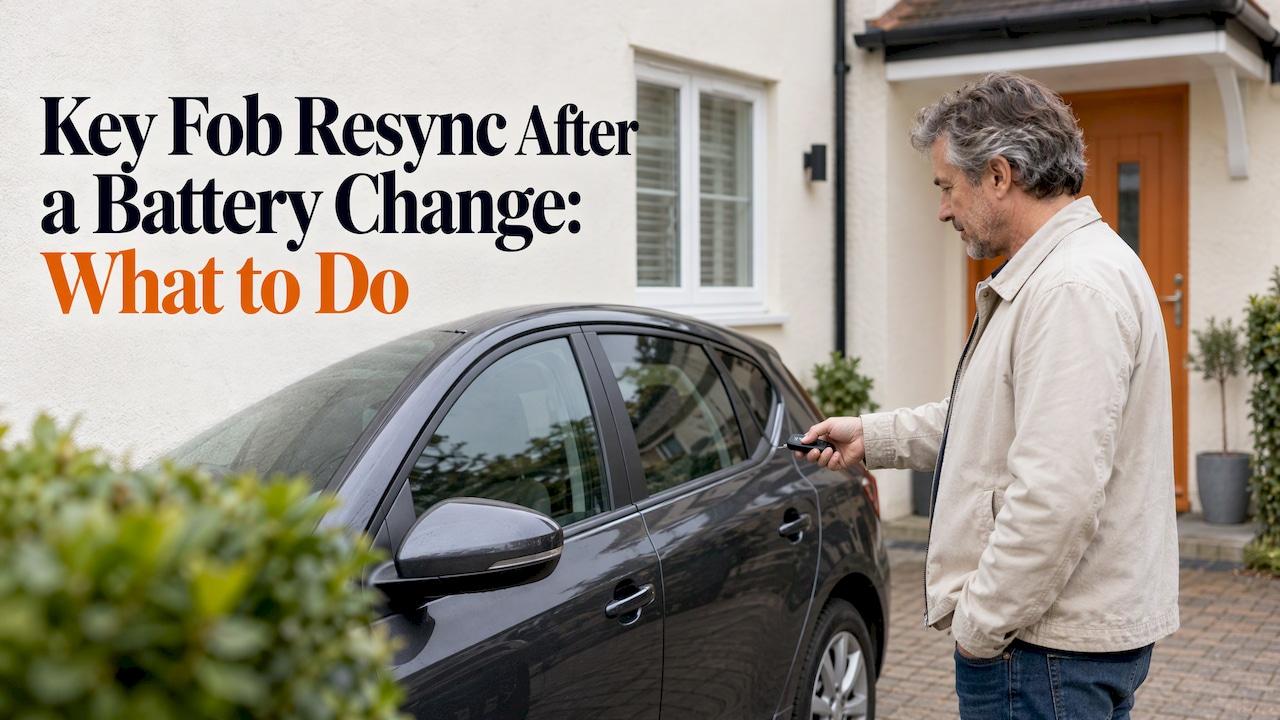
Most key fobs do not need resynchronising after a battery change, because the code that pairs the fob with your car is stored in the fob's memory, not held by the battery. A minority do lose sync, and for those the fix is usually a short sequence in your handbook. If the fob still fails after that, the cause is usually the battery itself, or the fob needs proper programming, which we do at your location in Essex and Hertfordshire.
This guide covers when a resync is needed, how the common procedures work, what to check before assuming the fob is broken, and when a fault is a programming job rather than a resync.
TL;DR
- On most cars a new battery just works. The fob's code sits in memory that does not depend on the battery.
- Some older or specific models, including certain Audi, VW Group, Renault, BMW, Ford, Toyota and Peugeot cars, can lose sync and need a short handbook procedure.
- If the fob is dead after the swap, check the battery type, the way round it sits and the contacts before trying any reset sequence.
- Repeating reset sequences will not fix a fob that needs programming. If it still fails, or all keys are lost, a mobile locksmith can programme a key on site.
- Our key programming starts from £120.
Table of Contents
- Does a key fob need resyncing after a battery change?
- Resync, reset or reprogram: what each word means
- Before you try any resync, check the basics
- Resync procedures by make: examples from official handbooks
- How to find the right procedure for your car
- Why a keyless or smart fob behaves differently
- When the fob still does not work
- Locked out because of the fob or the car battery
- Fob repair or a new key
- When we come to you
- Our view on key fob resyncs
- FAQ
- Sources
Does a key fob need resyncing after a battery change?
Usually, no. Maplin's guide to fob batteries says the code is held in permanent memory, so a battery swap does not affect the pairing with the car. A small number of older remotes can lose synchronisation, and the handbook procedure, often turning the ignition on and pressing a fob button, puts it right.
One UK repair-cost site puts it at roughly 95 times in 100 with no resync needed. It names some older Renaults, certain BMWs and a few Fords as the minority that can lose sync if the fob is without power for a while or buttons are pressed during the swap. Treat that as a rough guide, not a rule for your model. Your handbook is the real authority for your car.
Two things make a lost sync more likely:
- Leaving the fob without a battery for a long time. Car Problems notes a fob can occasionally lose synchronisation this way, and working quickly during the swap reduces the chance.
- Pressing buttons while the fob is out of range or unpowered. On rolling-code systems, where the code changes with each press, this can put the fob and car out of step.
So have the new battery ready before you open the fob, swap it in one go, and leave the buttons alone until it is closed.
Resync, reset or reprogram: what each word means
People use "resync", "reset" and "reprogram" for the same problem, but they describe different jobs.
Resynchronising means the fob and car already know each other, but their rolling code has drifted apart. You are re-aligning them, usually with a button and key sequence that needs no tools. The Audi and Cupra procedures below are examples.
Programming means teaching the car a key it has not met before. That covers a replacement after loss, a spare, or a fob whose electronics have been replaced. It needs diagnostic equipment that talks to the car's immobiliser (the anti-theft system that stops the engine starting without a recognised key). A button sequence cannot do this.
The practical difference: a resync costs you a few minutes and a handbook. Programming is a job for equipment. If a resync sequence fails twice, you are probably looking at programming or a fault, not a better sequence. Our guide to keyless fob programming in the UK explains how that process and its costs work.

Before you try any resync, check the basics
The most common reason a fob fails after a battery swap is not lost sync at all. Run through these first.
- Battery type. Fobs use specific coin cells such as the CR2016 or CR2032. The Peugeot 107 handbook names a CR2016 3-volt cell, for example. A thicker or thinner cell can sit loosely and lose contact.
- Polarity. The battery must go in the right way up. The Jaguar XF handbook says to fit its CR2032 with the positive side downwards. Yours may differ, so note the orientation before you remove the old cell. Haynes lists reversed polarity as one of the simplest reasons a Toyota fob fails after a swap. The Cupra handbook goes further and warns that an unsuitable battery or incorrect polarity can damage the key.
- Skin contact. The Jaguar handbook advises avoiding touching the new battery, because moisture or oil from fingers can shorten its life and corrode contacts. Hold it by the edges.
- Contacts and housing. Look for bent or dirty metal contacts, and check the two halves of the case have clicked fully shut.
- A faulty new battery. Cells bought loose or kept for years can be flat. Try a fresh one from a sealed pack.
If the fob works after this, you did not need a resync. If the dashboard still shows a low-battery warning, the cell may not be seated properly.
Resync procedures by make: examples from official handbooks
Procedures vary by make, model and year. The examples below show the pattern. They are not a substitute for your own handbook, which is the only source for your car's exact sequence.
Audi
Audi's 2024 technical service bulletin (MC-10253261, published on the US safety regulator's site) says central locking can fail after the remote battery is replaced, or after the key has been used several times out of range. It gives two patterns:
- For the A3 (8P and 8V), A6 (4B), R8 (4S) and TT (8J): press a button, lock or unlock the car mechanically with the key, then press a button again, all within 30 seconds.
- For the A4 (8K), A5, Q5 (8R), A8 (4H) and A6/A7 (4G): press a button, open with the emergency key if needed, then switch the ignition on and off.
If synchronisation fails, the bulletin says to check for interfering transmitters before the key is adapted to the central locking system. Our Audi key programming guide covers the DIY remote sync and when a transponder needs professional help.
Cupra, VW, Skoda and Seat
The Cupra Formentor owner's manual says that if the button is pressed often outside the car's range, the key must be resynchronised. Remove the key blade, press the unlock button (the key must stay with the car), then open the car with the blade within one minute.
ServiceTutorials gives two methods for 2016 to 2024 VW Golf, Passat, Skoda and Seat models. Either press unlock twice quickly next to the car, or press unlock once while holding the key close and unlock the driver's door manually with the blade within one minute. It says that if neither works, the key may need programming with a diagnostic tool.
Peugeot and Toyota
The Peugeot 107 handbook says that if the remote does not work after a battery change, it must be reprogrammed. In that case, follow the sequence in the handbook for your year. Haynes notes that some Toyota models can lose synchronisation after a battery change, with the steps in the owner's manual.
Hondas and others
The common thread in these procedures is a combination of ignition position, a button press and a time limit. Some Honda models use a sequence involving the ignition and a fob button, for example. Do not borrow a sequence from a different make, model or year. A wrong sequence at best does nothing, and at worst it can stop the car accepting a fob that was working.
How to find the right procedure for your car
- Open the handbook. Look under "keys", "remote control" or "central locking", and search for "synchronise" or "initialise". Many manufacturers publish the handbook as a PDF.
- Note your exact details. Make, model, year and key type (a flip key, a plain remote key or a keyless smart fob). A sequence for one does not suit the other.
- Do the sequence once, calmly. Watch the time limits. Many procedures allow only 30 seconds or a minute between steps.
- Stand away from interference. The Audi bulletin points to interfering transmitters as a cause of failure. Move the car away from other radio sources and try again.
- Test every function. Lock, unlock, boot release and, if fitted, the panic button.
If the manual lists no resync procedure, that is informative: it means the fob should not need one, and a failure is down to the battery, the fob or the car.
Why a keyless or smart fob behaves differently
If your car starts with a button and you never use a key blade, your smart fob may show a different symptom: "key not detected" or the car refusing to start, even though the fob unlocks the doors. That is less often a sync problem than a weak battery or a signal issue. Many smart fobs also contain a physical emergency blade and a spot on the car, often near the start button or in a cup holder, where the fob can be held so the car reads it at very short range. Your handbook shows where.
Our smart key not detected checklist goes through the checks that can save a tow, and our keyless entry triage guide covers the fixes that a mobile locksmith can do on site.
When the fob still does not work
Work through this order. Each step rules out a cause before you move to something that costs money.
| Symptom | Likely cause | What to do |
|---|---|---|
| Nothing happens, no light on the fob | Battery flat, wrong way round or loose | Re-seat or replace the cell, check polarity |
| Fob lights up but the car ignores it | Lost sync or interference | Follow the handbook resync once, away from other transmitters |
| Works close to the car, not at distance | Weak or poor-quality battery | Fit a fresh cell from a sealed pack |
| Unlocks doors but car will not start | Immobiliser not recognising the transponder | Needs diagnosis, possibly programming |
| Worked before, now dead after being opened | Damaged contacts or circuit board | Fob repair or replacement |
| All keys lost or one broken | No working key to resync | Needs a new key programmed |
If the first three rows do not solve it, stop repeating sequences. Our key fob not working guide walks through three quick checks, and our remote key repair guide explains when a fob can be repaired, re-paired or needs replacing. If the car will not lock with the fob, see our guide to cars that will not lock with the key fob.
The same applies to transponder keys. If the key opens the door but the engine will not start, see our guide on a transponder key that is not working for the checks to run first.
Locked out because of the fob or the car battery
Sometimes the fob problem arrives with a lockout: the fob is dead, the car is locked, and the key blade is in the fob you cannot use. Most fobs hide a mechanical key that opens the driver's door, as the Cupra procedure above shows. If that is not possible, or the car battery is also flat, our guide to a dead car battery and being locked out explains how to get back in. We offer car lockout services from £120 if you need help on the spot.
Fob repair or a new key
A fob that has been dropped, soaked or opened roughly may have damaged contacts or a cracked board. In that case no battery or resync helps. The choice is between repairing the fob and having a new one made and programmed. We list key fob repair and replacement among our services, with a standard key from £120 and a remote key from £150.
For vans, the same logic applies. A commercial vehicle off the road costs a working day, so on-site help matters more than it does for a car that sits on a drive. We cover van key replacement as well.
When we come to you

If you have tried the handbook resync and the fob is still dead, you have probably moved from a resync problem to a programming problem. That is where our mobile service helps. We bring the equipment to you in Harlow, Chelmsford, Epping, Brentwood, Bishop's Stortford, Braintree and the surrounding parts of Essex and Hertfordshire, so you do not need to tow the car to a dealership.
Our vans carry advanced diagnostic tools, and we aim to deliver dealership-level service on site, typically within 30 to 60 minutes. Our technicians are licensed, insured and SERMI-certified. SERMI is the scheme under which technicians are vetted to access the security data some modern vehicles require for key work.

Key programming starts from £120, and the same figure applies to our emergency callout fee. A standard key is from £120 and a remote key from £150. Not every service has a published price, so for a lost-all-keys job or a van, see our services or get in touch for a quote.
Our view on key fob resyncs
We see a battery swap as a two-minute job that rarely goes wrong, and the advice that prevents most trouble is boring: know your battery type, note the orientation, swap quickly and leave the buttons alone.
The mistake we would steer you away from is treating every dead fob as a sync problem. A resync is a handbook sequence for a fob that the car already knows. Once that has not worked, a second and third attempt does not add anything. The fob needs to be checked, or the car needs to be told about a key it has not met, and that is programming.
That is why we come to you with diagnostic tools rather than ask you to tow the car away. Programming on the driveway or at the roadside saves the day a dealership visit takes, and our SERMI certification means we can work on modern, complex security systems. If your fob is dead after a battery change and the handbook sequence has not helped, a call to us is the shortest route to a working key.
James
FAQ
Do key fobs need reprogramming after a battery change?
Usually not. The code is held in memory that does not depend on the battery, so most fobs work straight away. A minority of models can lose sync, and these have a short handbook procedure. If that does not work, the fob may need programming with diagnostic equipment.
How do I reset a key fob after changing the battery?
There is no universal reset. Look in your handbook under keys or remote control for the sequence for your make, model and year. Typical patterns combine a button press, a manual unlock with the key blade or an ignition cycle, within a set time such as 30 seconds or one minute.
Why is my key fob not working after a battery change?
The commonest causes are the wrong battery type, a battery fitted the wrong way round, a flat new cell or dirty contacts. Check those first. If they are fine, try your handbook's resync sequence once. If the fob is still dead, it may need diagnosis or programming.
How much does it cost to have a fob programmed?
Our key programming starts from £120. A standard key starts from £120 and a remote key from £150. The final price depends on the job, so contact us with your make, model and year for a quote.
Can I resync a fob if I have lost all my keys?
No. A resync needs a working fob that the car already recognises. If all keys are lost, a new key has to be made and programmed to the car, which we can do at your location in Essex and Hertfordshire.
Sources
- Which Battery Does My Car Key Fob Need? (Maplin)
- Key Fob Battery: £3 DIY Job (My Repair Cost)
- How Do You Replace a Key Fob Battery? (Car Problems)
- Peugeot 107 keys and remote control guide
- Jaguar XF owner's handbook
- Toyota key fob not working after battery change (Haynes)
- Audi technical service bulletin MC-10253261
- Cupra Formentor owner's manual
- Resynchronise VW Golf, Passat, Skoda, Seat key fob (ServiceTutorials)