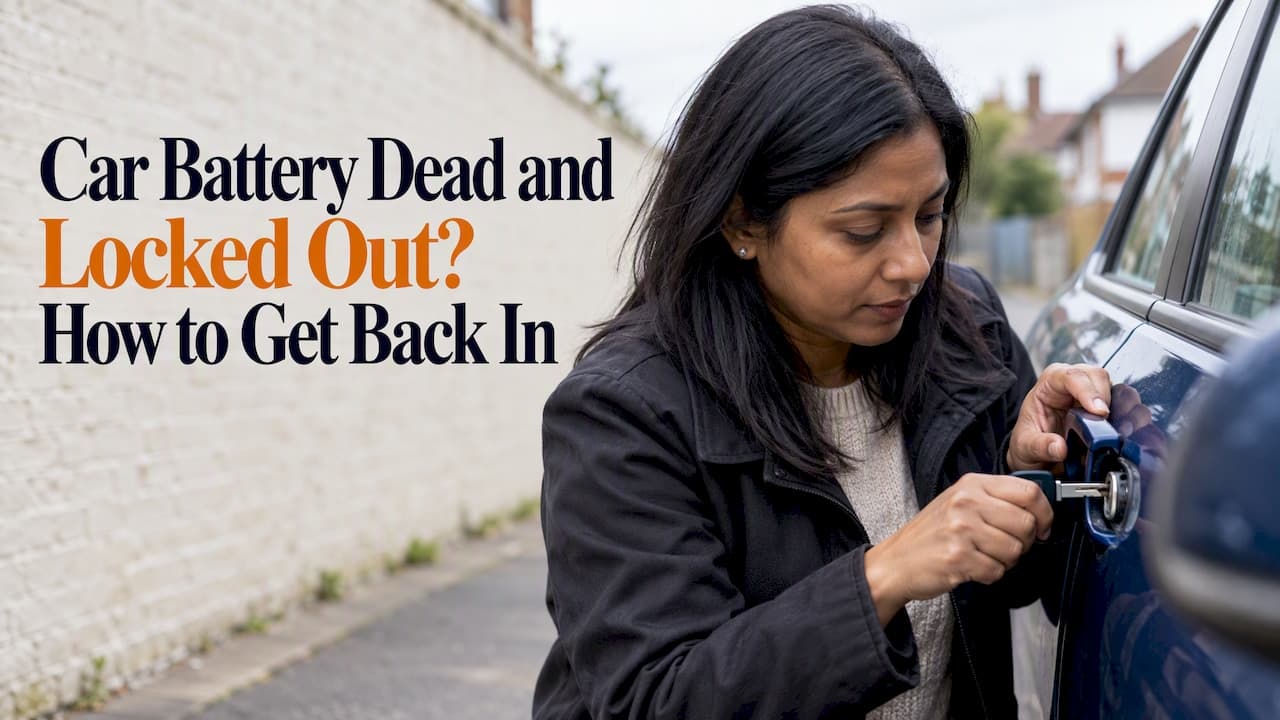
If your car battery is flat and the doors will not unlock, the way in is almost always the mechanical key hidden inside your key fob. Release the blade, find the lock cylinder on the driver's door (on many modern cars it sits behind a small plastic cover on the handle) and unlock the door by hand. If that fails, or the lock is damaged, a mobile locksmith can open the car without damaging it, usually at your location rather than a garage.
This guide walks through each step, explains the mistakes that turn a flat battery into an expensive repair, and tells you when to stop trying and call for help.
TL;DR
- A flat 12V battery stops the remote and central locking, but the mechanical key in your fob still works in the door lock.
- On many modern cars the lock is hidden under a plastic cover on the driver's door handle. Your owner's manual shows the exact method for your model.
- Do not connect jump leads to the wrong terminals once you are in. Use the points the manufacturer specifies.
- If the key will not turn, the lock is damaged or there is no visible cylinder, stop forcing it and call a mobile locksmith.
- We cover Essex and Hertfordshire with mobile vans, and non-destructive entry is part of what we do.
Table of Contents
- Why a flat battery locks you out
- Step one: use the key hidden inside the fob
- Finding the lock when there is no visible keyhole
- When the key will not turn, or there is no lock at all
- Once you are in: do not make the battery problem worse
- Fob battery or car battery: a quick comparison
- If you are locked out somewhere unsafe
- What we do differently
- Perspective: why a flat battery lockout is rarely about the battery
- Getting help from Autokeymaker
- How to avoid the next lockout
- FAQ
- Sources
Why a flat battery locks you out
Modern car doors are locked and unlocked electrically. Press the button on your fob and a signal tells the car to release the locks, which needs power from the 12V battery. When that battery is fully discharged, the car cannot respond.
Toyota explains this plainly: a remote or smart entry system can fail because the key's own battery or the vehicle's 12V battery is depleted, or because of signal interference, and a fully discharged 12V battery can stop smart entry and other electrical functions from working normally (Toyota UK Help Centre). Renault adds that other devices on the same frequency, or a high-electromagnetic-radiation area, can also cause remote entry to fail, and advises using the key in those cases (Renault user manual).
So there are really three different problems that look the same from the pavement:
- The fob battery is flat, but the car battery is fine.
- The car battery is flat, but the fob is fine.
- Both are fine, but interference is blocking the signal.
A quick test tells you which one you have. If the fob's light does not come on when you press a button, suspect the fob battery. If the fob light works but the interior lights and dashboard are dead once you are inside, suspect the car battery. Our own guide on fixing a key fob in three quick checks covers the fob side in more detail.
Step one: use the key hidden inside the fob
Most people with keyless or remote fobs have never used the metal key inside. Motor1 describes it as a backup for the moment the electronics fail (Motor1), and Consumer Reports notes that many owners do not realise their fob contains one and advises learning how to use it before you are locked out (Consumer Reports).
The general process:
- Look at your fob for a small switch, button or slider. Slide or press it and pull out the metal blade.
- Take the blade to the driver's door and find the lock cylinder (see the next section).
- Insert the key and turn it to unlock. On some cars you may need to turn it twice, or hold it, to unlock all doors.
- Open the door. Be prepared for the alarm to sound, because the car will see the door opened without a recognised fob signal.
Ford's own advice for a completely flat battery is to use the mechanical key blade in the fob to unlock the driver's door (Ford UK). Toyota says the same for its smart key: if smart entry is unavailable because the 12V battery is fully discharged, remove the mechanical key and unlock the vehicle manually (Toyota UK Help Centre).
The alarm is worth a moment's thought. If it goes off, do not panic. Once you are in and the car has power, or the fob is recognised, it normally stops. If it keeps sounding, our guide to six emergency fixes for starting a car with a dead key fob explains what to try next.
Finding the lock when there is no visible keyhole
This is where most drivers get stuck. Many newer cars have no obvious keyhole, because the manufacturer has hidden it for a cleaner look.
On many modern Ford models, the lock cylinder is in the driver's door handle behind a small plastic cover, which you can pop off using the mechanical key blade (Ford UK). The cover usually sits on the underside or rear end of the handle, so run your fingers under the handle and look for a small slot or seam.
A sensible way to do it:
- Slide the blade into the slot at the cover's edge and gently lever it away from the handle. Do not force it, because cheap plastic caps crack.
- Keep hold of the cap. It often clips back on afterwards.
- Insert the key into the exposed cylinder and turn it.
Ford is clear that the key-release button and related instructions are specific to the vehicle, and tells owners to consult the owner's manual (Ford UK). That is true across makes. A Volkswagen, a Vauxhall and a Toyota can each hide the cylinder somewhere different. If the manual is locked in the glovebox, search for the model's name plus "owner's manual" on the manufacturer's UK site.
If you drive a Ford and want a spare key or a fob replacement before this ever happens, our Ford key replacement page lists what we offer for the make.
When the key will not turn, or there is no lock at all
Sometimes the mechanical route does not work. The usual reasons are:
- The key blade is worn or bent. A key that has been in a pocket for years can stop engaging the lock wheels cleanly.
- The lock is stiff, seized or damaged. Dirt, corrosion, or a previous attempted break-in can leave a cylinder that will not turn.
- The cylinder is on a different door or only works for some functions. Some cars have the cylinder only on the driver's door, and a few only unlock that one door.
- The car has deadlocked. Some cars have a second locking mode, often called deadlocking or superlocking, which stops the door being opened from inside and sometimes changes how the exterior lock responds.
- The key in your hand is not the right one. A spare that has been cut but never programmed may open the door but not start the car.
Whatever the cause, the rule is the same: stop forcing it. Pushing a coat hanger or a wedge into the door frame can bend the weatherseal, scratch paintwork or damage the wiring inside the door, all of which cost far more than a call-out. If you are in this situation, our article on what to do when the car door will not open with the key explains the likely causes in more depth.
A mobile locksmith can use non-destructive entry methods that open the car without drilling the lock or breaking glass. For a car that is deadlocked with a flat battery, that is often the quickest answer, and it avoids a tow. Our page on locked keys in the car explains how that works in practice.
Once you are in: do not make the battery problem worse
Getting through the door is only half the job. The battery is still flat, and how you deal with it matters.
Check where to connect jump leads
It is tempting to clip leads straight onto the battery terminals, but on many cars the battery is hidden, relocated or fitted with a protection system. Ford advises against assuming one procedure fits every car and points to the owner's manual (Ford UK).
The Financial Ombudsman Service looked at a case where a driver used the vehicle's battery terminals rather than the manufacturer's recommended engine-bay terminals. The Ombudsman said this bypassed a protection system and introduced a risk of physical damage to a sensitive module, though the cause of the failure could not be determined (Financial Ombudsman Service decision DRN-5729338). It is one case, not a rule for every car, but it shows why the manual's connection points matter.
Volvo is even more specific for its EX90. If the 12V battery is flat, the electrically operated locks cannot unlock the car, and a special external 12V terminal can temporarily power it for access and charging. Volvo also warns that reversing the polarity of the low-voltage system can damage components or blow the 30 A fuse (Volvo Cars UK). Hybrids and electric cars have a small 12V battery that behaves differently, so read the guidance for your own model.

Starting with a flat fob battery
If the car battery is fine and only the fob is flat, getting in is not the end of it. After unlocking, some modern cars require you to hold the fob near the start button, or place it in a backup slot, before they will start (Mr Tyre). Where that spot is varies by make, so check the manual. If the car still does not recognise the key, see our guide to a smart key that is not detected.
Fob battery or car battery: a quick comparison
| Symptom | Likely cause | First move |
|---|---|---|
| Fob light does not flash, but the car is otherwise fine | Fob battery | Use the hidden key, then replace the fob battery |
| Fob light works, but no response from the car, dead interior lights | Car 12V battery | Use the hidden key, then charge or jump using the manual's points |
| Fob works elsewhere but not here | Signal interference | Move away from the source and try again |
| Key goes in but will not turn | Worn key or damaged lock | Stop and call a locksmith |
| No visible keyhole and no cover found | Hidden cylinder | Check the manual before prying anything |
The first two rows are the ones most drivers hit. If the fob keeps failing even with a fresh battery, the problem may be the fob itself, and our keyless entry triage guide explains how to tell.
If you are locked out somewhere unsafe
A flat battery can strand you in an awkward place: a car park at night, a lay-by, a petrol station forecourt. The safest approach depends on where you are.
On a motorway, do not try to fix anything yourself. THINK! advises motorists whose vehicle breaks down to use an emergency area where possible, switch on hazard lights and contact their breakdown recovery service. If it is not safe to leave the vehicle, stay inside with your seatbelt fastened, and dial 999 if you feel your life is in danger (THINK!). A flat battery on a motorway usually means a breakdown rather than a lockout, so you will probably be inside the car anyway.
On ordinary roads, park as safely as you can before the battery fails if you notice warning signs such as slow cranking, dim lights or a clicking noise. Roadside workers also face real danger from passing traffic, according to a Department for Transport-commissioned evidence review (Department for Transport evidence review), so stay well back from the carriageway while you wait.
If children or pets are inside the locked car, or it is very hot or cold, treat it as an emergency and call 999 rather than waiting for a locksmith.
What we do differently
This is where we come in. We are a mobile auto locksmith serving Essex and Hertfordshire, including Harlow, Chelmsford, Epping, Brentwood, Billericay, Bishop's Stortford, Braintree, Great Dunmow, Ongar, Loughton and Ware. Our vans carry diagnostic tools, so most work is done where the car is parked, typically within 30 to 60 minutes, rather than on a tow truck to a dealership.
Our technicians are licensed, insured and SERMI-certified, and they are experienced with modern, complex vehicle security systems.
Perspective: why a flat battery lockout is rarely about the battery
In our experience, the battery is the trigger, not the real problem. Most people who call us have never used the hidden blade in their fob, or have a key that has not been turned in a physical lock for years. When the electronics fail, the mechanical backup suddenly matters, and it turns out to be stiff, worn or hidden under a cover nobody has opened.
Our advice is simple. Take your fob apart on a quiet afternoon, release the blade, find the cylinder on your door and try it once. Do it before you need it. If the key sticks, have it checked while you still have a working remote, because replacing a worn key is far easier than recovering from all keys lost.
We also see drivers cause expensive damage by forcing a door or jump-starting at the wrong points in a panic. A calm call to a locksmith who can open the car without marks is cheaper than a new door seal, a damaged module or a trip to the dealership.
— James
Getting help from Autokeymaker
If the hidden key does not work, or you would rather not risk your paintwork, we come to you. Our car lockout service starts from £120, and our emergency callout fee is from £120 (emergency services). If the lock itself is the problem, our lock and ignition repair service also starts from £120.

If you need a new or spare key after the lockout, key programming is from £120, and for Fords a standard key starts from £120 and a remote key from £150 (Ford keys). We also handle van keys, all keys lost replacements and stolen key deletion and reprogramming, all listed on our services page. Prices vary by vehicle, so ask for a quote before we come out.
How to avoid the next lockout
A few habits make a repeat unlikely:
- Replace the fob battery on a schedule. If your fob has been in use for two or three years, change the coin cell before it fails.
- Know where your hidden key is. Check the owner's manual and test it once.
- Watch for early warning signs. Slow starts, dim interior lights and a clicking starter all point to a weak 12V battery. Short, infrequent journeys can leave the battery undercharged.
- Carry a spare. A spare key kept at home, not in the same bag, saves a lot of trouble. If you do not have one, a programmed spare is a sensible investment.
- Do not rely on one fob. If you only have one working key, getting a second cut and programmed is far cheaper than an all keys lost job.
More guides on keys, fobs and lockouts are on the Auto Key Maker blog.
FAQ
Can I unlock a car with a dead battery without the key?
Not easily. With the battery flat, the electric locks cannot work, so the mechanical key in your fob is the normal route. If you have no key with you, a locksmith can use non-destructive entry methods. Avoid forcing the door or window yourself, because the repair often costs more than the callout.
Will a dead key fob battery stop the car starting?
It can. Toyota says a depleted key battery may stop smart entry from working (Toyota UK Help Centre). Some cars let you start them by holding the fob close to the start button or placing it in a backup slot (Mr Tyre). Check your manual for the exact spot.
Why can't I open my car with my remote key?
The usual causes are a flat fob battery, a flat car battery or signal interference (Toyota UK Help Centre). Use the hidden mechanical key to get in, then work out which one it is. If a fresh fob battery does not fix it, the fob may need repair or reprogramming.
Is it safe to jump-start a car once I get in?
It can be, if you connect the leads where the manufacturer says. Using the wrong terminals has been linked to damage to protection systems and sensitive modules, and reversed polarity can blow fuses (Volvo Cars UK). If your manual is unclear, ask a breakdown service or locksmith.
What if the hidden key will not turn in the lock?
Stop and do not force it. The key may be worn, or the lock stiff or damaged. A mobile locksmith can open the car without damaging it, and can repair the lock or cut and programme a new key afterwards.
Sources
- Should I jump start my Ford vehicle battery? (Ford UK)
- Toyota UK Help Centre
- EX90 powerless or unresponsive car (Volvo Cars UK)
- Financial Ombudsman Service decision DRN-5729338
- Operating faults (Renault user manual)
- Your car has a hidden mechanical key (Motor1)
- Your car's key fob may have hidden features (Consumer Reports)
- How to unlock your car when the key battery is dead (Mr Tyre)
- Vehicle safety checks (THINK!)
- Use of red flashing lamps on roadside recovery vehicles: evidence review (Department for Transport)