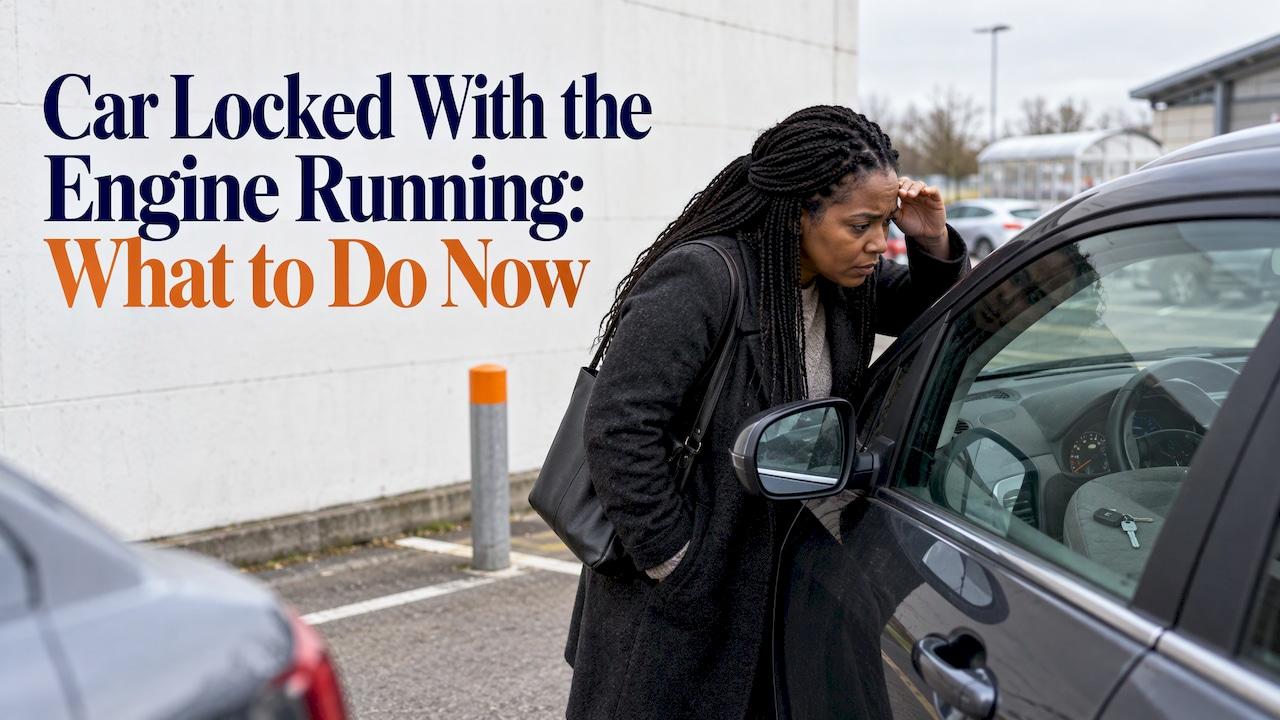
If your car is locked with the engine running and the keys inside, first check whether anyone, a child or a pet, is in the car or whether the car is in a dangerous spot. If so, call 999. If not, switch to a calm plan: try any spare key or manufacturer app, then call a mobile locksmith or your breakdown provider. Don't force a door or smash a window. The engine can keep running while you wait, and a professional can usually open the car without damage.
We cover Essex and Hertfordshire, and this is one of the more stressful lockout calls we get. The good news is that the situation is common and fixable. Here is how to handle it, step by step.
TL;DR
- Check for people or animals inside first. If anyone is at risk, or the car is blocking a live lane, call 999.
- Try the quick options: a spare key, a manufacturer app, or the fob's own mechanical key if you have it with you.
- Don't break a window or force the door. Non-destructive entry is usually quick and leaves the paintwork, seals and electrics alone.
- Call a mobile locksmith or your breakdown provider. Our vans reach most of Essex and Hertfordshire, typically within 30 to 60 minutes.
- Stay nearby and visible, because a car left running and unattended is a theft risk and may breach the law.
Table of Contents
- First, check whether this is an emergency
- Why a running car is a different kind of lockout
- Can a car really lock itself with the engine on?
- What to try before you call anyone
- Why you shouldn't force your way in
- Your two main routes to getting back in
- What happens when we arrive
- What it costs
- Perspective: why we always advise a professional entry
- Need help now? Call us
- While you wait: stay safe and visible
- How to avoid it happening again
- Vans and commercial vehicles
- FAQ
- Sources
First, check whether this is an emergency
Before anything else, look through the windows. Is there a child, a baby or a pet inside? Is it a hot day? Is the car stuck somewhere unsafe, such as a live lane?
The RAC says you shouldn't call 999 unless you, your passengers or pets are in immediate danger. It adds that a hazardous situation, such as a vehicle trapped in an active lane or people trapped inside on a hot day, may justify contacting 999. The AA makes a similar point: police or fire crews might not be able to retrieve keys without causing damage, but they may be the best option in a real emergency, such as a baby or pet in a hot car.
So the rule is simple. If a life could be at risk, make that call and don't worry about the paintwork. If not, you have time to do this properly.
Why a running car is a different kind of lockout
A normal lockout means the car is parked, silent and secure. A running car adds three problems.
The car is exposed. Police.uk explains that leaving a vehicle running unattended, for example while de-icing, is illegal, and an insurer won't pay out if it is stolen. Your car is locked, which helps, but a running engine still makes it an attractive target if you wander off.
There is a legal angle. Regulation 107 of the Road Vehicles (Construction and Use) Regulations 1986 says that a vehicle left on a road must be attended by a person licensed to drive it, or have its engine stopped and any required parking brake set, with limited exceptions. In practice, this means you should stay with the car until help arrives. Don't leave it unwatched while you go and fetch a spare.
Fumes and fuel. A running engine burns fuel and produces exhaust. If your car is in a garage or a closed car port, the risk of carbon monoxide builds up. NHTSA, the US vehicle safety regulator, notes that leaving an engine active in a closed environment increases the risk of carbon monoxide poisoning. If the car is in a garage, open the garage door fully and keep well clear of the exhaust.
A running car also tells you something useful: the key is still being recognised. On many modern cars, the engine keeps going until you switch it off or the key leaves the car. Volkswagen, for example, says that if the key is removed while the engine is running, an amber "key not in vehicle" light comes on and the engine cannot be restarted. That matters later, and we come back to it below.

Can a car really lock itself with the engine on?
Yes, and it is usually down to one of a handful of causes. We see these most often.
- Auto-lock settings. Many cars lock the doors once you pull away, or after a set time if no door has been opened. If you leave the engine running, step out and close the door, some cars will lock after a short delay.
- Pressing the lock button as you step out. If you hold the keys and the central locking button at the same time, you can lock the car while the keys stay inside on a seat or in the door pocket.
- Keyless entry quirks. With a keyless system, the car may lock when you walk away with the fob, then you realise the fob is still in the cabin, or the other way round. A weak fob battery can make this more confusing. The RAC notes that a flat fob battery is the most common reason a fob stops working, while the car can still start because it recognises the key at close range.
- A child or passenger pressing the lock. It happens more than you would think.
If your car locks itself repeatedly, check the owner's handbook for the auto-lock setting. Many cars let you turn it off in the settings menu or by a button sequence. If you can't find it, we can help when we're on site.
What to try before you call anyone
Take a minute for these checks. They cost nothing and work more often than people expect.
- Walk round every door and the boot. One may be unlocked, especially on older cars where a single door sometimes fails to lock.
- Look for a spare key. A family member, a neighbour or a work colleague may be able to bring it. Remember the rule about staying with the car if it is on a road.
- Check your phone for a manufacturer app. Carwow explains that many modern cars, such as those with FordPass or myAudi, have companion apps that can unlock the vehicle remotely, though this is typically only on newer models and only if it is already set up.
- Use the fob closer to the car. The AA advises that if you suspect radio interference is stopping your remote working, try using it closer to the vehicle. Cars with remote central locking should also have a bypass using the normal metal key.
- Try the mechanical key, if you have it. If you are carrying a separate key and the fob is inside, the door lock itself may still turn.
If none of those work, stop. The next step is professional help.
Why you shouldn't force your way in
It is tempting to grab a coat hanger, a wedge or a rock. Don't. Carwow warns against breaking a window unless there is a child, a pet or an immediate emergency, because DIY entry methods can easily cause costly damage or even injury. The AA also advises calling your breakdown provider, because taking emergency action yourself could damage your car.
A broken window or bent door frame costs far more than a locksmith callout. On modern cars, side-impact airbags, wiring and sensors sit inside the door. Prising a door can trigger fault lights, damage seals or leave a wind-noise problem you can't fix easily.

Your two main routes to getting back in
Your breakdown provider
If you have breakdown cover, check whether it includes lockout assistance. The RAC states that one of the best options is to call your breakdown provider, whose patrols will attend and try to get in, though you may still need a locksmith or garage. The AA adds that its patrols use specialist lock picks or entry tools to gain access.
This route is worth trying if your cover includes it and you are not in a hurry. Waiting times depend on demand, and a patrol may not have the tools to fix a key problem as well as the entry.
A mobile auto locksmith
A mobile locksmith comes to you with the right tools, and in our case a van equipped for diagnostics and key work. The AA describes the usual method: an air wedge and long-reach tool to press the interior unlock control in 5 to 15 minutes on most UK vehicles, without cutting, bending or scratching anything.
That matches how we work. Our non-destructive entry is designed to get you in without marking the car, and our technicians are licensed, insured and SERMI-certified. If you want to read more about the process, our guide to locked keys in your car and non-destructive help walks through it.
What happens when we arrive
Here is the sequence for a locked car with the engine running.
- We confirm the situation on the phone. We ask the make, model, year and exactly where you are, and whether anyone or anything is inside.
- We check the car is safe. If it is in a garage or enclosed space, we ask you to open the door and keep clear.
- We gain entry without damage. We use specialist entry tools and the interior release, so the lock, door seals and paint are left alone.
- You switch off the engine or we help you do so. Once inside, switch the engine off properly and make sure the car is in park or neutral with the handbrake set.
- We check the key and locks. If the central locking or the fob misbehaved, we can diagnose it on the spot.
Most jobs of this kind are over within the 30 to 60 minutes it takes us to reach you and complete the work.
What it costs
Our car lockout service starts from £120, and our emergency callout fee is also from £120. Price depends on the car, the time of day and the work needed, so ask when you call. Other work, such as key programming, is listed on its own page. Key programming starts from £120, and a standard key for Ford starts from £120, with remote keys from £150 (see our Ford key page).
Compare that with the alternatives. A tow to a dealer takes the car off the road for longer and adds recovery costs, while a smashed window brings glass, labour and sometimes trim repair. A quick, non-destructive entry is typically the cheaper route overall.
Perspective: why we always advise a professional entry
We get these calls most weeks. The driver has stepped out for a moment, the door has swung shut, and the car has locked itself with the engine ticking over. They are usually embarrassed, and they shouldn't be. It is one of the easiest mistakes to make.
What worries us is not the lockout. It is what people do in the first ten minutes: wedging the door with a screwdriver, trying a coat hanger, or wandering off to find a spare while the car idles on the road. Modern doors are full of wiring and airbag sensors. A few seconds of force can cost far more than the callout.
Our approach is to come to you with the tools and diagnostics a dealership would use, so we can get you in, check the key and locks, and leave the car exactly as we found it. We are licensed, insured and SERMI-certified, which means we are trained to work on modern security systems. If a key or fob is part of the problem, we can often sort that on site without a tow.
James
Need help now? Call us
If your car is locked with the engine running anywhere in Essex or Hertfordshire, our car lockout service is designed to get you back in without damage. If it is urgent, our emergency auto locksmith page explains how to reach us fast. We cover Harlow, Chelmsford, Epping, Brentwood, Billericay, Bishop's Stortford, Braintree, Great Dunmow, Loughton, Ware and the villages in between.

If the lockout has also left you with a lost, damaged or unreliable key, ask us about replacement and programming at the same visit. Our key programming service covers that, and our guide to what a locksmith can make on site shows what to expect.
While you wait: stay safe and visible
Carwow advises that while you wait, you stay somewhere safe and visible, stay comfortable and hydrated, and keep your phone charged. A few practical points for a running car:
- Stay within sight of the car. This protects it from opportunist theft and keeps you within the law on attended vehicles.
- Keep away from the exhaust. Especially if you are in a car park or garage.
- Don't leave the area. If you must move, tell the locksmith where you will be.
- Have the details ready. Registration, make and model, and your exact location help us arrive prepared.
- Be ready to prove ownership. A locksmith will normally ask for ID and proof the car is yours before opening it, which also protects you.
If it's cold or wet, use a nearby shop, café or covered bus stop that still has a clear view of the vehicle.
How to avoid it happening again
The AA's advice is straightforward: check for your keys before locking the car, keep a spare somewhere safe or with a family member, use the manufacturer's app as a backup where available, and use an eye-catching key chain. We would add a few habits.
- Switch the engine off whenever you leave the car. Even for a moment. It protects you from theft, fumes and fines, and means the car can't lock with the engine going.
- Pocket the key first. Make it a habit to take the key before you close the door.
- Check your auto-lock settings. If your car locks itself after a delay or on moving off, you can often change the behaviour in the vehicle menu.
- Keep a spare, and keep it safe. If you only have one key, get a spare made before you need it. Our guide on adding a key to your car's immobiliser explains the process.
- Replace worn fob batteries. A weak battery can make the car behave oddly with locking and unlocking. Our keyless entry triage guide covers typical faults.
- Set up the app. If your car supports a remote unlock app, set it up now, when you are calm, not on the pavement.
Vans and commercial vehicles
Van owners are hit hardest by a lockout, because every hour off the road costs money. A van with its engine running and the keys inside is a typical problem on delivery rounds, where drivers hop in and out all day. We handle van key replacement and lockouts across Essex and Hertfordshire. The same advice applies: switch off, take the key, and call us rather than forcing the door. A damaged van door can leave you with a vehicle that no longer secures properly, which is the last thing you need with tools or stock on board.
FAQ
Can you lock a car with the engine running?
On many cars, yes, though some refuse to lock with the key detected inside and beep instead. It depends on the make, the model and whether it has keyless entry. Auto-lock features can also lock the doors for you after a set time or when you pull away.
Will the engine keep running if the key is inside?
Usually, yes. Most cars keep running until you switch them off. On some keyless models, if the key leaves the car, a warning light appears and the engine can't be restarted once switched off, as Volkswagen's guidance shows. Stay with the car and switch it off once you are back inside.
Should I break a window to get in?
Only if there is a child, a pet or someone in immediate danger inside, in which case call 999. Otherwise, a locksmith can usually open the car without damage, and a broken window costs more than a callout.
Is it illegal to leave my car running while I wait?
Leaving a vehicle running and unattended on a road can breach Regulation 107, and your insurer may not pay out if it is stolen. If you can't switch it off, stay with the car until help arrives.
How quickly can a mobile locksmith reach me?
Our mobile vans typically reach customers in Essex and Hertfordshire and complete the job within 30 to 60 minutes. Actual times depend on your location and demand, so give us your postcode when you call.
Sources
- Locked keys in car | What to do, The AA
- What to do if you lock your keys in your car, RAC Drive
- Key fob not working? Here's what to do, RAC Drive
- What to do if you've lost your car keys, The AA
- What to Do If You're Locked Out of Your Car, Carwow
- Preventing car and vehicle theft, Police.uk
- The Road Vehicles (Construction and Use) Regulations 1986, Regulation 107
- Keyless Ignition Systems, NHTSA
- Key Not In Vehicle Warning Light, Volkswagen UK