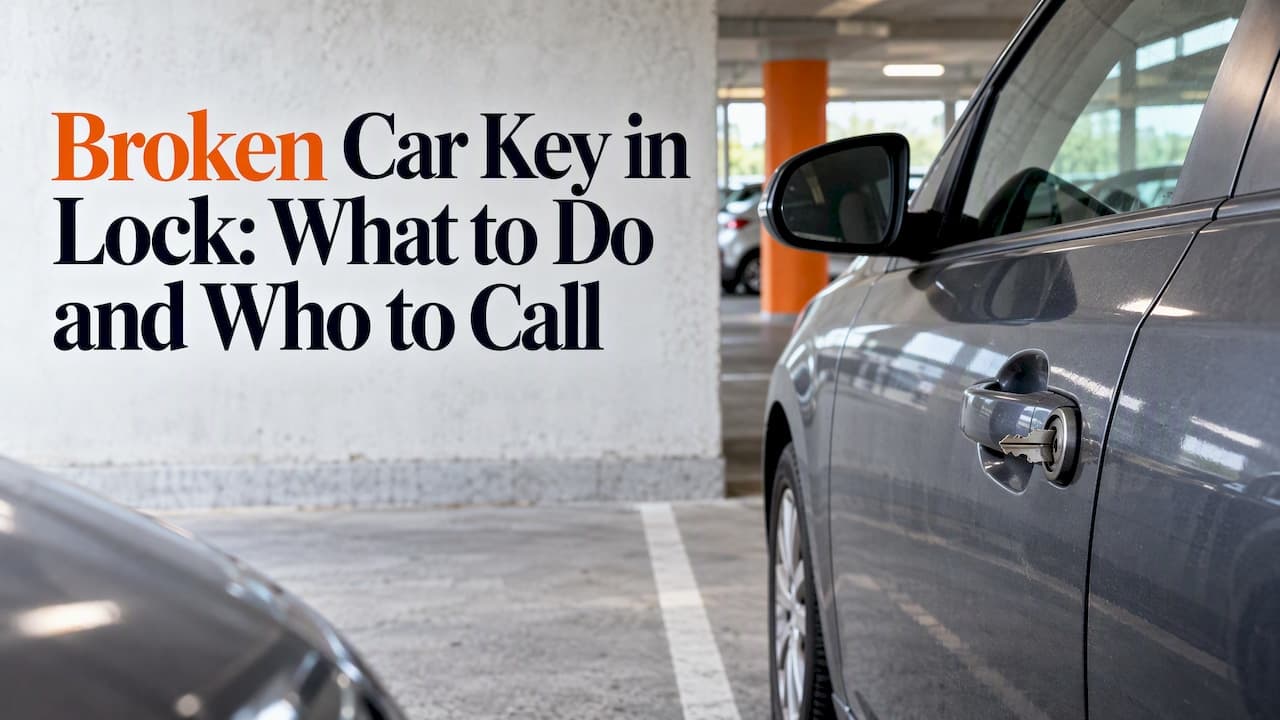
If your car key has snapped in a door lock or ignition, stop turning it and stop pulling. Keep the broken pieces, check whether any part is visible and straight enough to grip, and if it isn't, call an auto locksmith rather than prise at the lock. Forcing it is the quickest way to turn a simple extraction into a lock repair. We're a mobile auto locksmith covering Essex and Hertfordshire, and we deal with snapped keys on driveways, in car parks and at roadsides every week. This guide covers what you can safely try, what to leave alone, and what happens when we arrive.
TL;DR
- Stop turning the key. Pressure on a snapped blade is what pushes the fragment deeper or damages the lock wafers.
- Keep every piece of the key. A locksmith can often use the broken parts to cut the new blade, and you'll need the head for reference.
- Only try to grip a fragment if a good part of it is sticking out. Never use screwdrivers, paperclips or drill bits.
- A broken key in the ignition, or one with a transponder chip, needs a professional. Cutting a blade is not enough to start the car.
- Our mobile vans are equipped to extract, cut and programme a new key at your location, typically within 30 to 60 minutes.
Table of Contents
- First, make the situation safe
- What actually happened to the key?
- What you can safely try yourself
- Broken key in a car door lock
- Broken key in the ignition
- Why car keys break in locks
- When to call an auto locksmith
- What happens when we arrive
- Can a new key be made from the broken one?
- Our perspective: why a snapped key is a good job to leave to a van
- Cost: what to expect
- Need a snapped key sorted today?
- FAQ
- Sources
First, make the situation safe
Before you think about the key, think about where the car is. If it is on a road, a slip road or a busy forecourt, the lock is the second problem.
The Highway Code says to get your vehicle off the road if you can and to use hazard warning lights if it is causing an obstruction. It also says not to stand between the vehicle and oncoming traffic. A snapped key in the driver's door on a main road is a good example: if the car is still unlocked on another door, or the key still turns the ignition on its own, move it somewhere safe first.
If the car is parked at home, at work or in a supermarket car park, you have all the time you need. Take a breath and look at what you have.
What actually happened to the key?
There are three common situations, and each calls for a different response.
- The blade has snapped and part of it is poking out of the lock. This is the best case. A fragment you can see and hold is often removable with the right tool.
- The blade has snapped flush or deep inside the lock. Nothing to grip. This needs a locksmith's extractor tools and proper lighting.
- The key has broken in the ignition. Here the barrel, the steering lock and the immobiliser are all involved, so the risk of making it worse is higher.
Look also at the key itself. Was it bending, creaking or springy before it snapped? That usually means the blade was worn, or the lock was stiff, and the same lock may do it again with the replacement. Mention it to the technician.
What you can safely try yourself
We'll be honest: some drivers do get a fragment out with patience. But only in the first case above, and only gently.
If a piece is sticking out of the lock
- Use a clean pair of fine needle-nose pliers or tweezers and grip the fragment as close to the lock face as you can.
- Pull straight out, along the line of the keyway. Do not twist, and do not rock it side to side.
- If it doesn't move with light, steady pressure, stop. More force on a small fragment tends to snap it lower down.
A small amount of graphite or dry lock lubricant can help a stiff lock. Avoid thick oils and sprays that gum up the wafers, which will slow down any professional extraction later.
What to leave alone
The urge to grab a screwdriver, paperclip, pin or drill bit is strong. Resist it. Improvised tools can push debris deeper, score the keyway or damage the wafers, and extra leverage with pliers acts on the blade's weakest point, which is how a stuck key becomes a broken one. This is a consistent warning from locksmiths, and it matches what we see on callouts: the lock that arrives with scratches inside is the lock that has had a screwdriver in it.

Also avoid superglue to "stick" the pieces together. It will bond to the lock, and what could have been a ten-minute extraction becomes a lock replacement.
Broken key in a car door lock
A snapped key in the driver's door usually means one of two things: the key was worn, or the lock was stiff from dirt, cold or lack of use. The key then gave up at its thinnest point, close to the shoulder.
The practical issue is access. If the door will not open, you may be locked out or unable to use the manual lock to get in, and if you have a modern car, the door lock may not be the only way in. Here is what to check:
- Try the other doors and the boot. Some cars unlock all doors from the remote even when the mechanical key has failed. If the remote button still works, the car may be accessible without any extraction.
- Try the key head. Many modern keys have a transponder or remote fob in the head. If the head still works, it still talks to the car even though the blade has gone.
- Don't force the door handle. Door handles and lock rods are cheaper than a locksmith's callout but not cheaper than a quick extraction.
If you're locked out as well, our car lockout service uses non-destructive entry, so we can open the car without damaging paint, seals or the lock. It's a separate job from the extraction, but we usually do both on the same visit. If the problem is that your keys are locked inside rather than snapped, our guide to locked keys in your car explains what to expect.
Broken key in the ignition
A key that snaps in the ignition is more serious, and it is a more common search than the door-lock version. Several things sit behind that small slot: the ignition barrel, the steering lock, and on most cars built in the last twenty-five years, the immobiliser.
What to do:
- Do not turn the barrel or try to crank the engine with a partial key. You can damage the barrel or jam the steering lock.
- Switch off the electrics and remove anything else from the key ring to reduce weight pulling on the barrel.
- Photograph it. Show the technician the break, the position and the make, model and year of the car.
- Don't try to dig it out. The ignition has tighter tolerances than a door lock, and a tool slipping inside can mean replacing the barrel.
We've written a separate, detailed guide on this: snapped key in ignition, the 5mm rule and when to pull or call. If the barrel is worn and it keeps happening, you may be looking at repair rather than extraction, and our piece on ignition barrel repair explains the options.
Why car keys break in locks
Keys rarely snap on the day. They fail over months.
- Metal fatigue. A key bent and flexed every day in a pocket or a heavy key ring develops tiny cracks. The final turn is just the last one.
- A worn blade. Heavily used duplicates of duplicates lose their cut accuracy, so the key catches in the lock instead of gliding in.
- Stiff or dirty locks. Door locks that are rarely used, especially on older cars, collect grit and corrode. Cold weather makes them stiffer.
- Heavy key rings. A bunch of keys hanging from the ignition pulls on the barrel and the key at every bump.
- Forcing a stuck key. Twisting harder when a key won't turn is the single most common cause of snapped blades.
Prevention is cheap. Replace a visibly worn or bent key before it snaps, keep the ignition key on a light ring, and if a lock feels gritty, get it looked at. A spare key made while the original still works is the most useful safeguard, and it costs far less than an emergency. Our key programming service covers spares as well as replacements.
When to call an auto locksmith
Call as soon as any of these is true:
- Nothing is sticking out of the lock to grip.
- The key has broken in the ignition.
- You tried gentle extraction and the fragment didn't move.
- The key has a chip or remote and you need a new working key, not just a blade.
- You need the car now, such as for work or a school run, and can't wait for a garage.
- You suspect the lock itself is damaged.
An auto locksmith has fine extractor tools designed for each keyway, lights and borescopes, and the experience to know when a lock will tolerate pressure and when it won't. A dealership generally can't do any of this at the roadside: the usual answer is to recover the car on a flatbed and wait for a workshop slot. A mobile locksmith avoids the tow, which is where much of the time and cost goes.
What happens when we arrive
A typical visit, at your home, workplace or roadside anywhere in our Essex and Hertfordshire area, goes like this:
- Check and identify. We confirm the make, model, year and key type, and look at the break.
- Extract. Using specialist extractor tools we remove the fragment without damaging the lock, whenever the lock allows.
- Test the lock. We check it turns smoothly. If it's worn, we say so and explain whether it needs lock or ignition repair.
- Cut a new key. From the code or the remaining pieces, we cut a replacement blade on the van.
- Programme. If your car has an immobiliser, the new key must be programmed so the car will start with it.
- Test and finish. Every key is tested in the door and ignition before we leave.
Our technicians are licensed, insured and SERMI-certified, and our vans carry diagnostic tools for modern and complex vehicle security systems. Most jobs are finished within 30 to 60 minutes.
Can a new key be made from the broken one?
A broken blade can sometimes be used as a pattern for cutting, but that is only half the job on a modern car.
Most cars from the late 1990s onwards use an electronic immobiliser. As Volkswagen UK explains, the immobiliser checks the unique transponder code in the key and allows the car to start only if the code is correct. So a mechanically copied blade will open the door and may turn in the ignition, but it will not start the engine unless its electronic code is authorised.
That's why a hardware-store copy of a car key often "fits" and doesn't work. What you need depends on the key:
| Key type | What a snapped key means | What we do |
|---|---|---|
| Basic metal key, no chip | Blade copy is enough | Extract and cut |
| Transponder key | Chip inside head must match the car | Cut and programme |
| Remote key / flip key | Blade and remote may need replacing | Cut, programme the remote |
| Smart / keyless key | Emergency blade may have snapped, fob usually fine | Extract, replace emergency blade, check the fob |
If the head has been lost too, or you now have no working key at all, that is an all-keys-lost situation. We explain how it works in 8 technician steps to fix all keys lost programming. If the new key refuses to start the car, our transponder key not working checks walk through the causes.
Our perspective: why a snapped key is a good job to leave to a van
We see the same pattern repeatedly. A driver tries a screwdriver, a pin or a pair of pliers "just to see", the fragment goes deeper, and what was a quick extraction becomes a lock repair. We'd rather arrive at a lock that hasn't been touched.

The second pattern is the tow. When a key breaks, many people assume the car has to go to a dealership. For the vast majority of snapped keys, it doesn't. Our vans carry key-cutting equipment and diagnostic tools, so the extraction, the new blade and the programming all happen on your driveway. That removes the recovery truck, the waiting and the day without a car.
The third is the advice we give most often: replace the key before it breaks. A bent or worn key is a warning. A spare cut and programmed while the original works is a calm, planned job, and an emergency callout is neither.
— James
Cost: what to expect
Prices depend on the car, the key and the job, so it's best to describe your situation when you call. For reference, our published prices start from £120 for key programming, for a standard key, and for lock and ignition repair, and from £150 for a remote key. Our emergency callout fee also starts from £120. These are starting prices, and the final figure depends on the vehicle and what the lock needs. Keys for particular makes are listed on our vehicle pages, such as Ford and Volkswagen.
Having the make, model, year and a photo of the break ready helps us give you a clear answer on the phone.
Need a snapped key sorted today?
We cover Harlow, Chelmsford, Epping, Brentwood, Billericay, Bishop's Stortford, Braintree, Great Dunmow, Ware, Loughton, Stansted and the surrounding villages, with mobile vans that bring the workshop to you. If your key has snapped in a door or ignition, contact us through our site and tell us the make and model. We'll tell you what we can do and how soon we can be there. Van owners can also ask about our van key replacement.
FAQ
Can you get a snapped key out of a car lock yourself?
Sometimes, if part of the key is clearly sticking out and you can grip it with fine pliers and pull straight. If nothing is visible or it doesn't move with gentle pressure, stop. Further attempts commonly push the fragment deeper or damage the wafers.
What should I do if a key breaks in the ignition?
Don't turn the barrel or try to start the car. Keep all the pieces, note the make, model and year, and call a mobile auto locksmith. Ignitions have tight tolerances and the immobiliser is involved, so a controlled extraction is safer than improvising.
Can a new car key be made from a broken one?
The blade can sometimes be copied from the pieces, but a car with an immobiliser also needs a key whose electronic code is authorised. A locksmith cuts the blade and programmes the key together, so it opens and starts the car.
How long does it take a locksmith to remove a broken key?
A straightforward extraction is often quick, and with cutting and programming our visits typically take 30 to 60 minutes. A worn or damaged lock can take longer, and we'll tell you if that's the case once we've seen it.
Will I need a tow to a dealership?
In most cases, no. Our vans carry the equipment to extract the key, cut a new one and programme it at your location, which avoids recovery and a day without the car.
Sources
- The Highway Code: Breakdowns and incidents (rules 274 to 287), GOV.UK
- Locking and security systems, Volkswagen UK