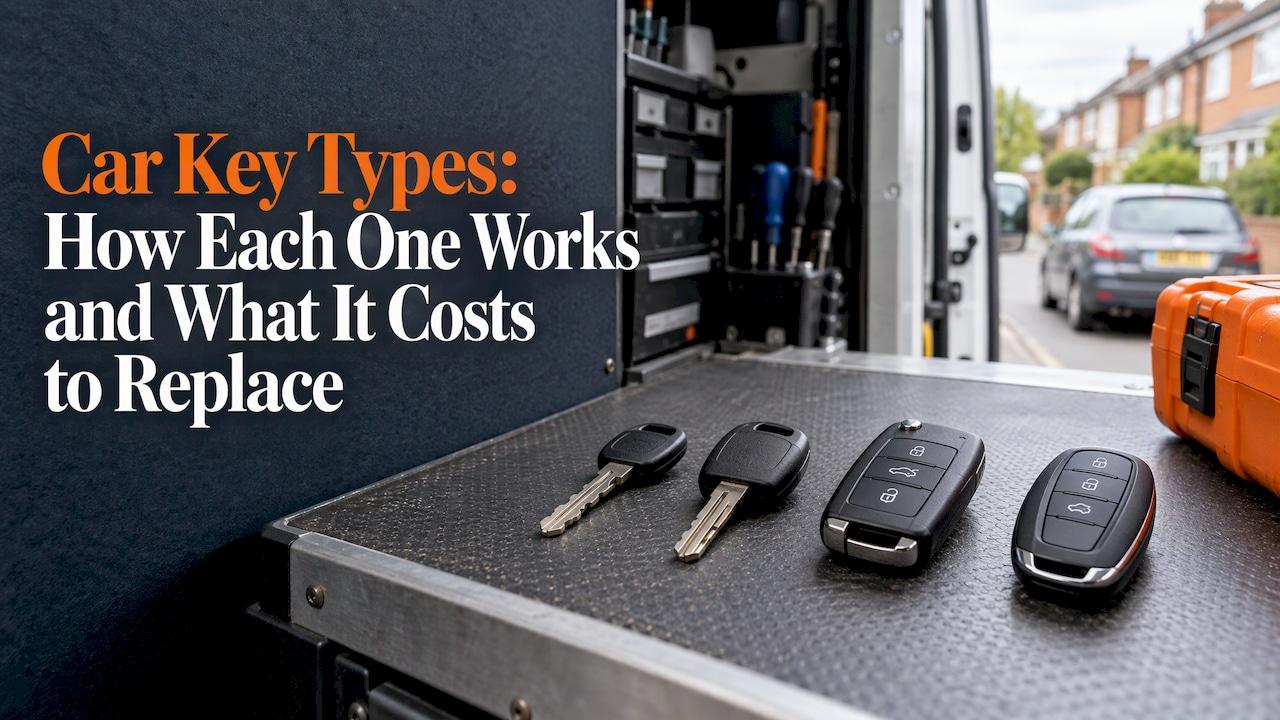
Most UK cars and vans use one of five key types: a basic mechanical key, a transponder key, a remote key, a smart (proximity) key, or a key fob that sits alongside a blade. The type decides whether a copy is a quick cut or a programming job, and whether you can be back on the road within the hour. We are a mobile auto locksmith covering Essex and Hertfordshire, and we make and programme all of these at your car, so you do not need a tow to a dealership.
TL;DR
- Keys fall into five main groups: mechanical, transponder, remote, smart (proximity) and fob-and-blade combinations. Each adds electronics to the one before.
- Any car registered since 1998 has an immobiliser, so almost every modern key needs a chip matched to the car, not just a cut blade.
- A remote key locks and unlocks by button. A smart key does the same without you taking it out of your pocket, and usually starts the engine by push button.
- Identify your key by its shape, its buttons and how you start the car, then tell the locksmith the make, model and year.
- Our standard key replacement starts from £120 and remote keys from £150. Programming and emergency callouts also start from £120.
Table of Contents
- The five car key types at a glance
- Mechanical keys: the original
- Transponder keys: the immobiliser era
- Remote keys: lock and unlock from a distance
- Smart keys: proximity and push-button start
- Smart key vs remote key: the difference in practice
- How to tell which key your car or van uses
- Why a cut blade is not enough
- Replacement and spare keys by type
- Vans and commercial vehicles
- Locked out, or the key will not work?
- Mobile key replacement in Essex and Hertfordshire
- Our view on choosing a key
- FAQ
- Sources
The five car key types at a glance
| Key type | What it looks like | What it does | What replacing it involves |
|---|---|---|---|
| Mechanical | Plain metal key, no plastic head chip | Turns the lock and ignition | Cutting the blade |
| Transponder | Plastic head, metal blade | Turns the lock and carries a chip the immobiliser reads | Cutting plus chip programming |
| Remote | Blade with buttons on the head, or a flip blade | Locks and unlocks by radio signal, carries a chip | Cutting, remote pairing, chip programming |
| Smart / proximity | Fob with no blade needed to drive | Unlocks as you approach, starts by push button | Programming to the car's security system |
| Fob with emergency blade | Fob with a hidden metal key | Smart functions, plus a manual backup | Fob programming and blade cutting |
The exact options depend on the make, model, age and security system of your vehicle, which is why two cars from the same year can need different work.
Mechanical keys: the original
A mechanical key is a cut piece of metal and nothing else. The pattern of cuts lifts the pins in the lock so it turns. Nothing in it talks to the car.
You will find these on older cars, mostly from before the late 1990s, and occasionally as a secondary key for a boot, glovebox or fuel flap. They are the simplest to copy, though they also give the least protection, because anyone with a copy of the blade can start the car.
Two cut styles are common. A standard single or double-sided key is cut on the edge. A "laser-cut" or sidewinder key has a wavy groove milled into the flat face of the blade, which is harder to duplicate and needs a specialist cutting machine. A laser-cut blade is not necessarily electronic, but on modern cars it usually comes attached to a transponder.
Transponder keys: the immobiliser era
Since 1998 all new cars in the UK have been fitted with an immobiliser, a system that stops the engine starting unless the correct key is present. The key carries a small chip, called a transponder. When you turn the key or bring it near the ignition, the car reads the unique code stored on that chip and only then allows the engine to run.
A transponder key looks like a normal key with a thicker plastic head, and the chip is hidden inside. It can have buttons or not.
This changes what a replacement means. A cut blade that fits the lock will turn the ignition, but the engine will not fire unless the chip has been programmed to the car. That is why a hardware-store copy often opens the door and then does nothing. If you want the detail, our guide on how transponder key programming works walks through it.

Remote keys: lock and unlock from a distance
A remote key adds buttons for locking and unlocking, and sometimes for the boot. The buttons can be on the head of a fixed blade, or the blade can fold out of the fob (a flip key or switchblade key).
The remote part is a radio transmitter. In Europe remote keys typically transmit on 433 or 434 MHz, sending an encrypted signal to the car's comfort control unit, which operates the doors. The immobiliser is separate: the transponder in the key and an individual code deactivate it when you start the engine.
So a remote key does two jobs with two sets of electronics. Both need setting up: the remote has to be paired to the car's receiver, and the transponder has to be coded to the immobiliser. A good fob is more than a convenience. It is a small electronic device that sends an encrypted radio signal with a code to a receiver in the car, which then performs the requested action.

Modern systems also change the code each time the fob is used, which is more secure than older systems that used a single code. That rolling code is one reason a remote cannot be casually cloned from a photo or a quick copy.
Smart keys: proximity and push-button start
A smart key, also called a proximity or keyless-entry key, stays in your pocket or bag. The car detects it nearby, so you can open the door by touching the handle and start the engine with a push button.
There is often a small emergency blade hidden inside the fob, released with a catch. It lets you open the door manually if the fob battery goes flat. Most drivers never use it, and many forget it exists until the day it matters.
Smart keys hold the most electronics, and replacing one means programming it to the car's security system. It is usually not something you can do by following a few steps at home. If you have lost one, our article on replacing a lost smart key without a tow explains what happens on the day.
Smart key vs remote key: the difference in practice
The two are easy to confuse because both have buttons. The difference is in how they communicate and when.
| Remote key | Smart key | |
|---|---|---|
| Unlocking | You press a button | Automatic as you approach, or by touching the handle |
| Starting | Blade in the ignition, or a chip read at the barrel | Push button, with the fob inside the car |
| Blade | Usually a working blade | Often only a hidden emergency blade |
| Battery | Only drains when you press buttons | Is also in constant low-level contact with the car |
A quick test: if you have to take the key out and press something to unlock the car, it is a remote key. If you can walk up with the key in your bag and the car unlocks, it is a smart key. If you get into the car and push a start button with the fob left in your pocket, that is a smart key too.
Because a smart key's battery is working all the time, a weak battery is a common reason for a fob to fail to unlock the car or for a "key not detected" message. Replace the battery before assuming the key itself is broken.
How to tell which key your car or van uses
You do not need technical knowledge to identify your key. Work through these checks:
- Look at the blade. If there is no plastic head chip bulge and the head is flat metal, it is likely mechanical. Look at the shape of the cuts too: edge cuts mean a standard key, a wavy groove along the face means a laser-cut blade.
- Check the head. A thick plastic head with no buttons suggests a transponder. Buttons mean remote.
- Notice how you start the car. A key turned in a barrel means mechanical, transponder or remote. A start button with the key left in your pocket means smart.
- Check the make, model and year. The registration plate and the date of first registration tell a locksmith far more about the system fitted than the key's appearance does.
- Look for a logo or number on the fob. Many fobs have a part number or a manufacturer mark inside the battery compartment. Take a photo before you send it to anyone.
If you have lost every key, you have no key to inspect. That is fine. The make, model and year are enough to work out what the vehicle uses, and a technician with the right diagnostic equipment can read what the car needs. Our all keys lost programming guide sets out the visit step by step.
Why a cut blade is not enough
The single most common misunderstanding about car keys is that a key is a key. On any car with an immobiliser, a blade that physically fits may still not start the engine. The car must recognise the chip. Remote and smart keys have further electronics that need to be matched to the vehicle too.
That is why adding a key to the immobiliser is a separate step from cutting it, and why the question can a locksmith programme car keys has a yes for most makes. Sometimes the process is called key coding, and our page on car key coding explains the term and what it costs.
One safe habit for older and newer keys alike: if a key sticks or will not turn, do not force it. There are some safe checks for freeing a stuck key that avoid snapping the blade in the barrel, and if the key still will not move, a lock repair is the next step rather than more force.
Replacement and spare keys by type
The type of key sets the work, and the work sets the price. These are our published starting prices:
- Standard key: from £120.
- Remote key: from £150. Both are listed on our Ford key page.
- Key programming: from £120, on our key programming page.
- Emergency callout: from £120, on our emergency services page.
The final figure depends on your vehicle and on what you need. A make with a more complex security system, or a job where every key must be reprogrammed, will sit above the starting price. We confirm what is needed for your vehicle before work starts.
Cheaper to do before you lose them all
A spare is always simpler than an all-keys-lost job. With a working key present, the car can be told to accept an additional one. With none, the technician has to work with the car's security system directly, and that takes longer. If you only have one key, getting a spare is the single best thing you can do for your car.
What to have ready
Have the registration number, the make, model and approximate year, and proof that the vehicle is yours, such as the V5C logbook and photo ID. A reputable locksmith will ask for these, because making a key for a car is a security-sensitive job. If your key was stolen, say so: the old key should be deleted from the car's memory so it can no longer start the vehicle, which is a service we offer as stolen key deletion and reprogramming.
Vans and commercial vehicles
Van keys follow the same families: many panel vans use a remote key with a flip blade, and some newer ones use a smart key. The difference is in the stakes. A lost van key can mean a lost day's work, locked-in tools and missed jobs, so the speed of an on-site visit matters more than the key type itself.
If you run more than one van, the same make and model are often registered across a fleet, so ask for spares at the same time. Having a second key in the office means a lost key becomes a minor problem rather than a stopped vehicle. We cover van key replacement across Essex and Hertfordshire, and you can start from our van key replacement page.
Locked out, or the key will not work?
A different problem from replacement is when you simply cannot get in. If your key is inside the car, or the fob is dead and you have no blade, you need entry without damage. Our car lockout service starts from £120 and uses non-destructive entry for all major car and van makes, so there are no broken windows or scratched doors.
If the key turns but the car will not start, the issue may be the chip or the lock itself rather than the key. Our lock and ignition repair service starts from £120 and covers that.
Mobile key replacement in Essex and Hertfordshire
We come to you across Harlow, Chelmsford, Epping, Brentwood, Billericay, Bishop's Stortford, Great Dunmow, Braintree, Loughton, Stansted and the surrounding area. Our vans carry advanced diagnostic tools, so dealership-level work happens at the roadside, at home or at your workplace, typically within 30 to 60 minutes. Our technicians are licensed, insured and SERMI-certified.
When the key type is the question, the answer is usually the same: tell us the make, model and year and we will tell you what your car needs. You can see everything we offer on our services page, or go straight to key programming if you already know you need a key made.

Our view on choosing a key
Most of the calls we get are not really about the key. They are about the situation: a lost key, a car that will not start, a van that cannot leave the yard.
Our view is simple. The key type matters less than being able to get a working one made where the vehicle is standing. A dealership will often want the car brought in, which means a tow, a wait and a bill for both. A mobile locksmith with the right equipment removes the tow and shortens the wait.
That is why we equip our vans with diagnostic tools and train our technicians to work on modern and complex security systems. The key is the small part. The programming is the part that makes it work.
If you have just one key, get a spare now. If you have none, call us with the make, model and year and we will tell you what to expect.
James
FAQ
What are the main types of car keys?
The main types are mechanical, transponder, remote, smart (proximity) and fob-with-blade keys. Each adds electronics to the previous one. Your car's age and make decide which you have, and a locksmith can confirm it from the registration.
What is the difference between a smart key and a remote key?
A remote key needs a button press to lock or unlock, and is usually used with a blade in the ignition. A smart key works by proximity: the car senses it nearby, unlocks as you touch the handle and starts with a push button. Both contain a transponder chip for the immobiliser.
Can I just get a copy cut for a car with a chip key?
A cut blade alone will usually open the door but not start the engine, because the immobiliser needs to recognise the chip in the key. The chip has to be programmed to your car. A mobile locksmith can cut and programme the key in the same visit.
Do I need my old key to get a spare made?
No, but it makes the job simpler. With a working key, a spare is added to the car's system. If every key is lost, a technician can still make a new one from the vehicle itself, using the make, model, year and proof of ownership.
Sources
- Faulty engine immobiliser? How to solve immobiliser problems, Start Rescue
- How remote car keys work, HELLA
- What is a key fob? Car Rental and Mobility Tech Glossary