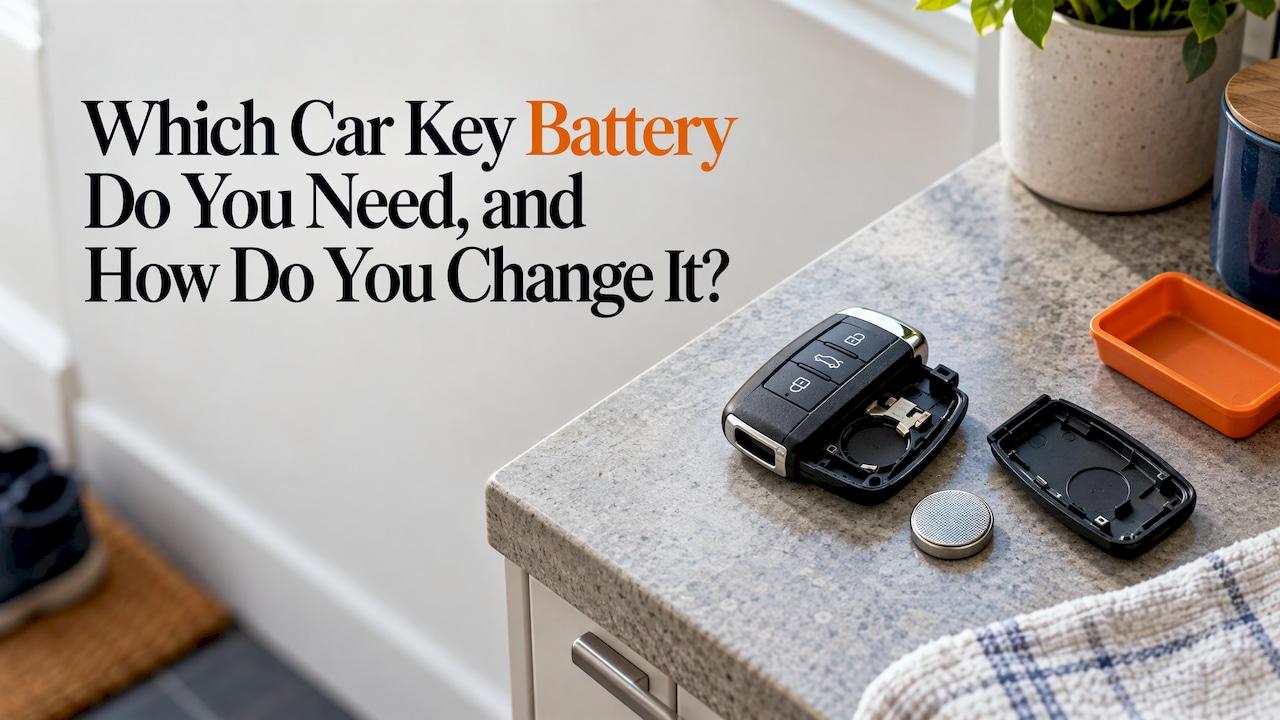
Most car keys and fobs run on a single 3V lithium coin cell, and on most cars you can swap it in about five minutes with a coin or a small screwdriver. The cell is usually a CR2032, and the type is printed on the battery itself. Changing it does not wipe the key's programming, so a fob that works before the swap should work after it. If the fob stays dead with a fresh, correct battery, the problem is no longer the battery. That is when a repair or re-pairing is the answer, and it can be done where your car is parked, without a tow.
This guide covers the signs of a low battery, how to identify the right cell, the steps for each style of key, how long a battery lasts and what to do when a new battery does not fix things.
TL;DR
- A weak fob shows itself through shorter range, repeated button presses or a "key battery low" warning on the dashboard.
- Most fobs take a CR2032, but CR2025, CR2450 and CR1620 also exist. Read the code on the old cell, check the handbook, and never swap one type for another.
- Fit the new cell the same way round as the old one, handle it by the edges and test the fob next to the car.
- Batteries typically last two to six years, and cold weather makes a tired cell fail sooner.
- If the fob still does not work with a new cell, it may need re-pairing or repair. We do that on site across Essex and Hertfordshire.
Table of Contents
- Signs your key fob battery is running low
- Which battery does your key fob need?
- How to change a car key battery, step by step
- Safety: coin cells and children
- Will changing the battery wipe your key?
- How often to change the battery
- What if the fob still does not work with a new battery?
- Where we come in
- Our view on key batteries
- FAQ
- Sources
Signs your key fob battery is running low
A fob battery rarely dies without warning. It fades, and the symptoms are easy to read once you know them.
- Shorter range. You used to unlock the car from across the car park. Now you have to walk up to it. Fleet News lists the fob working only within roughly 30 feet of the car as a low-battery sign.
- Repeated presses. The button works on the second or third try, or the fob opens the doors only now and again. Age UK Trading says a fob that unlocks only occasionally, or not at all, could simply need a new battery.
- A dashboard warning. Many cars tell you directly. Land Rover's service manual, for example, describes a "SMART KEY BATTERY LOW" message in the message centre alongside a clear drop in range.
- Unreliable keyless entry. If the door handle does not always sense the key as you walk up, the cell is a prime suspect. Maplin also lists a key that is more than three years old as a reason to replace the battery.
Cold mornings make all of this worse. Fleet News explains that low temperatures slow the chemical reaction inside the cell and cut its capacity by 20 to 30 per cent. A fob that was marginal in October can fail completely in a frosty January. If a fob only misbehaves in winter, treat it as a battery warning rather than a one-off.
If the battery looks fine but the fob still behaves oddly, our guide to fixing a key fob in three quick checks walks through what else to look at.
Which battery does your key fob need?
The cell is a lithium coin battery. Maplin says almost every fob uses one, and that the CR2032 is the most common type on UK roads. CR2025, CR2450, CR1620 and others are used by different brands.
The code is not random:
- "CR" means a 3V lithium coin cell.
- The first two digits are the diameter in millimetres.
- The last two digits are the thickness in tenths of a millimetre.
So a CR2032 is 20mm across and 3.2mm thick, and a CR2025 is 20mm across and 2.5mm thick. Maplin warns that the two are not interchangeable, because of fit and contact problems. A thinner cell can rattle loose and lose contact, so the fob works one day and not the next.
Three ways to find the right type
- Read the old battery. Open the fob and read the code printed on the cell. This is the most reliable method, because it tells you what is actually in your key.
- Check the handbook. Look under "remote control" or "key battery". Maplin notes the type is also often moulded into the battery compartment.
- Check the manufacturer's guidance. Ford's UK support page points out that requirements vary by vehicle type and model year, so a battery that suited one Ford key may not suit another.
Buy the cell before you start, and buy the exact code you read. Multipacks of mixed sizes are a false economy if the one you need is missing.
How to change a car key battery, step by step
The method depends on the key style. Ford's UK guide separates three types, and the same split applies to most makes.
Before you start
Work on a clean, well-lit surface, with a small tray or saucer so no screws or clips go missing. Have the new cell ready and a small flat-blade screwdriver or a coin. Take a photo of the open fob before you remove anything, so you can see how it goes back together.

Flip keys
These have a fold-out blade released by a button. Press the button to release the blade, then pry the cover open with a flat tool, as Ford describes. Lift out the old cell, note which way up it sits, and fit the new one the same way.
Smart or push-button-start keys
- Slide or press the release to remove the emergency key blade.
- Look in the blade slot for a small notch. Maplin says to split the casing there with a coin or flat-blade screwdriver, without forcing it.
- Twist the two halves apart gently. Ford advises against touching the circuit board or any grease on the terminals.
- Note the battery orientation. The positive side is usually up. Land Rover's manual specifies a new, unused CR2032 with the positive side up for its Smart key.
- Flick the old cell out with a small screwdriver and fit the new one, holding it by its edges so skin grease does not reach the contacts.
- Clip the case back together and test the fob near the car.
Keys held together by screws
Some fobs are screwed shut. Start Rescue warns that the screw head can strip easily, so use a very small screwdriver, such as a size 0, with a good bite. A worn screw head is a common way a five-minute job turns into a damaged key.
Sealed units
Some older or commercial-vehicle keys have a sealed, rechargeable unit that is not designed to be opened. Ford's guidance for these is to leave them closed. If you drive a van with a key like this, our van key replacement service is built for exactly that kind of key, and we come to the van wherever it is parked.
Where it goes wrong
- Forcing the case. Levering hard cracks the plastic or snaps the clips, and a loose case lets dirt and damp in.
- Wrong way round. A reversed cell gives no contact. If a new cell does nothing, check the orientation first.
- Wrong thickness. A CR2025 in a CR2032 slot may seem to work and then cut out.
- Touching the contacts. Grease and fingerprints on the cell or terminals can cause poor contact.
Safety: coin cells and children
Treat the old and new cells with care. Maplin states that 20mm lithium coin cells such as the CR2032 can cause severe internal burns within two hours if swallowed, and that this needs immediate A&E attention. If a child or pet may have swallowed a cell, go to A&E straight away.
Change the battery out of reach of small children, and keep spare cells and the dead one out of sight until you have disposed of them. Take dead cells to a battery recycling point, such as those in most supermarkets, rather than putting them in the bin.
Will changing the battery wipe your key?
No. Ford's UK support page states that replacing the battery does not erase the programmed key from the vehicle's memory. The car remembers the key, not the battery. So a successful swap should leave you with a working fob straight away. If it does not, the cause is somewhere else, and the next section is for you.
How often to change the battery
Published guidance gives a range rather than one number:
| Source | Typical life |
|---|---|
| Age UK Trading | Around three to four years |
| Start Rescue | Three to four years, replacing every two and a half to three years before it goes flat |
| Fleet News | Anywhere between two and six years |
A sensible habit is to change the battery around the three-year mark, ideally in autumn before the cold arrives. Fobs on cars with keyless entry tend to work harder, because they are in contact with the car more often, so a keyless key may sit towards the shorter end. Fleet News also suggests asking for the battery to be checked at routine servicing, and checking the manufacturer's recommended interval if the car is leased.
If you carry two keys, change both cells at the same time. A spare that has sat in a drawer for years often has a flat battery too, and you only find out when you need it most.
Keep your fob somewhere warm when you can. Indoors beats a cold porch or a glovebox overnight, and it costs nothing.

What if the fob still does not work with a new battery?
Work through these in order.
- Check the cell. Is it the right type, the right way up, and genuinely new? Land Rover's manual says that if the low-battery warning does not clear, the replacement cell is not new and unused.
- Check the contacts. Look for corrosion, bent metal tabs or a fob case that does not close fully.
- Try the spare key. Age UK Trading suggests trying a spare fob and the manual key blade in the door to work out whether the battery is the cause. If the spare works and the main fob does not, the fault is in the main fob.
- Consider water damage. For a wet fob, Age UK Trading advises removing the battery and letting the inside dry for a couple of days before refitting. Our guide on a wet key fob covers when to call for help.
- Consider re-pairing. Ford says a key that still does not work after a battery change may need to be re-paired with the vehicle.
That last step is where most owners get stuck, because re-pairing needs diagnostic equipment. A broken fob button, a cracked board or a lost key falls into the same bracket. Our guide to remote key repair explains when a fob can be fixed, re-paired or needs replacing, and if the car will not lock with the fob, see what causes that and how to fix it.
If the car will not unlock at all and you are stuck outside it, the lockout guide shows how to get back in. For a push-button key with no response, our keyless entry triage goes through the usual causes.
Where we come in
Swapping a coin cell is a job you can do yourself. The jobs that follow when it does not work are the ones that need equipment. We are a mobile auto locksmith covering Essex and Hertfordshire, including Harlow, Chelmsford, Brentwood, Billericay, Epping, Bishop's Stortford, Braintree and Great Dunmow. Our vans carry diagnostic tools so the work is done where the car is parked, typically within 30 to 60 minutes, and our technicians are licensed, insured and SERMI-certified.
If your fob needs more than a battery, these are the services that matter:
- Key Fob Repair & Replacement for fobs with broken buttons, damaged boards or a case that no longer holds together. A standard key starts from £120 and a remote key from £150.
- Key Programming, from £120, when a fob needs to be paired with the car. Read more in our guide to keyless fob programming costs and process.
- All keys lost replacement and other key services if the key is gone altogether. Our guide to a lost smart key explains how that works without a tow.
If you are locked out with a flat fob and the blade will not help, our car lockout service starts from £120.

For an engine that will not start even with a working fob, see transponder key not working. Our blog has more key guides.
Our view on key batteries
A battery change is the cheapest key job there is, and we would like every driver to know that it is also the one most often blamed wrongly. When a fob stops working, a flat battery is the first thing to rule out, and a new CR2032 costs very little. Do that first, with the right cell and a gentle hand.
What we see differently is the step after it. Modern keys are small computers. They hold a transponder chip and a rolling code that the car checks before it will start. When a new battery does not bring a fob back, the cause is usually the electronics, the pairing or a physical fault, and that is dealership-level work.
That is why we built our service around the van. Our technicians arrive with diagnostic tools, so repairs, programming and replacement keys are done at your home, workplace or roadside, without a tow or a day without the car. Our technicians are licensed, insured and SERMI-certified, and experienced with advanced modern vehicle security systems.
Our advice: change the battery every three years, keep a working spare, and if something goes wrong, call before the problem becomes a lockout.
James
FAQ
How much does a car key battery replacement cost?
The cell itself is a low-cost item, and many drivers fit it themselves in minutes. Pricing for fitting varies by where you go and by the type of key, so check the price before you hand the key over. If the fob needs repair, replacement or programming rather than a battery, our standard key starts from £120 and our remote key from £150.
Which battery does my key fob take?
Most take a CR2032, but some use a CR2025, CR2450 or CR1620. Open the fob and read the code on the old cell, or check the handbook under "remote control" or "key battery". Do not swap a CR2025 for a CR2032, because the thickness differs and the contact can be poor.
How do I know if the key fob battery is low?
The usual signs are shorter range, needing several presses, intermittent keyless entry or a "key battery low" message on the dashboard. A fob that only fails on cold mornings is another strong sign, because cold reduces battery capacity.
How often should I change my key fob battery?
Published guidance suggests the battery lasts around three to four years, with a wider range of two to six years depending on the car and how the key is used. Changing it at about three years, before winter, avoids most surprises.
Do I need to reprogram the key after changing the battery?
No. Ford's UK guidance says replacing the battery does not erase the programmed key from the car's memory. If the fob is dead after a correct battery change, it may need re-pairing or repair, and we can do that on site.
Sources
- Which Battery Does My Car Key Fob Need? (Maplin)
- How to Replace the Ford Key Fob Battery (Ford UK)
- Entering the vehicle (Land Rover service manual)
- Tips for looking after your car keys (Age UK Trading)
- Why the cold causes key fob failure (Fleet News)
- Why's my key fob not working? (Start Rescue)