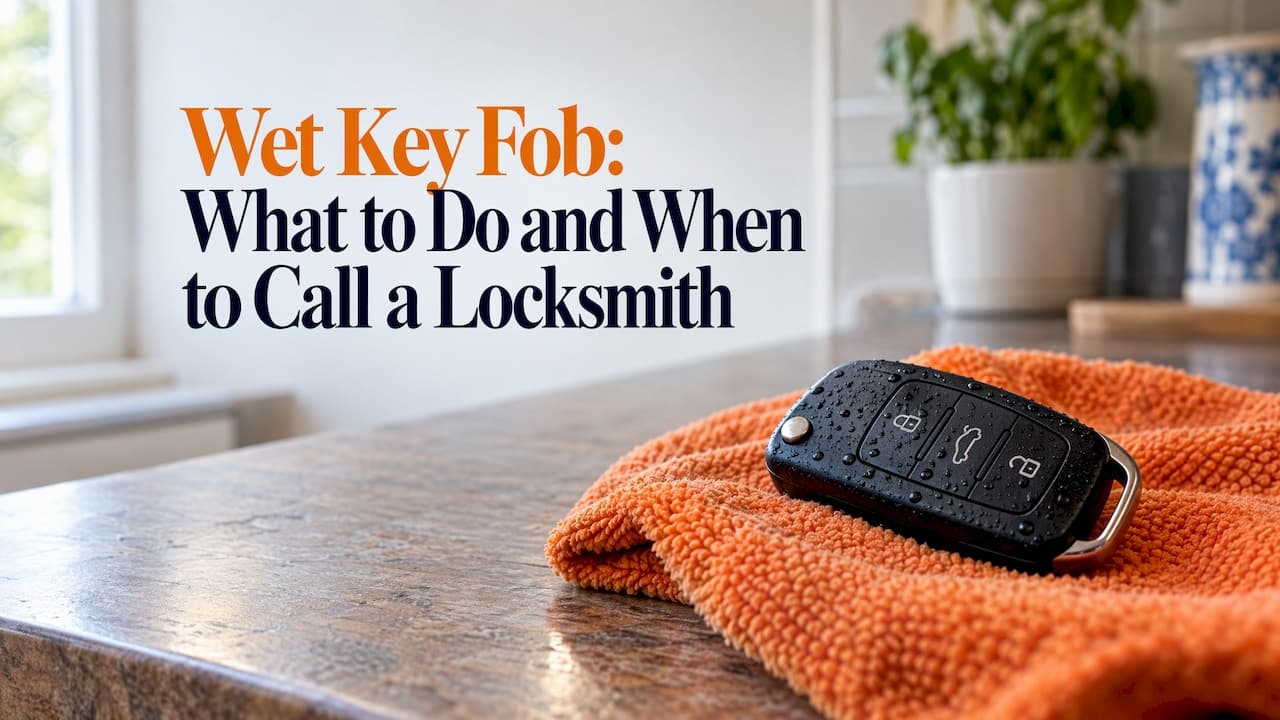
If your key fob has got wet, act within minutes: open it, take out the battery, pat it dry and leave it somewhere warm and dry with silica gel. Don't press the buttons and don't use heat. Many fobs recover once they are properly dry. If yours doesn't, or it went in salt water, a mobile locksmith can repair or replace it at your location without a tow.
This guide covers what to do in the first ten minutes, how to dry the fob, how to tell a flat battery from a damaged fob, what to do if the alarm keeps sounding, and when it is time to stop trying.
TL;DR
- Open the fob straight away, remove the battery and dry the outside with a cloth. Keep your fingers off the buttons.
- Dry it in a sealed bag with silica gel packets, or air dry it in a warm room. Skip hair dryers, ovens and radiators.
- Once the inside is completely dry, fit a fresh battery and test the fob. A dead fob often just needs a new battery after drying.
- Salt water or a corrosive liquid usually means lasting damage, so repair or replacement is the realistic route.
- If you are stuck, we come to you across Essex and Hertfordshire. Key programming starts from £120.
Table of Contents
- The first ten minutes after a fob gets wet
- How to dry a wet key fob safely
- Testing the fob once it is dry
- Washing machine, sea, pool or puddle: does it matter?
- My fob got wet and the car alarm keeps going off
- Repair, reprogramming or replacement: which one do you need?
- Perspective
- If the fob won't come back: what we do
- Looking after your fob so it doesn't happen again
- FAQ
- Sources
The first ten minutes after a fob gets wet
What you do immediately matters more than anything that follows. Water on its own is less of a problem than water sitting on a powered circuit board, so the aim is to cut the power and get the water out.
- Take it out of the water. Whether it was a puddle, a sink, a pocket in the rain or a washing machine load, get it out and stop the cycle.
- Don't press the buttons. Each press can push moisture further into the casing and across the contacts.
- Open the case. Most fobs have a seam you can gently prise with a thumbnail or a small flat tool. Some have a small screw. Many have a slot for a hidden mechanical key, so slide that out first.
- Remove the battery. This takes power away from the circuit board while it is damp.
- Shake out the water and pat the parts dry. Use a soft cloth or kitchen towel. Don't rub hard, and don't poke at the board with metal tools.
If you cannot open the fob, dry the outside as well as you can and move on to the drying step anyway. If it still won't respond, that is the point to get help rather than force the case and break the clips.
How to dry a wet key fob safely

Patience is the whole method. Age UK's motoring advice suggests placing the fob in a plastic bag with silica gel packets to help it dry, or otherwise air drying it in a warm room. Both work on the same principle: draw moisture out slowly, without cooking the electronics.
What works
- Silica gel packets in a sealed bag. The packets that come in shoe boxes and new bags are fine. Put the opened fob and its loose battery cover alongside several packets and seal the bag.
- A warm, dry room. An airing cupboard shelf or a room with the heating on is better than a damp windowsill.
- Time. Leave it for at least a full day. Drying times quoted online range widely, and a fob that feels dry on the surface can still hold moisture under the board or inside the buttons.
What to avoid
- Hair dryers, ovens, microwaves and radiators. Direct heat can warp plastic, loosen components and damage the circuit board.
- Switching it on to check. Testing too early is the most common way a recoverable fob becomes a dead one.
- Putting the old battery straight back. A battery that has sat in water may be corroded or flat. Fit a fresh one of the right type, which is printed on the battery or in your handbook.
A note on the waxy or glossy coating
If you open a fob and find a shiny or waxy film over the board, that is normally a protective coating applied to the circuit. Leave it alone. Don't scrape it or wash it off. It is there to help the board cope with a little moisture, which is why a brief splash is often survivable.

Testing the fob once it is dry
Once the inside is dry, Age UK advises that you replace the battery and try it out to see whether it works. Stand close to the car and test one button at a time.
| What you see | Likely cause | Next step |
|---|---|---|
| Fob works normally | Moisture has cleared | Keep an eye on it for a few days, as intermittent faults can return |
| Nothing happens, no light | Flat or corroded battery, or damaged board | Try another new battery, then check the contacts |
| Works from very close only | Weak battery or partial corrosion | Fit a fresh battery, then consider a repair |
| Works sometimes, not others | Moisture or corrosion still on the board | Dry again for longer, then get it checked |
| Doors unlock but the car won't start | Transponder chip or immobiliser communication fault | Needs diagnostic equipment, so book a locksmith |
Is it the battery or the fob?
Separating the two saves money and time.
- Look at the battery. White, green or crusty deposits on the battery or its contacts point to corrosion. A new battery may fix it, or the contacts may need cleaning by someone who knows what they are doing.
- Try the spare key, if you have one. If the spare works the car's remote functions normally, the car is fine and the fault lies with the wet fob.
- Use the mechanical key. Turning the hidden key in the driver's door proves the lock side works but tells you nothing about the electronics.
- Try your car's emergency start method. Many cars with push-button start let you hold the fob against a marked spot on the steering column or dashboard, which reads the chip without battery power. Your handbook shows where.
If a new battery and a dry fob still give nothing, the board is the likely problem. Our blog has a three-check walkthrough for fobs that stop working if you want to go through it step by step.
Washing machine, sea, pool or puddle: does it matter?
Yes. Fresh water that has dried out cleanly often does no lasting harm. Anything dissolved in the water changes the picture.
- Rain, a puddle or a sink. Usually recoverable if you open it and dry it quickly.
- Washing machine. The fob has been soaked, tumbled and exposed to detergent. Dry it for longer than you think you need to, and expect to need a new battery at least. Don't tumble dry it.
- Salt water. Age UK notes that exposure to salt water or a corrosive liquid may cause lasting damage, and replacement might be needed. Salt tends to attack the protection on the circuit, so even a fob that appears to work after drying can fail weeks later.
- Swimming pool, hot tub, coffee, fizzy drinks. Chlorine, sugar and acids can leave residue on the contacts. Treat these as higher risk than clean water.
If the fob went in the sea, a pool or a sugary drink, it is often quicker to arrange a repair or a new fob than to spend days drying one that is likely to fail.
My fob got wet and the car alarm keeps going off
This is common, and it usually has a simple cause: the car is getting confused signals or no valid signal at all.
- Open the car with the mechanical key. Some cars will then sound the alarm because the door was not opened with the remote. Turning the key in the ignition, where there is a conventional barrel, often silences it. On push-button cars, try the fob-against-the-steering-column method from your handbook.
- Keep the wet fob away from the car. A damaged fob can send stray or repeated signals.
- Use your spare. If you have a working spare, press its unlock button. Most alarms stop once the car recognises a valid key.
- Disconnect nothing. Don't pull fuses or disconnect the battery unless your handbook says so. On many modern cars that can trigger further faults.
If the alarm will not stop, or the car is immobilised and you have no working key, you need diagnostic equipment, not more guesswork. We attend lockouts and key faults at the roadside or at home. See our guide on getting back in when the car battery is dead if the car itself is also not responding.
Repair, reprogramming or replacement: which one do you need?
A wet fob ends up in one of four places.
- It recovers by itself. Dry, new battery, works. No cost beyond the battery.
- It needs a repair. The shell, buttons or battery contacts are damaged, but the chip inside is fine. A repair or a new shell can restore it.
- It needs a replacement and programming. The board is corroded or dead. A new fob has to be cut, if it has a blade, and programmed to your car so that it is recognised by the immobiliser.
- It needs reprogramming only. Sometimes the fob works for the doors but has lost its pairing with the car, which a diagnostic tool can restore.
If you have lost all your keys in the process, for example the fob went through the wash and there is no spare, that is a different job, and one we deal with regularly. Our write-up of how an all keys lost job is done in one visit shows what happens on the driveway.
Why a spare matters
The cheapest time to make a spare is while the current key still works. If your fob has dried out and is working again, treat it as a warning. A water-damaged board can fail without notice, so having a second key cut and programmed now saves a stressful call later. Our key programming service covers spare key creation as well as replacement.
Perspective
We attend a lot of cars where someone has put the fob through the wash or dropped it in a puddle, and the same pattern comes up. The people who do best are the ones who stopped pressing buttons, took the battery out and left the fob alone for a day. The people who struggle tried to hurry it with heat.
Our view is simple: dry it properly first, because a fob that recovers saves you money. But when it doesn't, don't lose a week to guesswork or pay for a tow to a dealership. Our vans carry diagnostic and programming equipment, so we can usually deal with the key at your location, typically within 30 to 60 minutes.
Our technicians are licensed, insured and SERMI-certified, and we work on advanced, modern vehicle security systems. That matters when the fob is the only thing telling the car that you are the owner. We would rather sort a dead fob on your drive than have you stuck at a car park or stranded away from home.
James
If the fob won't come back: what we do
We are a mobile auto locksmith covering Essex and Hertfordshire, including Harlow, Chelmsford, Epping, Brentwood, Billericay, Bishop's Stortford, Great Dunmow, Braintree, Loughton, Ware and Stansted. We come to wherever the car is, so you don't need to arrange recovery.
The prices we publish are:
| Service | Price |
|---|---|
| Standard key | from £120 |
| Remote key | from £150 |
| Key programming | from £120 |
| Emergency callout fee | from £120 |
Fob repair and replacement, remote programming, all keys lost replacements and van key replacement don't have a published price, so we quote those for your vehicle. Start with our services page or, if you drive a Ford, the Ford key and fob page.

If you are locked out because of the wet fob, our car lockout service uses non-destructive entry. For commercial vehicles, we also replace van keys. If you have already lost your only working key, call us before you try anything else.
Looking after your fob so it doesn't happen again
- Empty pockets before the wash. Make it a habit, especially with coats and jackets that stay on a hook by the door.
- Keep a spare somewhere safe and dry. Not in the car, and not with the main key.
- Replace the battery before it fails. A weak battery can look like water damage and wastes your drying time.
- Use a silicone cover if you are around water often. It won't make the fob waterproof, but it keeps splashes off the buttons.
- Don't clip the fob to a wet bag or wetsuit. Salt and chlorine residue builds up on keyrings.
If you drive a keyless-entry car, the same applies. Our guide to keyless entry faults covers other reasons a fob stops working, and our piece on replacing a lost smart key explains how a replacement is handled without a tow.
FAQ
Are key fobs ruined if they get wet?
Not always. A quick splash or a brief dunk in fresh water often does no lasting harm if you open the fob, remove the battery and dry it thoroughly. Soaking, a washing machine cycle or salt water carries a much higher risk of corrosion on the circuit board. If it still won't work after drying and a new battery, it needs repair or replacement.
How long should I leave a wet key fob to dry?
Give it at least a day in a sealed bag with silica gel packets, or in a warm, dry room, with the case open and the battery out. Longer is safer for a fob that was fully submerged. Don't use a hair dryer or any direct heat to speed it up.
Can a dropped fob in water be fixed without replacing it?
Sometimes. If only the battery, contacts or casing are affected, a repair can bring it back. If the circuit board is corroded, a replacement fob is cut and programmed to your car. A locksmith can tell which you need once the fob has been checked.
What if my car alarm keeps going off after the fob got wet?
Keep the wet fob away from the car and use a working spare if you have one. Otherwise open the car with the mechanical key and use the emergency start method in your handbook. If the alarm continues or the car won't start, book a mobile locksmith with diagnostic equipment.
Do you cover my area?
We cover Essex and Hertfordshire, including Harlow, Chelmsford, Epping, Brentwood, Billericay, Bishop's Stortford, Great Dunmow, Braintree, Loughton, Ware and Stansted. Contact us through our website with your car make, model and location.