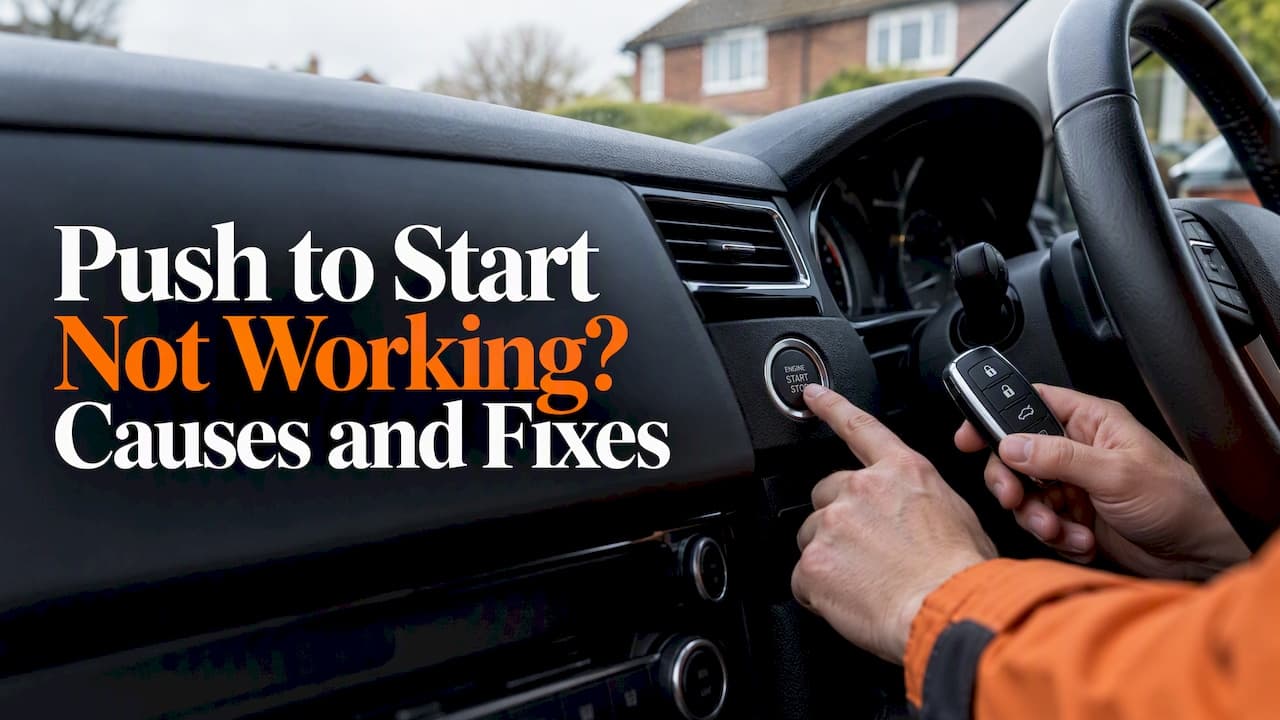
When the push to start button does nothing, the cause is usually one of four things: the brake or clutch pedal isn't registering, the battery in the fob is flat, the car's own 12V battery is weak, or the car can't recognise the key. The first three you can check in minutes at the roadside. The fourth, along with a failed ignition or a lost key, is where a locksmith comes in.
This guide takes the checks in the order that saves the most time. It also tells you what the symptoms mean and when a tow is a waste of money.
TL;DR
- Press the brake (or clutch) firmly and check that the dashboard responds before you assume the key or engine is at fault.
- Hold the fob against the start button. If the car starts, the fob battery is flat. If it doesn't, check the car battery next.
- A single click and rapid clicking mean different things. Listen before you ask for a jump start.
- A low car battery can trigger a "key not detected" message even when the key is fine.
- If the car still won't start, or the key is lost, a mobile locksmith can diagnose and reprogram on site without a tow. We cover Essex and Hertfordshire.
Table of Contents
- Start with the basics: pedals, gear and the dashboard
- What the dashboard and the sounds are telling you
- Fix 1: A flat battery in the key fob
- Fix 2: The car's own battery is the real culprit
- Fix 3: The car can't recognise the key
- What you shouldn't do
- When the key is lost, stolen or dead
- Our view: why we don't start with the key
- What we can do for you in Essex and Hertfordshire
- Locksmith, dealer or garage: who fixes what?
- FAQ
- Sources
Start with the basics: pedals, gear and the dashboard
A push-button system won't fire the engine unless the car's computer is satisfied that it is safe to do so. Pressing the button sends a request, and the engine control unit then checks things like the park or neutral position and the brake pedal switch before it lets the starter engage.
That is why the AA lists a pedal that isn't fully pressed, or a faulty brake pedal switch, among the common reasons a car won't start. Before anything else:
- Press the brake firmly (automatic) or the clutch fully down (manual) and hold it as you press the button.
- Check the car is in Park or Neutral.
- Press the button once, without holding it, and watch what the dashboard does.
- Check the steering wheel isn't locked. Turn it slightly left and right as you press.
A useful clue: if you press the brake and the brake lights don't come on, the brake switch may be the problem. Many cars will refuse to start because the switch tells the computer the pedal hasn't been pressed. That is a repair job, but a simple one.
What the dashboard and the sounds are telling you
Pay attention to exactly what happens when you press the button. The symptom narrows the cause quickly.
| What you see or hear | Likely cause | First thing to try |
|---|---|---|
| Nothing at all, no lights | Flat car battery or loose terminals | Check battery voltage and connections |
| Lights and radio work, but no crank | Low battery voltage, starter or alternator fault | Test the battery under load |
| Single click | Faulty starter motor or solenoid | Have the starter checked |
| Rapid clicking | Battery without enough charge to turn the starter | Jump start or charge, then test |
| "Key not detected" message | Flat fob battery, weak car battery, interference or a key fault | Hold the fob to the start button |
| Engine cranks but won't fire | Fuel, spark or sensor problem | Breakdown or garage |
| Dashboard lights but button ignored | Brake switch, immobiliser or key recognition | Pedal check, then key diagnosis |
If the car cranks but never fires, you are looking at a fuel or engine issue, not a key issue. The key is doing its job. That is a garage or breakdown job rather than ours.
Fix 1: A flat battery in the key fob
This is the cheapest cause and the most common reason for the "key not detected" warning. A keyless fob talks to the car by radio, and a weak coin cell can leave it too quiet for the car to hear.
Signs the fob battery is fading: you have to hold the fob closer to the car to unlock it, the remote lock button needs several presses, or the warning has started appearing on cold mornings.
How to confirm it without a spare battery:
- Hold the back of the fob directly against the start button, or place it in the slot or tray your handbook shows (often in the centre console or cup holder).
- Press the brake and press the button.
- If the car starts, the fob battery is the problem.
This works because the car reads the chip in the key by close-range induction, without needing battery power. Makers describe it in their manuals. Mazda's owner's manual covers starting by holding the transmitter over the button when the key battery is dead, and warns about things that can interrupt the signal. Check your own handbook for the exact spot on your model, because it varies.
Most fobs take a CR2032 or CR2025 coin cell, though you should check which one yours uses. If a new battery doesn't cure it, the fob itself may have a fault. Our guide to starting a car with a dead key fob goes through the emergency options model by model.
Fix 2: The car's own battery is the real culprit
Here is the trap that costs drivers money. A low main battery can produce a key warning even when the key is perfect. The car's receiver needs enough voltage to read and authenticate the key, and when the voltage sags the error can appear anyway. Replacing a working key because of that is an expensive mistake.
What to check:
- Do the lights and radio work? Working electrics don't prove the battery is healthy. They draw little current compared with a starter motor.
- Voltage at rest. A healthy battery should read around 12.6V on a multimeter, according to the AA's advice. Lower than that, or a car that won't crank, means the battery, starter or alternator charging system needs a professional check.
- Cold weather. Cold reduces a battery's cranking power and thickens the oil, so the starter works harder. An ageing battery that coped in September can fail in the first frost.
- Short journeys. Repeated short trips never fully recharge a battery, and cars with stop/start systems are especially fussy about charge level.
- Terminals and earth strap. Look for loose or corroded battery clamps. The earth strap between battery, chassis and engine block can corrode or break, and it mimics a dead starter or battery because the circuit can't complete. It is a classic cause of intermittent no-starts, particularly on older cars and vans. A thread on the RAC forum about a van starting fault points the same way: test the battery and charging first.
If you want a structured way to separate a battery fault from an alternator fault, this battery or alternator triage guide walks through it. It is written for a Canadian audience, but the electrical logic is the same in the UK.
A jump start will tell you a lot. If the car fires with a boost but dies again the next day, suspect the battery or alternator, not the key.
Fix 3: The car can't recognise the key
If the pedals are right, the fob has a fresh battery, and the car battery tests healthy, the fault is likely in key recognition. The usual suspects:
- A failed transponder chip in the key. Chips can fail after a drop, water exposure or simple age. See our guide to a transponder key not working.
- A key that lost its pairing with the car, for example after a battery replacement or an electrical fault.
- Radio interference or a damaged fob case, which can stop the fob and the car hearing each other. Our checklist on a smart key not detected covers the five checks worth making before calling anyone.
- A fault in the car's antenna or receiver module, which a diagnostic tool can identify.
- A worn ignition or start switch, which stops the button registering at all.
If the car starts with the fob held against the button but not otherwise, you've ruled out a total key failure. The chip is working and the problem is the fob's battery or its radio side. If the car won't start either way, with a healthy car battery, the problem is the key's chip, the pairing or the car's receiver.
This is the point where guessing gets costly. A mobile locksmith with the right diagnostic equipment can read what the car is reporting, test the key and, if needed, cut and program a new one at your location. For fault-finding around entry rather than starting, see keyless entry not working and key fob not working.
What you shouldn't do
- Don't keep hammering the button. Repeated attempts on a weak battery can drain it further and may trigger immobiliser lockouts on some cars.
- Don't buy a replacement key before testing the car battery. The key may be fine.
- Don't use a cheap unbranded fob or copy from an online listing. Some won't pair properly, and a failed attempt can leave the car in a worse state.
- Don't tow before ruling out the simple causes. If the car won't start because of a key or pedal issue, a tow only moves the problem to a dealer's forecourt.
When the key is lost, stolen or dead
Sometimes there isn't a diagnosis to make, because the key is gone or broken. This is the key-related part of a no-start that we handle every day.
All keys lost. If you have no working key, the car has to be programmed to accept a new one, which needs specialist equipment. Our write-up of all keys lost programming explains the technician steps, and why it's usually a one-visit job.
Stolen key. If a key has been stolen, the old key should be deleted from the car's memory so it can't start the vehicle. We offer stolen key deletion and reprogramming.
Relay theft worries. If your fob stopped working and you suspect someone has tampered with your car, it is worth knowing the law is moving. The government has said it will ban devices used in vehicle theft, with up to five years in prison and an unlimited fine for possession, manufacture or supply. The Home Office estimated that 40% of vehicle thefts in England and Wales involved manipulating remote locking signals as of 2024. Report suspected theft to the police.
Programming needs a stable supply. A weak car battery can wreck a programming session, which is why technicians connect a power support unit. Our blog explains why battery support matters when programming immobilisers.

Our view: why we don't start with the key
We get a lot of calls that begin "my key has stopped working". About as many end with a different diagnosis: a tired battery, a sticky brake switch, a corroded terminal. We would rather tell you that on the phone than book you a visit you don't need.
Our approach is to work from the simplest cause outward. We ask what the dashboard says, whether the fob works when held to the button, and how old the car battery is. If those point to the key, our vans carry the diagnostic tools to confirm it on your driveway or in a car park. Everything is done at your location, usually within 30 to 60 minutes, so there's no tow to a dealership and no day without the car.

Our technicians are licensed, insured and SERMI-certified, and we work on modern, complex security systems. We want you to leave knowing what was wrong, not just with a key that works.
One piece of advice we repeat often: get a spare made before you need one. Programming a spare when you still hold a working key is simpler than an all-keys-lost job, and it gives you a backup if the fob fails on a cold morning.
— James
What we can do for you in Essex and Hertfordshire
If you've worked through the checks and the car still won't start, we can come to you. We cover Harlow, Chelmsford, Epping, Brentwood, Billericay, Bishop's Stortford, Sawbridgeworth, Great Dunmow, Ongar, Ware, Writtle, Braintree, Stansted, Loughton and nearby areas.
Published prices start at:
- Key programming: from £120
- Lock and ignition repair: from £120
- Standard key: from £120
- Remote key: from £150
- Emergency callout: from £120
Final cost depends on your make, model and what the fault turns out to be. We also replace key fobs, delete stolen keys and handle van keys. See the full list on our services page, or browse more on our blog.
Locksmith, dealer or garage: who fixes what?
| Problem | Best first call |
|---|---|
| Flat fob battery | You, with a coin cell, or us |
| Weak or failing car battery | Breakdown service or garage |
| Starter motor or alternator fault | Garage |
| Brake switch fault | Garage, or us if the ignition is involved |
| Key not recognised, chip failed | Mobile auto locksmith |
| All keys lost or stolen | Mobile auto locksmith |
| Worn ignition or start switch | Mobile auto locksmith or garage |
The useful thing about a mobile locksmith is that you avoid the tow. If it turns out to be a battery or starter fault, we will say so, and you will have saved the cost of a key you didn't need.
FAQ
Why does my push to start say "key not detected" when the key is in the car?
The fob battery may be flat, or the car's own battery may be too weak to read the key. Try holding the fob against the start button. If that works, replace the fob battery. If it doesn't, have the car battery tested before replacing the key.
Can I start a push button car with a dead fob?
Usually, yes. Most cars let you hold the fob against the start button or place it in a marked tray, so the car reads the chip without battery power. Your handbook shows the exact spot. Press the brake while you do it.
Why does my car click once when I press the start button?
A single click often points to a faulty starter motor or solenoid, not a flat battery. Rapid repeated clicking is more typical of a battery without enough charge. Listen for which one you get before you ask for a jump start.
How much does it cost to replace a push start key?
Our published prices start from £120 for a standard key and from £150 for a remote key. The final price depends on the make and model. Contact us with your registration and we will confirm the cost before we come out.
Do I need a tow if my keyless car won't start?
Not usually. Many causes, from a flat fob battery to a lost key or a failed chip, can be fixed where the car is parked. A tow is only worth it for faults that need a garage workshop, such as a failed engine component.
Sources
- The AA: Top reasons why your car won't start
- Mazda owner's manual: Start/Stop Engine
- Under Hood Service: Diagnosing push-button keyless start systems
- AA1Car: Diagnose Start Engine Push Button
- Tivoli Auto Services: Hidden winter problems that catch drivers out
- RAC Forum: Renault Master starter
- GOV.UK: Vehicle theft equipment to be banned under new government law