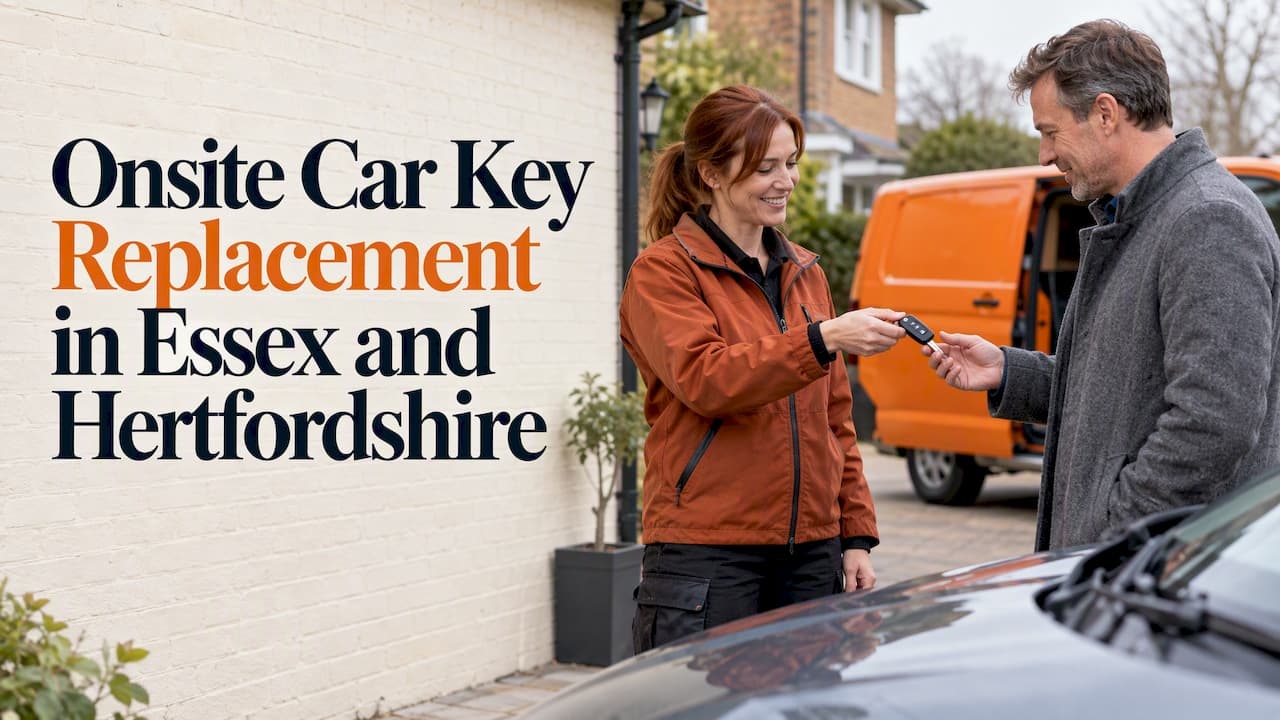
Onsite car key replacement means a locksmith drives to your car, cuts the key, programs it to the vehicle and tests it there, so nothing is towed and you don't wait for a dealer slot. We do this across Essex and Hertfordshire, and our vans are set up to finish most jobs at the roadside, in a car park or on your drive, typically within 30 to 60 minutes. Standard keys start from £120 and remote keys from £150.
TL;DR
- An onsite locksmith can replace and program most car and van keys at your location, even when you have lost every key you own.
- Have your photo ID, proof you own or are entitled to use the vehicle, and the registration ready. The V5C is the document most providers ask for.
- Our published prices start from £120 for a standard key and from £150 for a remote key. Complex or keyless vehicles can cost more, so always get the final quote before work begins.
- A dealer may still be needed for a small number of vehicles, and Ford itself says so for some of its models.
- Check that the technician is insured and SERMI-certified before they touch your immobiliser.
Table of Contents
- What onsite car key replacement actually involves
- Can a key be replaced when you have lost the original?
- What you need to show before a key is made
- What it costs with us
- How long does it take?
- Onsite locksmith or dealer?
- Our perspective: where we see jobs go wrong
- Booking an onsite replacement with us
- Check these before you agree to any mobile key job
- FAQ
- Sources
What onsite car key replacement actually involves
A modern car key is three things in one. There is the metal blade (if it has one), the remote that locks and unlocks the doors, and a transponder chip that talks to the immobiliser. Most cars now have an electronic immobiliser built into the key, which is why a hardware shop cannot simply copy it.
So a replacement is not just cutting metal. The locksmith has to do four things:
- Identify the exact key type for your make, model and year.
- Cut the blade, or supply the blank for a keyless fob.
- Connect diagnostic equipment to the car's OBD port and pair the new key with the immobiliser.
- Test the remote, the door locks and the ignition (or push-button start) before leaving.
When all of this happens at your location, it is what people mean by mobile or onsite replacement. The difference from a workshop is only where the work is done. The kit, the skill and the security checks are the same.
Why a van can do what a key kiosk cannot
A high-street kiosk can cut a mechanical key. It generally cannot talk to your car's security system. Our vans carry diagnostic and programming equipment, which is what allows dealership-level work on the spot. If you want the detail of how a key is paired, our guide to car key coding explains what it is, what it costs and who can do it.
Can a key be replaced when you have lost the original?
Yes. This is the most common worry, and the answer is reassuring. ALA's replacement FAQ says a replacement is generally possible even when the original is lost, including for keyless-entry fobs. The process does depend on the vehicle's make, model, age and key type, and may involve proof of ownership, identity checks and immobiliser pairing.
This is called an all keys lost job. The locksmith has no working key to clone, so they program a brand new one straight to the car's computer. It takes more steps than adding a spare, which is why it often costs more. We have set out the sequence in 8 steps to fix an all keys lost situation in one visit.
If your smart key has gone
Keyless fobs are not a dead end either. Many can be replaced without a tow, and our piece on replacing a lost smart key covers what to expect.
What you need to show before a key is made
A good locksmith will ask who you are and whether the car is yours. That is not bureaucracy. It protects you, because the same skill that makes you a key could make a thief one.
Autotrader says the basic documents are proof of identity, such as a driving licence, and the V5C vehicle document. It adds that knowing the exact make and model helps the provider cut the correct key. RAC Drive says arrangements normally need the make, model, year and registration, plus the VIN where available.

Ford shows how seriously manufacturers take this. For a coded key, its UK procedure requires you to attend a dealer in person with photo ID and vehicle documents showing the VIN and your name. A replacement is tied to the vehicle's anti-theft system, so it is never just a copy.
Your pre-call checklist
- Photo ID (driving licence or passport).
- The V5C, or other proof you are the keeper or authorised user.
- Registration number, make, model and approximate year.
- The VIN, found on the V5C and at the base of the windscreen. If you want to understand how those characters are read, this walkthrough on decoding a VIN shows the structure.
- Any remaining key, even a broken one, and the key's shape (blade, flip or push-button).
Will the VIN alone do it?
Not usually. ALA notes a VIN may sometimes give the manufacturer's key specification so a blank can be cut. But a VIN alone generally does not complete the job, because modern vehicles still need programming and immobiliser pairing, and sometimes a new transponder.
What it costs with us
Here are the prices we publish. Each is the starting point, not a fixed quote for every vehicle.
| Service | Our price |
|---|---|
| Standard key | from £120 |
| Remote key | from £150 |
| Key programming | from £120 |
| Car lockout | from £120 |
| Lock and ignition repair | from £120 |
| Emergency callout fee | from £120 |
Services such as all keys lost replacement, stolen key deletion, key copying and cutting, key fob repair and van key replacement have no published price, because the cost depends on the vehicle. Tell us the make, model and year and we will quote before we start.
What moves the price
- Key type. A mechanical blade is cheap. A remote flip key costs more. A proximity smart key usually costs the most.
- Make and model. Some brands lock down their security more than others, which affects the programming time.
- Lost all keys or adding a spare. With no working key, the car has to be programmed from scratch.
- Urgency and location. Emergency callouts are priced separately from booked appointments.
- Extra work. A worn ignition or damaged lock may need repair on top. See our lock and ignition repair service.
Could your insurance help?
Some policies include lost key cover. Carwow points out that this can be cheaper than paying the full price yourself. Check your policy wording for key cover and the excess before you book. If the excess is close to the cost of the job, paying directly may be simpler, and you avoid a claim on your record.
How long does it take?
The cutting itself is quick. Carwow reports that physical key production can take as little as 20 minutes, whereas an OEM key through a franchised dealer may take far longer, potentially weeks.
For our own jobs, the typical visit lasts 30 to 60 minutes once we arrive. Rare or heavily protected vehicles can take longer, and we will say so on the phone rather than promise a time we can't keep.
Onsite locksmith or dealer?
Both have a place. The honest comparison looks like this:
| Onsite locksmith | Dealer | |
|---|---|---|
| Where the work happens | Your location | Their workshop |
| Towing if you have lost all keys | Not needed | Often needed |
| Typical wait | Under an hour of work on site | Can run to days or weeks |
| Booking | Same day often possible | Appointment and parts order |
| Best for | Most cars and vans, emergencies | Some vehicles with restricted systems |
Ford says its keys use a vehicle-specific Passive Anti-Theft System. It states that a replacement must be programmed to that vehicle and that, where necessary, the vehicle may have to be transported to the dealer. That is the exception, not the rule, but a trustworthy locksmith will tell you honestly if your car falls into it, before you pay for a callout.
Our perspective: where we see jobs go wrong
Most of the stress we see is not about the key itself. It is about the tow. A driver loses their only key in a supermarket car park in Harlow or Chelmsford, and the assumption is that the car must go to a dealer on a flatbed. It usually doesn't.
Three things we would tell a friend:
- Order a spare before you need one. Adding a key when you still have a working one is simpler than an all keys lost job. If you are down to one key, treat that as the problem to fix this week.
- If a key is stolen, don't just replace it, delete it. A stolen key can still start the car. Reprogramming the vehicle so it no longer recognises the old key is what protects you. Carwow's advice for stolen keys is to contact the police, your insurer and a specialist locksmith or dealer, since the car may need reprogramming.
- Ask about certification. Our technicians are licensed, insured and SERMI-certified. SERMI is the scheme that governs access to security-related vehicle data, so it is a fair question to put to anyone about to programme your car.
Van owners feel the cost of downtime most. A van stuck on a job site loses a day of work, and a tow adds to the bill. Mobile service is built for that situation.
— James
Booking an onsite replacement with us
We cover Harlow, Chelmsford, Epping, Brentwood, Billericay, Loughton, Ongar, Great Dunmow, Braintree, Stansted, Sawbridgeworth, Bishop's Stortford, Ware and surrounding areas in Essex and Hertfordshire. Our vans carry the equipment to cut and program on the spot, for cars and vans of all major makes.
If you need a key now, start with our key programming service page, or see the full list of mobile locksmith services for lost keys, spares and van keys. Locked out with the key inside? Our car lockout service uses non-destructive entry so the car is not damaged.

Have your registration, ID and V5C to hand when you call, and we can usually give you a firm quote within minutes.
Check these before you agree to any mobile key job
A few questions will protect you from poor service, whoever you call.
- Does it cover your vehicle? Give the exact make, model and year and ask for confirmation that they can programme that car, not just most cars.
- Will they check ID? A provider that makes you a key with no questions is a red flag.
- Is the quote complete? Ask whether it includes the key, cutting, programming, callout and VAT, and what happens if the job turns out harder than expected.
- Are they insured and certified? Ask about insurance and SERMI status.
- Is there a warranty? Ask what happens if the key stops working.
- Will the old key be deleted? If a key was stolen, say so, and ask for it to be removed from the car.
Other jobs we do at the same visit
A visit can solve more than one problem. If your key casing has cracked, we can replace a car key case in 30 to 60 minutes. If you want to understand cutting from a code, read key cutting by code. Brand-specific pages cover common questions, such as Audi key programming and Kia car key replacement. If the lock itself is the issue, rekeying a car lock can save money against a full replacement.
FAQ
How much does onsite car key replacement cost?
Our standard key starts from £120 and a remote key from £150. Programming, lockouts and lock repairs also start from £120. The final price depends on your make, model, key type and whether you have lost all your keys, so we confirm it before starting.
Can you make a key if I have no spare and have lost the original?
Yes, in most cases. An all keys lost job means programming a new key directly to the car. You will need to prove who you are and that the vehicle is yours, usually with photo ID and the V5C.
Do I need to have the car towed?
Usually not. Our vans carry the equipment to cut and program on site. A small number of vehicles with restricted security systems may need dealer attention, and Ford, for one, says that can apply to some of its models. We will tell you at the quote stage.
How long will I wait?
Once we arrive, a typical job takes 30 to 60 minutes. Dealer-supplied keys can take far longer, potentially weeks according to Carwow's guide. Tell us how urgent it is when you call and we will give you a realistic arrival time.
Sources
- What to do if you've lost your car keys, Carwow
- How do I get a Replacement Ford Key?, Ford UK
- Seven steps to get a car key replacement, Autotrader
- What to do when you lose your car keys, RAC Drive
- Replacing lost or stolen car keys FAQs, ALA
- Decode Classic Car VIN Numbers, Butter Classics