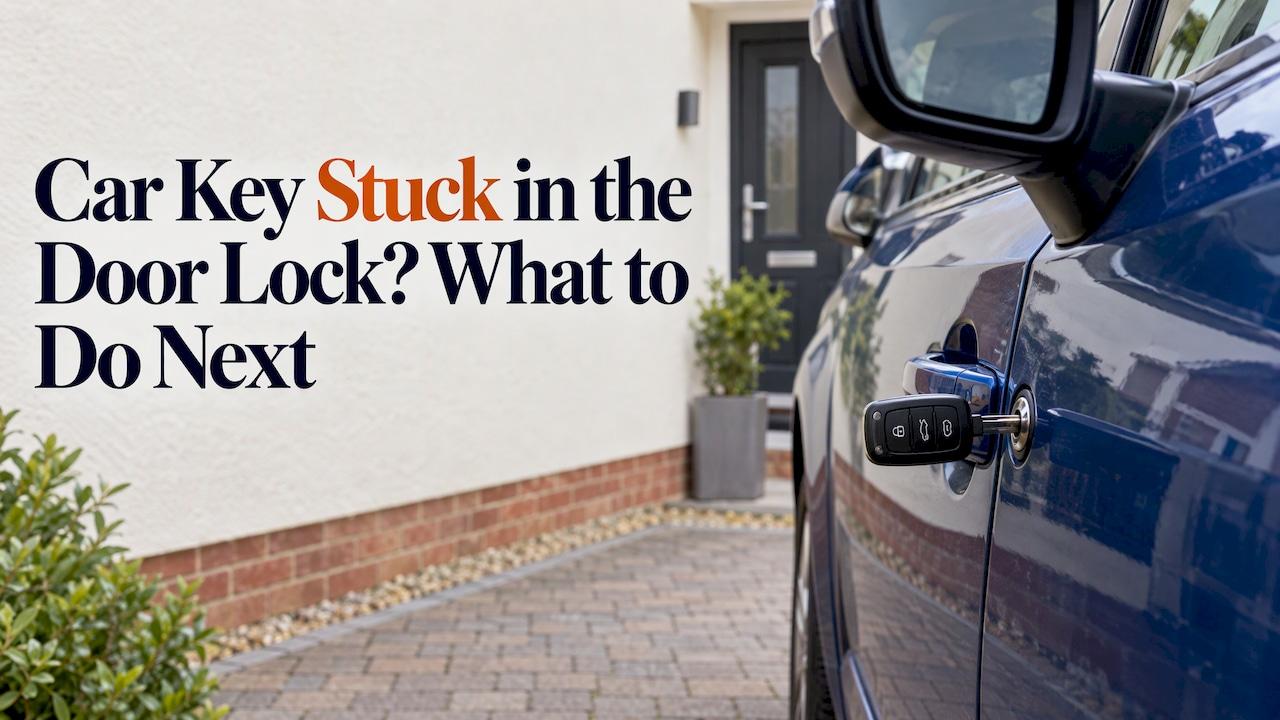
If your key is stuck in a car door lock, stop pulling on it. Leave the key where it is, keep the door as it is, and call an auto locksmith. Forcing a stuck key is the quickest way to turn a nuisance into a snapped key, a damaged lock and a bigger bill. In Essex and Hertfordshire, our mobile locksmiths come to you, so the car stays where it is and nobody has to tow it anywhere.
This guide explains why keys jam, what to do in the first few minutes, what to avoid, and what happens when a locksmith arrives. It is written for car and van owners who want the key out and the car working again, with as little fuss as possible.
TL;DR
- Do not force, twist hard or hammer a stuck key. A key forced out can snap in the lock, and taking the lock apart makes things worse.
- Note whether the door is locked or unlocked, and whether the key turns at all. A locksmith will ask.
- A locksmith can remove a key stuck in a lock whether the door is locked or unlocked, usually without replacing anything.
- Our mobile vans cover Essex and Hertfordshire, and we typically work on site within 30 to 60 minutes. Lock and ignition repairs start from £120.
- Once the key is out, regular cleaning and a worn-key check stop it happening again.
Table of Contents
- Why a car key gets stuck in the door lock
- What to do first
- Locked door versus unlocked door
- What we do when we arrive
- If the key has snapped
- What it costs
- Keeping the key from sticking again
- Vans, remote keys and modern fobs
- Why a mobile locksmith rather than the dealership or a tow
- Stuck key in Essex or Hertfordshire? Call us
- FAQ
- Sources
Why a car key gets stuck in the door lock
A car door lock is a small cylinder containing a row of spring-loaded wafers or pins. The correct key lifts each one to exactly the right height, and the cylinder turns. When anything interferes with that, the key can stop mid-way: it will not turn, it will not come out, or it does both.
The usual causes are:
- A worn key. Keys that have been copied from copies, or used for years, lose their sharp cuts. A worn key no longer lifts every wafer cleanly, so it can bind halfway.
- A bent key. A key that has been leant on, used as a lever or sat on in a back pocket can be slightly twisted, enough to catch inside the lock.
- Dirt and grime. Road dirt, dust and old lubricant build up inside door locks, which sit low on the door and take a lot of weather. A gritty lock grips the key.
- A worn or damaged lock. Internal wafers wear, break or stick. This is common on older cars and on the driver's door, which is used far more than any other.
- Cold, damp or frost. Moisture inside the cylinder can freeze overnight and make the lock rigid.
- A failed cheap copy. Badly cut duplicates look right but do not match the lock's tolerances, and they are a regular culprit when a key suddenly sticks.
None of these is your fault, and none is rare. What matters is what you do in the next five minutes.
What to do first
The UK Master Locksmiths Association's advice, repeated on its stuck key guidance, is simple: do not force the key out because it could snap in the lock, do not try to take the door lock apart yourself, and leave the key alone and phone a locksmith. That is the right instinct for a car door too, where the lock is tied into the door handle, the central locking and, on many modern cars, the alarm.
Here is the sequence we would follow if it were our own car.
- Stop. Take your hand off the key. Every extra tug risks bending or breaking it.
- Check the basics, gently. Is the key fully inserted? Sometimes a key is simply not pushed all the way in and looks stuck. Light pressure to seat it is fine. Heavy force is not.
- Note what state the car is in. Is the door locked or unlocked? Are the other doors locked? Is anything inside, such as a child, a pet or a phone? If a child or animal is locked inside in hot weather, call 999.
- Do not use tools in the lock. Pliers, screwdrivers and bent wire can mark the lock face, push the key in further or break the tip off inside the cylinder.
- Take a photo of the key in the lock and note your car's make, model and registration. It speeds up the call.
- Call a mobile auto locksmith and describe what you see. If the key is partly out, say so. If a piece has already snapped, say that too.
If it is raining or you are somewhere unsafe, lock yourself into a safe place and wait. A key stuck in the door does not make the car less secure than it already was, but a snapped key can leave the lock unusable, so it is better to wait than to try again.
Locked door versus unlocked door
It helps to tell the locksmith which of these you are in, because the job is slightly different.
| Situation | What it usually means | What the locksmith does |
|---|---|---|
| Key stuck, door unlocked, car accessible | The lock is gripping the key but the car is open. | Frees the key, checks the lock and key condition, and cleans or repairs the lock if needed. |
| Key stuck, door locked, keys inside | You are locked out and the lock is jammed. | Gains entry without damaging the car, then removes the stuck key. |
| Key stuck, door locked, key is your only one | You still have the key but cannot use it normally. | Frees the key and tests the lock. A replacement key can be cut and programmed if the old one is worn. |
| Part of the key snapped inside | The broken piece is lodged in the cylinder. | Extracts the piece, then cuts a new key if the original cannot be used. |
The Master Locksmiths Association's guide notes that a locksmith can take a key out of a lock whether the door is locked or unlocked, and that an unlocked door is the easier job. Either way, you do not need to replace the lock simply because a key stuck.
What we do when we arrive
Our vans are equipped with diagnostic tools, so the work is done at your location rather than a garage or dealership. We typically reach customers and complete the job within 30 to 60 minutes. Our technicians are licensed, insured and SERMI-certified, which means they are experienced with modern vehicle security systems. SERMI is the scheme under which locksmiths and repairers can be approved for access to vehicle security-related information, and it matters because today's keys often contain transponder chips that the car checks before it will start.
What happens on site depends on the cause, but the pattern is this:
- Assess the lock and the key. We look at how the key is sitting, whether it is bent, whether there is debris, and whether the lock is turning at all.
- Free the key carefully. The aim is to release it without breaking it and without marking the lock, so the car is not left with cosmetic damage.
- Check how the lock behaves. If the lock is worn or damaged, we can carry out lock repair work from our lock and ignition repair service.
- Assess the key itself. If the key is bent, worn or cracked, we can make you a new one and programme it to your vehicle. It is far cheaper to replace a worn key now than to wait for it to fail in the lock again.
- Test it. Before we leave, you will see the key go in, turn and come out smoothly, and the door locking and unlocking as it should.
If you are also locked out, the entry is done without damaging the car using our car lockout service.
If the key has snapped
A key that breaks in the door lock, or in the ignition, is a different problem and it is time-sensitive in one respect: do not try to dig the piece out with a pin or a knife. You are likely to push it deeper and scratch the cylinder. Keep the broken piece if you have it, because it can help the locksmith match the cut. Our guides on what to do with a broken car key in the lock and on a snapped key in the ignition cover each case in more detail.
A key stuck in the ignition rather than the door often points to a worn key or a worn ignition barrel, and the steering lock may also be engaged. That is a different mechanism, and the first step is the same: do not force it.
What it costs
Our published prices are fixed starting points, not estimates of every job:
| Service | Price |
|---|---|
| Vehicle lock and ignition repair | from £120 |
| Car lockout | from £120 |
| Emergency callout | from £120 |
| Key programming | from £120 |
| Standard key (Ford example) | from £120 |
| Remote key (Ford example) | from £150 |
The final price depends on your vehicle, the type of key and what the lock needs. Prices are one-off, per job, and you will be told what applies to your car when you call. Because we come to you, there is no towing bill and no day without the car at a dealership.
Keeping the key from sticking again
Once the key is out and the lock has been checked, a few habits make a repeat unlikely.
- Replace worn keys early. If a key has visibly rounded cuts, needs jiggling to turn, or has been copied from a copy, have a fresh one made from the original code or from the car. A new key is the single most effective fix for a lock that sticks.
- Keep the keyring light. A heavy bunch of keys hanging from the key in the ignition wears the barrel. It matters less in the door, but a heavy fob still twists the key.
- Do not use the key as a lever or screwdriver. It bends the shaft in ways that are not always visible.
- Keep the lock clean. Dust and grime build up in a door lock over time. Cleaning the surrounding door area keeps debris from getting carried into the keyway, and our partners' guide to cleaning door jambs safely shows a quick routine that avoids harming the paintwork.
- Choose lubricants with care. Thick oils can mix with grime already in the lock and make a stiff mechanism worse. Ask us which product suits your lock when we are with you, rather than spraying whatever is in the garage.
- Do not ignore early signs. A key that is stiff to insert, or a lock that sometimes refuses to turn, is the warning. Our guide to a door lock that has seized explains what to look for.
If your car door will not open with the key but the key is not stuck, the cause may be different: a low key fob battery, a faulty actuator or a frozen lock. Our guide on a car door that will not open with the key walks through the options, and if the car battery is flat as well, see how to get back in with a dead battery.
Vans, remote keys and modern fobs
A lot of the cars and vans we deal with have remote keys or transponder keys. When one of these jams in a door, the issue is nearly always the metal blade or the lock, not the electronics, but a sticking key can also point to a damaged blade that will soon fail altogether. For work vehicles, a day off the road costs money, so a quick on-site fix matters. We carry out van key replacement as well as car keys, and where a key needs replacing we can programme the new one on site.

If you have a spare that is still in good condition, tell us. It is useful to compare against the stuck key, and it is also a reminder that having a spare cut before a key fails is cheaper than doing it in an emergency.
Why a mobile locksmith rather than the dealership or a tow

With a stuck key you have three practical options: the vehicle's dealer, a tow to a garage, or a mobile locksmith. The first two mean moving a car that has a key stuck in it and a lock that may not work. They also mean waiting for a booking slot.
A mobile locksmith comes to the car. That is the whole advantage, and it is why we built our service this way: dealership-level work on site, with no tow, usually inside an hour, and with a key that can be programmed to the car where it stands. For a driver stuck on a driveway in Harlow, in a car park in Chelmsford or outside a unit in Braintree, that is the difference between losing an afternoon and losing a few minutes.
Our view on stuck keys
Almost every stuck-key call we get begins with someone who has already tried to pull, twist or lever the key. That is understandable, but it is the single step that turns a simple extraction into a snapped key or a damaged lock. Our advice is always the same: stop, call, and let us do the careful part.
We built our vans so that the whole job happens at your car. Our technicians are licensed, insured and SERMI-certified, and they carry the diagnostic tools to deal with modern keys and lock systems on site. That means that if the stuck key turns out to be worn, we can make and programme a new one while we are there, rather than sending you away with a half-solved problem.
A stuck key is a warning that something in the lock or the key is wearing out. Fixing both at once, in one visit, is better for you and for your car.
James
Stuck key in Essex or Hertfordshire? Call us
We cover Harlow, Chelmsford, Epping, Brentwood, Billericay, Bishop's Stortford, Sawbridgeworth, Great Dunmow, Ongar, Ware, Writtle, Braintree, Stansted, Loughton and the surrounding areas. Tell us the make and model, whether the door is locked, and what the key is doing, and we will send the nearest van. Repairs to a worn lock or ignition start from £120 on our lock and ignition repair page, and if you need an urgent visit, our emergency callout starts from £120 too.

Not sure whether you need a repair, a new key or a lockout? Our auto locksmith quiz points you to the right service in a minute, or you can start from our main page.
FAQ
My key is stuck in my locked car door. What should I do?
Leave the key alone and do not force it, because it can snap in the lock. Do not try to take the lock apart. Phone a mobile auto locksmith, tell them whether the door is locked and what make of car it is, and wait for them to arrive. We can free the key and, if needed, open the car without damaging it.
Can I get the key out myself?
The safest course is not to try. Pulling, twisting and levering are what snap keys and damage the lock. If part of the key is clearly visible and loose, the professional advice remains to leave it and call. A locksmith has extraction tools and can free the key whether the door is locked or unlocked.
Why does my key keep sticking in the door?
The usual reasons are a worn or bent key, dirt in the lock, or a worn lock. If it happens more than once, the key or the lock is the problem and it will return. Having the key replaced or the lock checked stops the pattern, and we can do either at your car.
How long will it take to get the key out?
We typically complete mobile jobs within 30 to 60 minutes. Freeing a stuck key from an accessible lock is often quick. If the key has snapped, or the lock needs repair or the car needs a new programmed key, it takes longer, and we will tell you what to expect when you call.
Will you need to replace my lock?
Not necessarily. A stuck key does not automatically mean a failed lock. We assess the lock once the key is out and only recommend repair or replacement if it is worn or damaged.