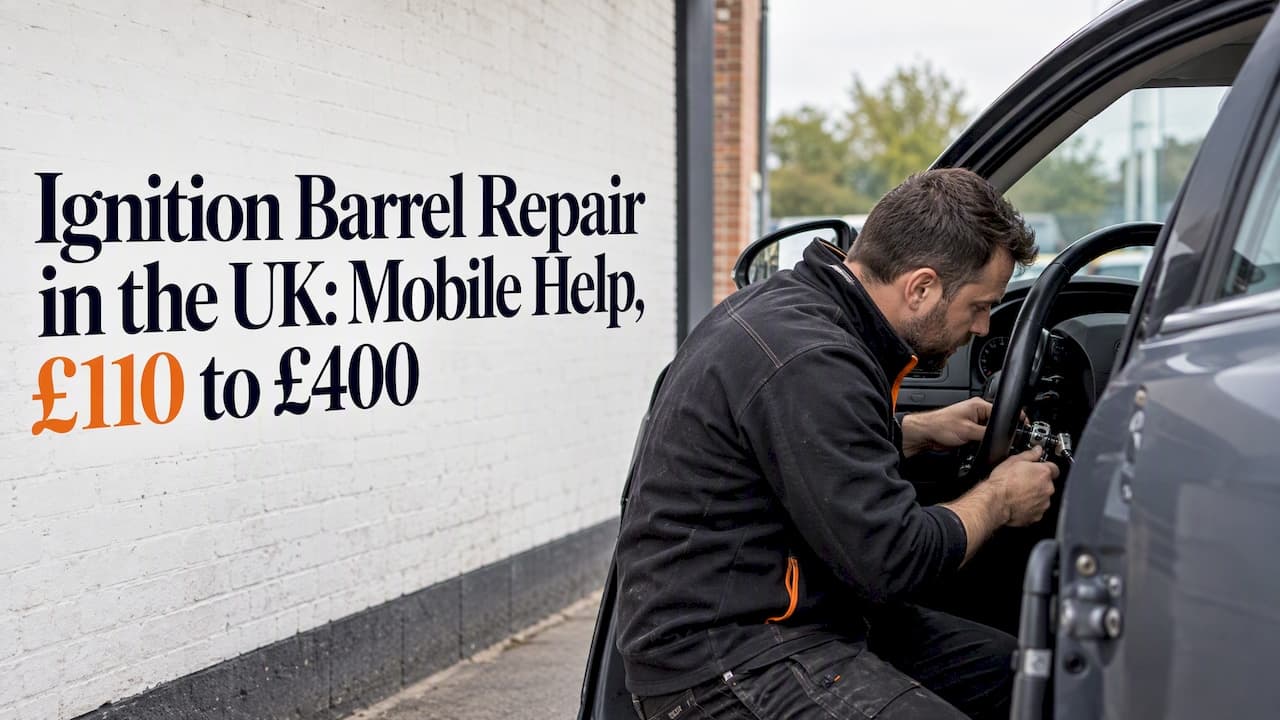
A sticky or sluggish ignition barrel is often fixable on-site in an hour or so, but a fully failed cylinder usually means replacement, new keys and transponder programming. Expect £110 to £400 for an independent fitted repair on most cars, more on premium or keyless models. Stop forcing the key, try a graphite or PTFE lock lubricant, and call a mobile auto locksmith if the problem persists.
TL;DR:
- Before booking, gently turn the steering wheel while turning the key, check dashboard or radio response, and replace a flat key fob battery if needed.
- Cleaning and repinning can fix a sound, sticky barrel in under an hour; seized cylinders usually need replacement, a new key, and immobilizer coding.
- Dealer fitting adds roughly 40% to 70% over independent work, while key cutting costs £5 to £40 and transponder programming costs £30 to £90.
- Keyless cars often need diagnostic equipment to pair a replacement ignition module with the immobilizer, so confirm the locksmith can code it before approving work.
Table of Contents
- Signs and quick checks for a failing ignition barrel
- What a typical repair or replacement involves
- Repair options and realistic UK cost ranges
- When to call a professional and how to choose an auto locksmith
- Field notes on ignition barrel repairs
- The real question isn't the barrel, it's the key work
- Booking a mobile fix for your ignition
- FAQ
- Sources
Signs and quick checks for a failing ignition barrel
A failing barrel rarely breaks without warning. Most drivers notice a pattern of small annoyances before the lock gives up completely.
- The key feels sticky, gritty or needs wiggling to turn.
- The key turns but nothing happens, no dash lights, no crank.
- The key physically jams and won't come out of the lock.
- Starting works some days and not others, with no obvious cause.
- The steering wheel feels locked even when the key turns.
- A keyless system flashes a "key not detected" warning despite a working fob.
Before calling anyone, run a few safe checks. Wiggle the steering wheel gently while turning the key, since a locked column often mimics a dead barrel. Check whether accessory functions, such as the dashboard lights or radio, still respond, which tells you whether the fault is mechanical or electrical. Swap or check the fob battery if you drive a keyless car, since a flat battery produces identical symptoms to a failed ignition module.
What you should avoid is forcing the key. Pushing harder on a sticky barrel is the single most common cause of a snapped key, and a snapped key usually means extraction tools, a locksmith visit and sometimes a tow, turning a cheap fix into a much bigger one.
What a typical repair or replacement involves
A technician arriving at your car follows a fairly predictable sequence, whether the fault turns out to be mechanical or electronic.
- Triage first. A quick visual and functional check rules out a flat fob battery, a jammed steering lock or a blown fuse before any lock is touched.
- Try the minor fix. Cleaning out debris, applying graphite or PTFE lubricant, and re-pinning worn tumblers resolves many sticky barrels in well under an hour, with a strong success rate on cars where the mechanism itself is only worn, not broken.
- Move to full replacement if needed. A seized or snapped barrel usually means swapping the cylinder or ignition switch, cutting a new key, and coding it to the car's immobiliser, a job that typically takes one to three hours.
- Test before finishing. A proper repair ends with several start cycles to confirm the fix holds, not a single successful turn of the key.
Keyless and push-button cars complicate this, since the "barrel" is often an electronic module or actuator rather than a mechanical tumbler, and replacing it usually needs dealer-level diagnostic equipment to re-pair it with the immobiliser.
Pro Tip: Ask whether the technician carries blank keys and a transponder programmer on the van, since that single detail decides whether your car gets fixed on-site or needs a second visit.
Repair options and realistic UK cost ranges
Three routes typically sort out a failing ignition barrel, and the right one depends on how far the fault has progressed.
A clean, lubricate and re-pin suits a barrel that's sticky but still mechanically sound, and it's the cheapest route by a wide margin. An aftermarket cylinder or switch replacement, paired with key cutting and coding, suits a barrel that's worn out or seized but the car itself is otherwise ordinary. A genuine dealer module tends to come into play on premium or keyless cars where the manufacturer's own diagnostic tools are needed to re-pair the system.

These bands and the 1 to 3 hour labour window come from UK cost data for fitted jobs, with dealer pricing running 40 to 70% higher than an independent fit for the same work.
A few extras commonly push the final bill up:
- New keys or fobs, with basic cutting from around £5 to £40 and transponder programming from roughly £30 to £90.
- Immobiliser pairing, required whenever the barrel or switch is swapped rather than just cleaned.
- A seized steering lock housing, which can force replacement of the whole assembly rather than the tumbler alone.
- An emergency callout fee if you need a technician out immediately rather than booked in.
Get an on-site diagnostic and a firm quote before agreeing to a tow or a dealer booking. A mobile visit often resolves the whole job for less than the cost of recovery alone.
When to call a professional and how to choose an auto locksmith
Some situations call for a professional straight away rather than more home troubleshooting.
- The key has snapped or is stuck fast. Forcing it further only makes extraction harder.
- The steering wheel is locked solid. This points to a mechanical fault that gentle wiggling won't clear.
- The car won't start at all, with no dash response. This usually means more than a simple clean and lube will fix.
When you call, ask whether the locksmith cuts and programs keys on-site, whether they've worked on your make and model before, and whether they're licensed and insured. Ask for an estimated time of arrival and a transparent quote before they start, not after.
A proper visit follows diagnosis, then quote, then repair, with parts carried on the van wherever possible and a test start before you pay. Be wary of anyone who won't give a price range over the phone or who pushes an expensive replacement before even looking at the car.
Field notes on ignition barrel repairs
Most of the ignition calls we attend split cleanly into two camps. A sticky barrel that's still turning, just roughly, usually responds to a clean and PTFE lubricant within the hour. A barrel that's seized, snapped, or paired with a dead keyless module needs a full swap, a cut key and immobiliser coding before the car will start reliably again.
Carrying dealership-level diagnostic kit on the van matters here, because coding a replacement key to the immobiliser without the right tools simply doesn't work. Our technicians are licensed, insured and SERMI-certified, which covers the security clearance needed to work on modern immobiliser systems rather than just the mechanical lock.
The real question isn't the barrel, it's the key work
The conventional advice on ignition faults tends to fixate on the lock itself, oil it, replace it, move on. That misses the part that actually determines your bill: whether the job needs key coding afterwards. A cheap cylinder swap can still cost more than expected if the new key needs pairing with an immobiliser that's fussy about aftermarket parts.
My honest view is that drivers should ask about coding compatibility before agreeing to any quote, not after the new barrel is fitted. A locksmith who mentions programming unprompted is usually the one who's actually done the job on your specific model before. The lock is replaceable. The electronics around it are where the real skill, and the real cost, sits.
— James
Booking a mobile fix for your ignition
If your ignition barrel is sticking, seized or snapped, we offer vehicle lock and ignition repair on-site, usually without needing a tow. Our vans carry dealership-level diagnostic kit, so key programming for a replacement cylinder happens in the same visit rather than a second appointment.

What to expect when you book:
- On-site diagnosis followed by a transparent quote before any work starts.
- Technicians who are experienced across most makes and models.
- Emergency lockout assistance if your ignition fault has left you stranded.
- A test start before you pay, so you know the fix has actually worked.
If dashboard readouts or your speedometer are also misbehaving alongside the ignition fault, that's usually a separate instrument cluster issue rather than part of the lock itself, and a specialist such as 5V Digital handles that kind of repair. For the ignition and key side, book directly through our lock and ignition repair page and we'll get a technician out to you.
FAQ
How do you remove a car ignition barrel?
Removing an ignition barrel usually means releasing a retaining pin or screw with the key inserted and turned to the correct position, then sliding the cylinder free. This varies significantly by make and model, and getting it wrong risks damaging the steering column, so it's worth leaving to a technician unless you're confident with your specific car.
What tool removes a broken key from the ignition?
A thin key extractor tool, sometimes paired with tweezers or a broken key extractor set, is the standard tool for pulling a snapped key fragment free. Mobile locksmiths carry these as standard, which avoids the scratching and further jamming that often happens with improvised tools.
How do you know if your ignition lock cylinder is bad?
Common signs include a key that sticks, turns roughly, or won't turn at all, along with intermittent starting problems and a steering wheel that feels locked. On keyless cars, a "key not detected" warning despite a working fob often points to the same underlying fault.
How much does it cost to replace an ignition barrel?
Independent fitted replacement typically runs from £110 to £400 for most cars, with premium or keyless systems reaching £280 to £900, while dealer fitting adds roughly 40 to 70% on top. Our vehicle lock and ignition repair service starts from £120, with key programming available from £120 where a new key needs coding to the immobiliser.