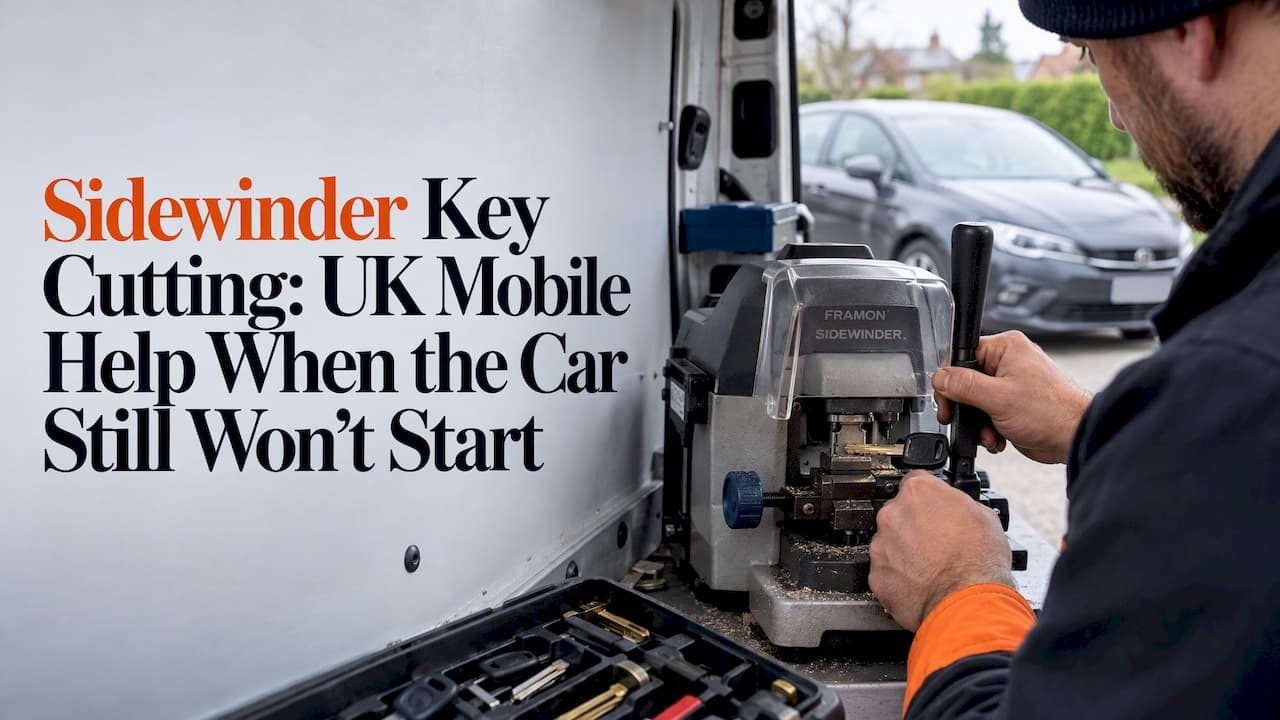
Yes, a sidewinder (laser) key can be cut by a trained locksmith, but the blade alone usually will not start the car. Many vehicles need the transponder chip inside the key programmed to match the immobiliser before the engine will fire. Domestic key-cutting kiosks can trim the metal but cannot touch that electronic step.
TL;DR:
- A working key lets a locksmith duplicate the blade without vehicle security codes, and bringing it usually makes the job quicker and cheaper.
- When every key is lost, the locksmith must originate the blade and access security data, so bring proof of ownership and expect higher costs.
- A failed remote with a working blade may need reprogramming alone; worn grooves, a cracked head, or recognition warnings warrant inspection before failure.
- Ordinary kiosks can cut household keys, but lack sidewinder milling and transponder programming, so use an automotive locksmith or dealer for a working car key.
- Before booking, confirm the locksmith can cut and program on site, carries sidewinder equipment, checks ownership, and offers proof of training and a warranty.
Table of Contents
- What a sidewinder (laser) key is and how it differs from ordinary keys
- How sidewinder keys are cut: machines and the mechanical process
- Programming and immobiliser pairing: why a cut blade may still not start the car
- Cost, typical timescale and the factors that change price
- Can you cut or copy a sidewinder key yourself, and what to do next
- What a trustworthy mobile locksmith visit looks like
- Signs your sidewinder key needs replacement or recutting
- Benefits of mobile sidewinder key cutting versus a dealer visit
- The gap between what sidewinder key cutting promises and what it actually needs
- How we can help with sidewinder key cutting and programming
- FAQ
- Sources
What a sidewinder (laser) key is and how it differs from ordinary keys
A sidewinder key, sometimes called a laser key, is cut differently to a standard household key. Rather than being cut all the way through from one edge, a sidewinder blade has material milled out of its face, leaving a wavy, S-shaped groove running down one or both sides. This is why locksmiths also call them side-milled or track keys.
There are two broad families. Internal-cut keys have the groove milled into the centre of the blade, while external or edge-milled keys have cuts closer to the blade's outer edges. Within those families, you will find two-track and four-track patterns, referring to how many milled grooves run along the key. A four-track key fitted to some models can be harder to duplicate without the right fixture.
Because side milling removes material from the face of the blade rather than slicing through it, the cutting path has to follow a precise depth and spacing sequence rather than a simple up-and-down pattern. Framon Sidewinder machines, among others, are built specifically to follow that path.
Many manufacturers adopted sidewinder-style keys once luxury and mainstream makes alike moved to higher-security locking systems, and the blank thickness, groove depth and spacing vary enough between manufacturers that a cutter calibrated for one make will often not suit another. That variation is the main reason a generic key-cutting machine cannot simply be adapted on the fly.

How sidewinder keys are cut: machines and the mechanical process
Professional locksmiths use purpose-built sidewinder machines rather than standard tracer or clamp cutters. Manual machines in the Sidewinder and SD2 family duplicate an existing key by tracing its pattern, while electronic machines such as Tri-Code and the Condor XC Mini can cut from a code or bitting number using an on-board database, which is useful when there is no working key to copy from.
Duplicating from an existing key generally follows this sequence:
- Align the cutter and guide to match the pattern key's groove.
- Clamp the pattern key and a matching blank into the correct jaws.
- Set the cutting depth against the pattern.
- Cut one side, then de-burr the fresh groove.
- Flip the blank and repeat the cut on the opposite face.
Originating a key from codes rather than a physical pattern uses a different approach. The technician sets depth and space rods, or loads the relevant data into software, fits a setup key to the machine, and code cuts each bitting position in sequence before finishing and testing the blank, a process documented in Framon's own sidewinder manuals.
Jaw selection and cutter diameter matter more than they might seem. Cutters come in different sizes, and fitting the wrong one can produce a groove that is too wide, too narrow or at the wrong depth, rendering the blank useless even though it looks correct. Calibration drift on a poorly maintained machine causes the same problem, which is part of why this work sits with specialists rather than general key cutters.
Pro Tip: If you still have a working key, bring it to the appointment. Duplicating from a pattern key is quicker and cheaper than originating one from scratch.
Programming and immobiliser pairing: why a cut blade may still not start the car
Cutting the metal blade only solves half the job. The transponder chip sealed inside the key's head has to be registered, or paired, with the car's immobiliser before the engine control unit will allow the car to start. The immobiliser sends a coded challenge to the chip, and the chip has to answer correctly, a check that happens every time you turn the ignition or press start.
On-site, a professional locksmith typically works through a set sequence:
- Identify the vehicle's make, model, year and immobiliser system.
- Connect a diagnostic tool via the OBD port to read the car's security data.
- Retrieve or calculate the security PIN where the system requires one.
- Write or pair the new key's transponder to the immobiliser.
- Test the start sequence, and erase lost or stolen keys from the system if asked to.
This workflow, outlined by Bullard Locksmiths, explains why a cut blade handed over without programming will turn in the lock but never start the engine.
A cut blade will not start the engine unless the chip is correctly synced with the immobiliser, a point confirmed by cost research into modern key replacement, which notes that programming and encryption, not the physical cutting, now drive most of the cost and complexity of a replacement key.
DIY programming kits exist, but they carry real risk unless you protect your keyless signals with an anti-theft signal blocking Faraday box. Getting a step wrong can lock the immobiliser into a fault state, and recovering from that often means a tow to a dealer and a far more expensive fix than the original job would have cost. Professional equipment and training exist precisely to avoid that outcome.
Cost, typical timescale and the factors that change price
Prices vary with the vehicle, the immobiliser generation and whether a working key already exists. As a broad guide, a spare transponder key cut and programmed from an existing key tends to sit at the lower end of the range, remote or proximity smart keys cost more because of the extra hardware and pairing steps, and an all-keys-lost job, where no working key or remote exists, is the most expensive scenario because the blade has to be originated from scratch and the security system accessed without a starting point.
A few factors tend to move the price most:
- The age and type of immobiliser system fitted to the vehicle.
- Whether the key blade needs to be originated rather than duplicated from a pattern.
- Whether the key is a basic transponder or a keyless proximity fob.
- Whether it is an all-keys-lost situation requiring full security data recovery.
By comparison, a basic household key cut at a B&Q in-store kiosk, typically run through a Timpson concession, costs around £7.00 for a single key, which is useful context but not a like-for-like comparison since those kiosks are not equipped for sidewinder milling or any transponder work.
Mobile locksmiths generally aim to reach a customer promptly, where distance and traffic allow, and complete cutting, programming and testing in a single visit. That can be more convenient than a dealer appointment, which may involve booking ahead and leaving the car while parts are ordered.
Can you cut or copy a sidewinder key yourself, and what to do next
Supermarket and hardware-store key kiosks, the kind found in B&Q or Timpson, handle flat, straight-cut household and simple padlock keys well. They are not built for the groove-milling accuracy sidewinder keys need, nor do they carry any transponder programming capability, so attempting one there will not produce a working car key.
What you should do depends on your situation:
- If you have a working key already, a locksmith can usually duplicate it on-site without needing the vehicle's security codes.
- If all your keys are lost or stolen, the blade has to be originated from the vehicle's identification details and the immobiliser's security data accessed directly, which takes longer and costs more.
- If your remote or fob has failed but the metal blade still works, you may only need reprogramming rather than a full key replacement.
Before booking anyone, it is worth asking a short set of questions: can they programme the key on-site rather than sending it away, do they carry sidewinder-capable machines such as an SD2 or equivalent, can they show proof of training or SERMI certification, what identification and proof of ownership will they need from you, and what is the price and any warranty on the work.
Pro Tip: Keep your V5C logbook or proof of ownership accessible when booking, since a legitimate locksmith will ask for it before cutting an all-keys-lost replacement.
What a trustworthy mobile locksmith visit looks like
A proper mobile visit starts with vehicle identification, confirming the make, model and immobiliser type before any cutting begins. The technician should then either duplicate from a pattern key or originate the blade, carry out programming or pairing through dealer-grade diagnostic tools, test the start sequence, and, if you ask, erase any lost or stolen keys from the car's system so they can no longer be used.

Licensed and insured technicians commonly carry the specialist sidewinder machines and diagnostic equipment needed to deliver dealership-level results at the roadside rather than in a workshop, which is what separates a professional call-out from a kiosk visit.
Expect reasonable verification steps too. A locksmith should ask to see identification and some proof you own or are authorised to use the vehicle, usually the V5C logbook, before cutting an all-keys-lost replacement. That is not bureaucracy for its own sake. It protects you from someone else being able to request a key for your car, and it is standard practice among properly trained operators.
— James
Signs your sidewinder key needs replacement or recutting
A worn sidewinder key often shows its age before it fails completely. Watch for these warning signs:
- The key turns stiffly in the ignition or needs jiggling to start the car.
- The remote buttons work intermittently or need pressing several times.
- You notice visible wear, rounding or shiny patches along the milled groove.
- The car occasionally fails to recognise the key, showing an immobiliser warning light.
- The plastic head of the key is cracked, loose or no longer holds the blade firmly.
Any of these is worth acting on before the key fails completely, since a worn blade that still just about works today can leave you locked out tomorrow. Getting a fresh key cut and tested while the original still functions is far less stressful than dealing with an all-keys-lost situation.
Benefits of mobile sidewinder key cutting versus a dealer visit
A dealer can cut and programme a sidewinder key, but it may mean booking an appointment, waiting for parts, and leaving the car at the dealership or arranging recovery if it will not drive. For a lost or non-functioning key, that is often impractical.
A mobile locksmith can bring the sidewinder machine and programming tools to wherever the car is, whether that is a driveway, a car park or the roadside. The work, cutting, programming and testing, may happen in one visit, avoiding the need to tow a car that will not start to a dealership. For an emergency lockout or an all-keys-lost situation outside of office hours, that difference in convenience and speed is often the deciding factor.
The gap between what sidewinder key cutting promises and what it actually needs
The conventional advice on this topic focuses almost entirely on the cutting machine, as if a correctly milled blade is the finish line. It is not. The real bottleneck on most jobs built since the mid-2000s is the electronic pairing between the chip and the immobiliser, and that is where DIY attempts and generic kiosks consistently fall short, not at the cutting stage.
If there is one thing worth prioritising, it is choosing a locksmith who can demonstrably do both halves of the job in one visit: the mechanical cut and the diagnostic programming. A beautifully cut blade that cannot talk to the immobiliser is just a shaped piece of metal. Ask about on-site programming capability before asking about price, because a cheap quote that cannot complete the pairing step will cost you more in a second call-out than a slightly higher quote that gets it right first time.
How we can help with sidewinder key cutting and programming
We cut and programme sidewinder keys on-site across Essex and Hertfordshire, bringing our mobile service directly to your car. Whether you need a spare cut from an existing key, a full all-keys-lost replacement, or an emergency lockout, our licensed and insured technicians handle the cutting and the programming.

Before you book, have these ready:
- Your vehicle's make, model and, if you have it, the VIN.
- Proof of ownership, such as your V5C logbook.
- Your current location for the mobile visit.
From there, we can usually confirm a visit and get moving quickly. Browse our full range of key copying, cutting and programming services, check car lockout support if you are locked out right now, or look at lock and ignition repairs if the issue sits with the mechanism rather than the key itself.
FAQ
Will a hardware store cut a car key for me?
Hardware store kiosks, typically run through a Timpson concession, cut basic household and padlock keys but are not equipped for the precision milling sidewinder car keys need, nor do they offer transponder programming. For a car key you need a specialist automotive locksmith or a dealer.
How much does it cost to cut a key at a DIY chain?
A simple household key at a B&Q in-store kiosk costs around £7.00 as of 2026, but this price applies to standard household keys, not sidewinder automotive keys, which require specialist equipment and programming that these kiosks do not provide.
Which car keys cannot be copied by ordinary kiosks?
High-security sidewinder, or laser, keys cannot be copied by ordinary kiosks because their side-milled grooves need purpose-built machines, and most also contain a transponder chip that needs electronic programming to work with the car's immobiliser.
Can a car key be deprogrammed or erased from the system?
Yes, a locksmith with the right diagnostic tools can erase a lost or stolen key from a car's immobiliser system during a programming visit, which stops that key from being able to start the vehicle again. This is a routine part of an all-keys-lost replacement and is usually done at the customer's request.
How long does mobile sidewinder key cutting usually take?
A mobile locksmith can typically cut, programme and test a sidewinder key in a single visit, often completing straightforward duplication jobs during the visit. More involved all-keys-lost jobs, which require originating the blade and recovering security data, can take longer depending on the vehicle.