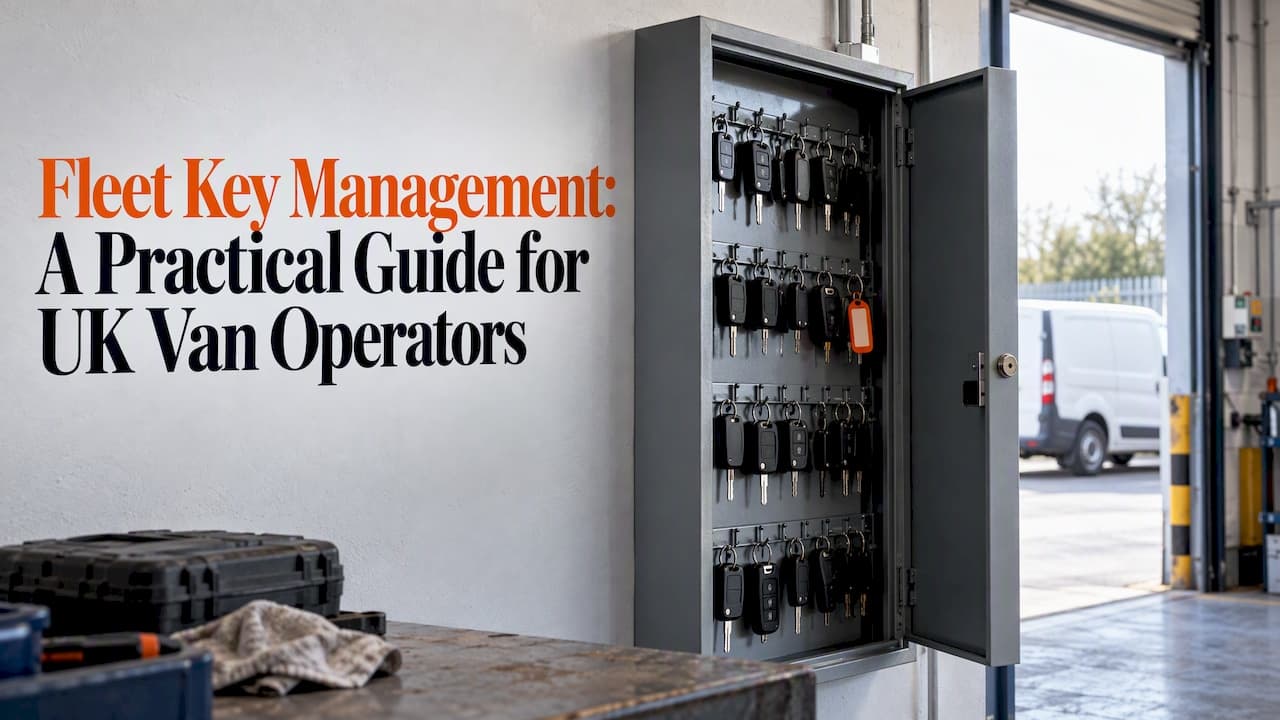
Fleet key management is the set of rules, records and equipment that decide who can take a vehicle key, when, and what happens when one goes missing. For a small or mid-sized van fleet the answer is rarely a big software project. It is a named owner, a locked place for keys, a sign-out record, a known number of spares and a plan for the day a key disappears. This guide sets out how to build that, and how to avoid a van sitting idle while you wait for a replacement.
TL;DR
- Start with a key register: every vehicle, every key, every fob, who holds it and where the spares are.
- Keys belong in a locked, access-controlled place, with a sign-out record that names the driver. A cabinet helps, but habit matters more than hardware.
- Plan for loss before it happens: know your spare count, your lost-key procedure and who you call, so a missing key does not mean a towed van.
- If a key is lost or stolen, have the old key deleted from the vehicle so it can no longer start it.
- Review the system quarterly, and check it against your compliance routines, not just your costs.
Table of Contents
- Why key control is a fleet problem, not just a drawer problem
- Build your key register first
- Where the keys live
- Systems fail when habits do
- Write a short key policy
- What to do when a key is lost
- Fobs, keyless entry and the faults that look like lost keys
- Spare keys: how many and where
- Measuring whether it works
- Our view on fleet keys
- When you need keys sorted today
- A 30-day plan to get your fleet keys under control
- FAQ
- Sources
Why key control is a fleet problem, not just a drawer problem
A van that cannot start costs you the day's work, whatever the reason. A missing key is one of the most avoidable reasons. Modern keys are also not cheap, simple pieces of metal: most carry a transponder chip and many are remote fobs that must be programmed to the vehicle. Losing one can mean programming, not just cutting.
There is a security side as well. Government guidance for drivers is blunt: when you leave your vehicle, always lock it and take your keys with you, never leaving them in the cab. That is written for those moving dangerous goods, but the principle suits every van with tools, stock or customer property on board.
And there is accountability. If a van is used out of hours, damaged or reported for an offence, you want to know who had the key. Without a record, you are guessing.

Build your key register first
Before buying anything, write down what you have. A spreadsheet is enough for most fleets of up to a few dozen vehicles. For each vehicle record:
- Registration, make, model and year.
- Key type: standard cut key, transponder key, remote key or keyless fob.
- Number of keys that exist, including spares, and where each one is kept.
- The current holder, if it is signed out, and the date and time it left.
- Whether the vehicle has a key-code or security label on file, and who holds it.
- Date of the last key check.
Then physically count the keys. Most fleets find at least one surprise: a spare nobody can locate, a key held by a former employee, or a vehicle with only one working key. Finding that out on a quiet Tuesday is far cheaper than finding it out at 6am on a job day.
Know how many keys each vehicle really has
A van that has only one key is a single point of failure. If you hold only one, getting a second made while you still have a working original is simpler and usually cheaper than recovering from an all-keys-lost situation, because a working key can be copied or a new one added to the vehicle. We explain the difference in our guide to all-keys-lost programming in one visit.
Where the keys live
The core rule is simple: keys are never left in vehicles, on desks or on hooks that anyone can reach. What replaces that depends on size.
| Fleet size | Typical set-up | Watch out for |
|---|---|---|
| 1 to 5 vehicles | Locked key box, paper or spreadsheet log, one named responsible person | Keys going home in pockets with no record |
| 6 to 25 vehicles | Wall-mounted lockable cabinet with numbered hooks, sign-out sheet or app, weekly check | The sheet being filled in late or not at all |
| 25+ vehicles or several depots | Electronic, access-controlled key cabinets with an audit trail, linked to your vehicle records | Buying the equipment but not the routine |
| Drivers who take vehicles home | Personal responsibility agreement, home storage rules, written lost-key procedure | No one knows where the key is overnight |
Electronic systems can pay for themselves in larger operations. One Essex dealer group case study describes an electronic system rolled out across seven sites, and the same document notes that operators often start with a single trial depot cabinet before going fleet-wide. That is sensible advice at any scale: prove the routine in one place, then extend it.
Systems fail when habits do
It is tempting to believe a cabinet or a piece of software solves the problem. Guidance from industry bodies points the other way. A BIFA practical guide to van fleet management stresses joining up compliance, procurement, driver management and cost control, rather than buying software and hoping. Government security guidance makes a similar point about culture: a healthy security culture should be part of everyone's daily working practice.
In practice that means:
- Drivers understand why the sign-out matters, because you have explained it and asked for their views.
- The sign-in is part of the end-of-shift routine, alongside the walk-around check.
- A manager looks at the log every week, not only after something goes wrong.
- Office staff follow the same rules as drivers.
A key log nobody reads is decoration. Ten minutes a week reviewing it is what makes it work.
Write a short key policy
A one-page policy settles most arguments before they start. It should cover:
- Who may hold keys. Named drivers only, and who authorises changes.
- Where keys are kept during the day, overnight and at weekends.
- How they are signed out and back, and what happens if the sign-in is missed.
- Duplicates. Nobody has keys copied informally. Spares are ordered through one person, and recorded.
- Leavers. Keys returned on the last day, with a check against the register.
- Loss. What the driver does, who is told, and how quickly.
The government's Road Transport Security Standards toolkit is designed to help commercial vehicle operators protect people, assets and vehicles from theft, and is a useful reference when you write yours. A public-sector example in the same spirit, an equipment and key log procedure, has keys issued to authorised personnel only with a signature for each item.
What to do when a key is lost
This is where fleet key management meets the real world. A good procedure takes the panic out of it.
Step 1: Establish what has actually gone
Is it a lost key, a stolen key or a broken one? Is it the only key, or do you hold a spare? That determines the fix and the urgency. If a key may have been stolen, treat it as a security incident, not an inconvenience.
Step 2: Secure the vehicle
If a lost key could be in someone else's hands, do not leave the van unattended with valuable stock or tools inside. Move it, or arrange for the key to be disabled quickly.
Step 3: Have the lost key removed from the vehicle
On many modern vehicles a locksmith with the right equipment can delete a missing key from the vehicle's memory, so it will no longer start the engine, and programme a new one. We call this stolen key deletion and reprogramming. It is far better than assuming nobody will use a key that has gone missing.
Step 4: Get a replacement on site
Towing a van to a dealership means a day or more off the road plus recovery costs. A mobile locksmith brings the cutting and programming equipment to the vehicle, wherever it is parked, so the van can go back to work the same day. Read more on when a transponder key fails and whether to call a mobile locksmith or visit a dealer.
Step 5: Update the register and review how it happened
Record the new keys, the date and the cost. Then ask honestly whether the loss pointed to a gap in your process, and fix that gap.
Fobs, keyless entry and the faults that look like lost keys
Not every key problem is a lost key. Remote fobs fail: batteries die, cases crack, buttons wear and the vehicle stops recognising the fob. Before you declare a key lost, run quick checks. Our guide to fixing a key fob in three quick checks walks through them. If a fob is physically damaged, a key case replacement can often be done on site. For vehicles with intermittent keyless faults, see our triage guide to keyless entry problems.
Separating faults from losses matters for your records too. A fob that has failed three times in a year points to a fault in the vehicle or the fob, and it may be a lock or ignition problem rather than careless handling. Our lock and ignition repair service covers those cases.
Spare keys: how many and where
For most commercial vehicles, a sensible baseline is two working keys per vehicle, with the second kept separately from the first, in a secured location rather than in the same drawer or the same driver's pocket. The aim is that one lost key never stops the van.
Add a spare when:
- A vehicle has only one key.
- Several drivers share a vehicle on rotation.
- The vehicle works far from base, where a lost key is expensive to recover from.
- The vehicle is due to be sold or redeployed, and you want the complete key set to travel with it.
Prices vary by vehicle, and a quote needs the make, model and year. As a guide to what we publish, our Ford key page lists standard keys from £120 and remote keys from £150. Other makes differ, so ask for a quote against your vehicle.
Measuring whether it works
Most fleets already track a handful of numbers. Key management should feed those rather than add a dashboard of its own. Industry guidance suggests choosing a small set of primary KPIs such as cost per mile, downtime and compliance and looking deeper only when one moves.
For keys, three simple measures are enough:
- Keys unaccounted for at each quarterly count. The target is zero.
- Vehicle downtime caused by key problems, in hours.
- Time from reporting a lost key to the vehicle working again.
The BIFA guide argues that compliance, including MOT status, licence checks and daily walk-around checks, is a leading indicator of performance. Key control belongs in that same discipline. A Jaama benchmark report shows that many organisations handle compliance as part of the fleet manager's wider job rather than a dedicated role, so a lightweight key routine tacked on to existing checks is realistic.
Our view on fleet keys
We spend our days on driveways, depots and industrial estates across Essex and Hertfordshire, and we see the same pattern. A fleet rarely gets into trouble because it lacks a clever system. It gets into trouble because it has one key for a van, nobody knows who last had it, and the need for a replacement arrives at the worst moment.

Our advice is plain. Get a second key made for every vehicle that only has one, while the original still works. Keep the spare somewhere other than the first. Write down who has what. And decide now, not on the morning, who you call when a key goes missing.
When it does happen, our technicians are licensed, insured and SERMI-certified, and our vans carry diagnostic equipment so that key replacement and programming happen at the vehicle, typically within 30 to 60 minutes. That means your van stays where it is and your driver goes back to work, instead of waiting for a recovery truck and a dealership slot. We would rather help you avoid an all-keys-lost call, but we are ready when it comes.
— James
When you need keys sorted today
If you manage vans in Harlow, Chelmsford, Brentwood, Bishop's Stortford, Braintree and the surrounding areas, we come to you. We cover key programming from £120, emergency lockouts from £120, and emergency callouts with a callout fee from £120. Services such as all-keys-lost replacement, stolen key deletion and van key replacement are quoted per vehicle, and you can see everything we do on our services page. For a fleet-wide spare-key sweep, send us your register and we will tell you which vehicles are exposed.
A recent example of the kind of work we do is on our blog, such as a Vauxhall Vivaro add-key job, and more guides are in the Auto Key Maker blog.
A 30-day plan to get your fleet keys under control
Week 1: Count and record. Build the register and physically check every key. Note single-key vehicles and any unknown keys.
Week 2: Secure. Choose where keys live. Install a lockable box or cabinet if you do not have one. Introduce the sign-out record.
Week 3: Close the gaps. Order spares for single-key vehicles, and have any key of uncertain history deleted and replaced. Write the one-page policy and brief drivers, asking for their input on what will work in practice.
Week 4: Review. Check the log, count again and fix what slipped. Decide when the next quarterly check falls and put it in the diary.
If, after that, you are running several depots or a large pool, that is the point to consider an electronic cabinet system. By then you will know what you need it to do.
FAQ
What is fleet key management?
It is the process of controlling who holds vehicle keys, recording when they are taken and returned, storing them securely and planning for loss. It can be a locked box and a log for a small van fleet, or electronic cabinets with an audit trail for larger operations.
Do I need an electronic key cabinet?
Not necessarily. For a handful of vehicles, a lockable box, a sign-out log and a weekly check can work well. Electronic cabinets make most sense when you have many vehicles, several sites or a need for an automatic audit trail. Many operators trial one at a single depot first.
What should I do if a van key is stolen?
Treat it as a security incident: secure the vehicle, tell the person responsible for keys and arrange to have the missing key deleted from the vehicle so it cannot start it. Then have a replacement programmed. If you think the van may have been taken or tampered with, report it to the police.
Can a mobile locksmith replace keys for commercial vans?
In many cases, yes. We replace and programme keys for a wide range of car and van makes on site in Essex and Hertfordshire, so the vehicle does not need to be towed. Give us the registration, make and model when you call so we can confirm what is possible and quote.
Sources
- Driver security advice, GOV.UK
- Essex Auto Group case study
- Van fleet management, BIFA practical guide
- Guidance for commercial vehicles and hire companies, ProtectUK
- RTSS toolkit for commercial vehicle operators, GOV.UK
- Equipment and key log procedure, Contracts Finder
- Top 10 fleet management KPIs to track in 2026
- The fleet compliance and cost benchmark report, Jaama